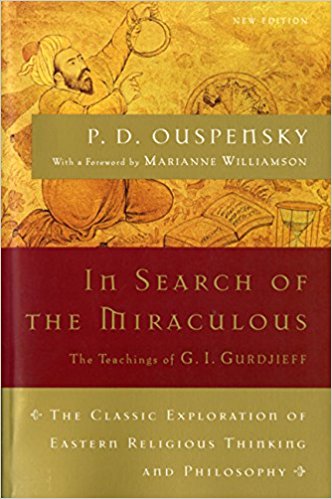
In Search of the Miraculous by P D Ouspensky
When I first came across this book, the title “In Search of the Miraculous” had a strange impression on me. It made a permanent home in my mind and would not leave. It seemed as if the search for the miraculous was my own search and I had at last found what I was looking for though I could not really articulate what I felt.
Among all the books I have read, this book stands out as one of the most intriguing, fascinating and challenging. The ideas of Gurdjieff, explained so lucidly by Ouspensky in this book, can make a life changing impression on someone really seeking the meaning of life.
Most books are just re-telling of the same thoughts again and again in slightly modified words. The concepts of awakening are also the same whether you read buddhism, hinduism or any other ism. This book really makes you sit up and take notice. If you have watched a movie many times and then suddenly someone writes a review which explains the movie in a radically new way, you pay attention. You start wondering if that is true. That’s the effect of this book. It wakes up the mind’s capacity to wonder.
Quotes from In Search of the Miraculous
Everything happens. All that befalls a man, all that is done by him, all that comes from him—all this happens. And it happens in exactly the same way as rain falls as a result of a change in the temperature in the higher regions of the atmosphere or the surrounding clouds, as snow melts under the rays of the sun, as dust rises with the wind. Man is a machine. All his deeds, actions, words, thoughts, feelings, convictions, opinions, and habits are the results of external influences, external impressions. Out of himself a man cannot produce a single thought, a single action. Everything he says, does, thinks, feels—all this happens. Man cannot discover anything, invent anything. It all happens.
Immortality is not a property with which man is born. But man can acquire immortality. All existing and generally known ways to immortality can be divided into three categories:
- The way of the fakir.
- The way of the monk.
- The way of the yogi.
But all the ways, the way of the fakir as well as the way of the monk and the way of the yogi, have one thing in common. They all begin with the most difficult thing, with a complete change of life, with a renunciation of all worldly things. A man must give up his home, his family if he has one, renounce all the pleasures, attachments, and duties of life, and go out into the desert, or into a monastery or a yogi school. From the very first day, from the very first step on his way, he must die to the world; only thus can he hope to attain anything on one of these ways. The fourth way requires no retirement into the desert, does not require a man to give up and renounce everything by which he formerly lived.
Man has no permanent and unchangeable I. Every thought, every mood, every desire, every sensation, says ‘I.’
A man must begin observing himself as though he did not know himself at all, as though he had never observed himself
 Big Picture Zen