Monthly Archives: March 2010

Ground Yourself in Impermanence

SEA

Change is the basic fact of nature. Everything around us and within us is changing every moment. Take a second to stop, see and listen. You can hear sounds changing, you can see things moving, you can feel the air on your skin, you can sense the breath going in and coming out. You can feel the sensations in your body and know the thoughts in your mind. Changing.. changing.. changing..

​Impermanence is the only permanent thing. Even the things which are seemingly solid like walls, wood, iron and stones are also changing at the microscopic level. It would be foolish to say that they do not change at all and are permanent.

When you strive for permanence in an impermanent world, it makes for a lot of sorrow, frustration, dissatisfaction and discontent. Real happiness can only be found when you ground yourself in impermanence all the time. Stay with impermanence, flow with it, and allow impermanence to flow through you.

It is a paradoxical notion that when nothing is permanent, how can there be a ground? And yet, the only refuge is the ground of impermanence.

One only needs to observe to penetrate this paradox. It is only when you are not aware that the nature of things is to change that you try to hold on to them – you want the good situation to continue, you want the good relationship to continue, you want the pleasant experience to extend and so on.

When you are continuously conscious of change, you have no experience. You ARE the very impermanence. In this state, there is no separation of experience from one who experiences. You have reached home.

Do Not Look Forward to Anything

Lookout-Large_625x349

It is so natural to think and imagine that tomorrow will be better than today. Aren’t we all planning for something or thinking of something that is going to happen sometime in the future? Maybe we are looking forward to a vacation. Maybe we are looking forward to getting married or having children. Maybe we are looking forward to a promotion in our job. On a daily scale, we look forward to the party at night or the meeting in the afternoon or even the cricket match on television.

Looking forward to a pleasant event causes anticipation of joy and excitement. Similarly, looking forward to an unpleasant event causes anxiety or fear. Have you even watched the process of looking forward to? Doesn’t it involve a lot of imagination born out of memory of past experiences or what information you have heard and gathered?

For instance, if you are looking forward to a vacation to a place you have never been to, do you not imagine what you will do or what you expect to find there based on the stories and experiences related by others who have been to that place before? Do you not imagine how happy you are going to be there or what experiences you are going to have there?

But what happens in reality? You might not have the exact same experiences when you visit that place? Many things might not be as you imagined they would be. That leads to frustration and anger. You blame those people who recommended that place to you. Even if you find most things as you imagined, you are unable to enjoy completely because the mind is filled with ideas about the place and is constantly comparing your actual experience with your imaginations.

To take another example, you might be looking forward to your exam results. You remember what other people commented on your results the last time and you start imagining what people’s reactions will be if you get poor results or better results than last time. All this imagination causes anxiety to build up.

Is it possible not to look forward to anything? Some people might say that it will make for a dull life where there is no hope and no future. But look at it in another way. What happens when you are not lost in the thoughts of what is going to happen tomorrow? Are you not fully in the present?

​The present moment is all there is. Imagination prevents your direct contact with the present moment. That is the reason why you do not experience anything even during the experience because the mind is busy in imaginations, comparisons, anger and frustrations.

Things are changing so rapidly that to experience the present moment requires your complete attention and energy but when energy is sapped in imagination about what is going to happen, one misses the moment and its beauty.

Therefore, do not look forward to anything – near or far, pleasant or unpleasant. When you are able to do this and remain in the moment, you will discover something totally unexpected. And it is the totally unexpected which has the quality of genuine happiness.

Spring, Summer, Fall, Winter… and Spring (2003)

Director – Ki-duk Kim

spring1

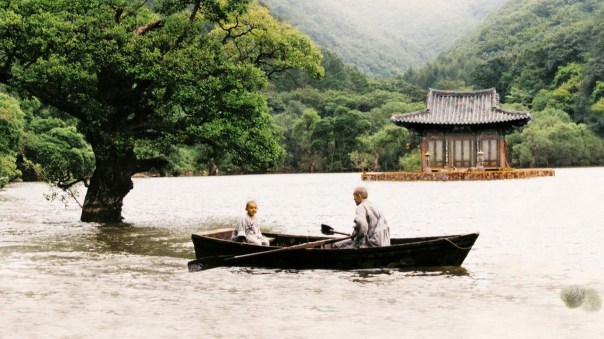
This is a beautiful Korean film (2003) that captures your imagination with its heavenly scenery. The whole story is shot in a hut floating in a serene lake surrounded by tall mountains.

An old Buddhist monk lives in the hut with a mischievous young boy – one who ties stones to frogs, snakes and fish with a thread and enjoys their predicament. The master teaches him a lesson one day by tying a big stone to his back. (Spring)

When the boy grows up, he gets attracted to a young girl who had come to stay with them to heal herself. When the master discovers their liaison, he asks the girl to return. However, the boy misses her so much that he runs away in search of her.(Summer)

Many years later, he returns to the hut a dangerous criminal. The police soon catch up with him and take him away. (Fall)

The master dies. Winter sets in. The lake is frozen completely. The prisoner has completed his sentence and returns to the hut, a changed man. He puts the hut back in order and trains himself. One day, a woman abandons her baby at the hut.

When the baby grows up into a young boy, he is shown to torment snakes, frogs and fish by putting stones in their mouth. (Spring)

In most films, there is an ending – a resolution of the tensions that are built up during the story telling. However, Spring, Summer, Fall, Winter… and Spring is a true buddhist movie as it does not have an ending because the ending is simply another beginning.

Like the seasons, our life moves through stages and almost everyone experiences the same emotions, childhood antics, sexual attraction, agony of separation, anger, and repentance of actions. Life is a powerful stream through which we flow and experience different things just like changing of the seasons.

There is another Korean film which I find to be very similar in theme – Why did Bodhidharma come to the east?

I Love Huckabees (2004)

Director – David O. Russell

4885571

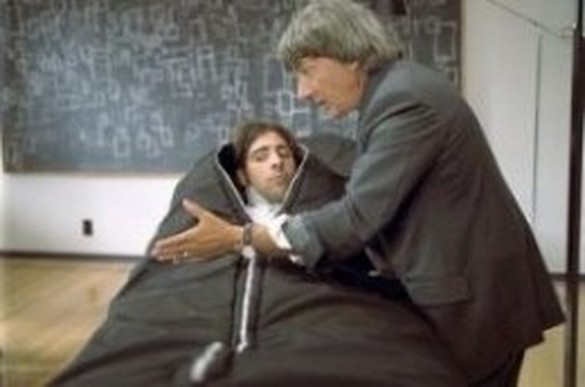
Also known as I Heart Huckabees, this is as lovely and humorous a movie as it can get. Have you ever pondered over questions such as who you are, what is your purpose and what is the meaning of life? Even if you have, you would not have probed deeper because of urgent matters taking your attention. But what if you could hire detectives to do this job for you! The idea itself is so ridiculous that makes one laugh. But that exactly is the story of this movie.

A husband and wife play the detectives who are available on hire to find out the meaning of your life. These detectives are not saffron clad sages but suit-wearing professionals who work for a fee. The detectives have a brand of existential philosophy which they use to investigate matters. As they help their client, they run against one of their former students who has now adopted the opposite brand of philosophy Nihilism to help her clients.

​It is a great treat to watch the characters as they try to figure out the confusion, discontent and angst in their lives with the help of these philosophies. The movie is a laugh riot if you are even a little bit interested in philosophy.