Monthly Archives: August 2017

Micchami Dukkadam – Beyond Forgiveness

micchami dukkadam

In the Jain community, there is a notion of asking for forgiveness once every year during their Paryushan event. Typically the words are

If I have caused you offence in any way, knowingly or unknowingly, in thought, word or deed, then I seek your forgiveness.

While most people exchange those words with each other as a ritual, I wonder if there is any deep feeling attached to the word forgiveness. Many joke about it as an opportunity to start offending afresh, now that the forgiveness is asked for.

To forgive means to stop being angry or resentful towards another for an offence or a mistake committed.

Forgiveness is considered a significant act in many traditions including Christianity where you ask the Father or God to forgive you for the sins you have committed. To forgive others and to ask for forgiveness is said to have health benefits also.

Let’s take a closer look at the whole scope of forgiving and forgiveness. The notion of forgiveness is tightly coupled with being hurt or with some kind of offence or mistake. If there is no mistake or offence or sin, the need for forgiveness does not arise. After all, where is the need to forgive another if he has not done anything wrong to you or where is the need to ask for forgiveness if you have not done anything wrong to anyone.

So essentially, we need to delve a little deeper into the notion of being hurt or offending another, if we have to understand what is forgiveness.

Let’s say A breaks the windshield of B’s car. So the car is hurt and also, B is hurt psychologically. Now if A asks for forgiveness from B, what happens? At the physical level, it is immaterial. The car is not going back to its state before the windshield was broken. The key question is whether the state of mind of B will go back to the state before the event, if B forgives A.

Another example. A says something offensive to B. B is offended. A asks for forgiveness. B forgives. Can the state of mind of B go back to the same state of mind before the event?

In both cases, the state of mind of B has changed irreversibly. The memory of the event, the broken windshield, the associated psychological hurt and the offending words are permanently etched on the memory. That cannot be undone even if B forgives. We often say – forgive and forget. But we cannot really forget anything.

So what does it mean to forgive? It means for B to not carry the hurt feelings for A, to heal B’s own hurt sentiments, to not actively plan a revenge against A. But once the hurt feelings are created, it is very difficult to get over them even with repeated forgiveness.

Is it possible, not to get hurt at all? As we know, when there is no hurt, there is no need for forgiveness.

We are not hurt psychologically when we are in full awareness and full wisdom about the nature of existence. When we know that a windshield is something that can break, can be broken, when we know that most people act with no awareness of what they say or do, then that knowledge becomes our psychological protection against being hurt or being offended. Nothing can hurt us in that state. Even if someone shoots us, we can be smiling.

Maybe that was the state Jesus was in when he was being crucified. He said – Father, forgive these people as they do not know what they are doing.

You might have noticed that when you are in a certain high state of mind (happiness might not be the right word), you are not hurt by what someone says or does. On the other hand when you are not in a happy state, then you might go around hurting others unintentionally.

So from the perspective of B, the need is to protect oneself from getting hurt which can be done through understanding and awareness of that understanding.

From the perspective of A, merely asking for forgiveness does not cause a transformation in A. It is possible that A will repeat the same mistake again. The transformation in A can happen only when there is a realization of the pain caused to another by one’s actions,  which means, A feels the same pain that B felt. Then there is a genuine repentance of the action, which leads to an increase in awareness.

Only an increase in awareness will make A realize the pain of another and will sensitize him in his actions to prevent hurt or offenses towards another. Then there is no need ask for forgiveness.

So the notion of forgiveness is relevant only in the domain of hurt. But there is a domain beyond hurt which is accessible to human beings in which forgiveness has only a limited role while awareness and wisdom have a primary role.


Alice in Fleetingland

If we look at the world around us minutely, we will notice that things are happening at different speeds. Vehicles on the road are moving at around 60 km/hour. A plane in the sky must be moving at 800 km/hour. People on the streets are walking at their own pace, some are running, some are ambling. If you watch the sun during sunset, you will be amazed at how fast it moves, which actually means how fast the earth is rotating on its axis.

There are some things which change rapidly like the scene on the road and there are other things that change slowly. We usually do not notice those and assume they are permanently there. For example a tree or a bench in the garden seem static. Everyday, you can see them there and we do not notice the gradual changes taking place.

273

We can see changes in the tree only when the season changes and we can see the changes in the bench only if it broken or gets disfigured due to constant use. However, we do not appreciate how they are changing even while we are looking at them.

The tree is actually like an extremely slow moving fountain. As sunlight falls on the leaves and water escapes, the branches pull up more water and nutrients from the trunk and roots. We cannot see this happening yet it is happening.

As people sit on the bench, there is wear and tear every moment. Even the flow of wind over the bench, the falling of leaves on the bench will keep affecting the bench very gradually. We all know how the waves created sandy beaches over millions of years.

Everything around us is constantly changing, fleeting every moment. We are also changing. We might see the same face and body in the mirror everyday. Yet we are changing – every cell, every organ is undergoing change. At the microscopic level, the changes are very rapid and mind boggling, if only we could notice or feel.

We usually get fooled by the illusion that things are permanent, as if they are existing in themselves and not as a process of happening. Our senses fool us into believing that the chair we are sitting on is solid and is not changing. Same is true about the people in our life. We start thinking he or she is the same individual everyday, every moment.

But armed with the knowledge about transience, We can become aware of the whole illusion. This does not mean that we get scared because the world is falling apart. On the contrary, you learn to love this creation, the beauty and the mystery of it.

So the wise way to live in this Wonderland is as if Alice.


Being Dharma

41ULCnFkFrL

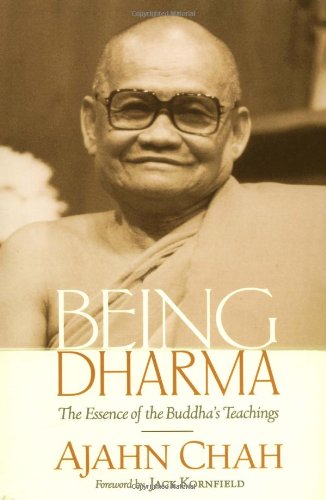
Being Dharma – The Essence of the Buddha’s Teaching by Ajahn Chah

Buddhism as we know branched out into 3 main followings, depending upon the inclination of the followers. The Theravada or the path of the elders is considered to be the original teachings of the Buddha, probably because the monks who follow it stick to the same rules as set during the time of the Buddha. They live in the forest, go to the town to beg for food and spend the day and night in solitary meditation. Other major branches include the Tibetan Buddhism, which takes Buddhism even beyond the teachings of the Buddha and Zen Buddhism, which makes no bones about its intention of pointing to the reality directly and nothing else.

Ajahn Chah was a renowned teacher of the Theravada school. He lived in the forests of Thailand and is the teacher of many western Buddhist monks. The hallmark of a good teacher is his ability to make complex theory into simple ideas and Ajahn Chah is one of the best teachers in this.

The book Being Dharma is a succinct exposition of the whole teaching of the Buddha. It covers just enough for any sincere seeker to grasp the insights. Ajahn Chah does not spend time in metaphysical discussions but directly addresses the heart of the matter. In this regard, he resembles a zen master.

The book is organized in the following chapters – hearing dharma, understanding dharma, practicing dharma, seeing dharma and being dharma. The contents are also as easy as the chapter titles.

Just like in the meditation practice, you are told to return to the breath whenever the mind is distracted, this is one book, I return to whenever I get lost in multiple other books. It always helps me to regain my center.

Quotes from Being Dharma

First one learns Dharma, but does not yet understand it; then one understands it, but has not yet practiced. One practices, but has not seen the truth of Dharma; then one sees Dharma, but one’s being has not yet become Dharma.


When there is no person, there are no problems. There is no need for solutions, because there are no problems to solve anymore and no one to solve them.


No matter where you are, no matter what your situation, it is possible for you to be practicing Dharma well


We are called Joe or Alice or perhaps Prince so-and-so, but if we realize the Dharma then we too are Buddha, no different from him.


That which we are talking about does not arise and does not cease. It abides as it is. Or to put it simply, it is not born and does not die.


People are born with physical form and mind. In the beginning these things are born, in the middle they change, and in the end they are extinguished. This is their nature. We can’t do much to alter these facts.