Category Archives: Zen

It is X Only Because it is Not X

X is a name. It can be a name of a person or thing or event or process. We all use names to identify things and people. But in the process we forget that they are simply names, not the things themselves.

There are different shades of identification. Some identification is stronger than others. One’s own name is the strongest identification. My name is Y but I start believing that I AM Y. Similarly I believe that my friend is A, my wife is B and my dog is D.

Other strong identification is with time. We actually believe that today is 9th of AUgust 2015, Sunday. The fact is that a date is only a convenient means to have order in our activities and planning.

The fact is that the name is not the person or the name is not the thing. We might say Hurricane Katrina, but that is just a name. The hurricane did not have a name. It was nameless all the time. Therefore, the truth is that it was not Hurricane Katrina. In other words, it was Hurricane Katrina only because it was NOT Hurricane Katrina.

This statement must be understood carefully. X is X only because it is NOT X. A name can be given to something which is nameless. If it already had a name, why give it one?

The Hurricane does not say that its name is Katrina. Similarly the dog does not say that its name is D. In the same spirit, even if I say that I am Y, you should not believe me because I am fundamentally nameless. So are you. That is why your name is P or S or K.

So look around you. In actual fact, nothing has a name. Everything is nameless from the beginning – all the chairs, tables, walls, people, are chairs, tables, walls and people only because they are NOT chairs, tables, walls, and people.

It is more true to say that it is not a chair than it is to say that it is a chair. Both statements are true but one is really true and the other is only conventionally true.

So if you can look at things and people as nameless which is not recognizing anything by its name – whether it is a tree, a bird, a flower, the sun and so on, you will attain the original mind, untainted and pure. After all, isn’t this what you want?
Koans – A Zen Practice for Enlightenment

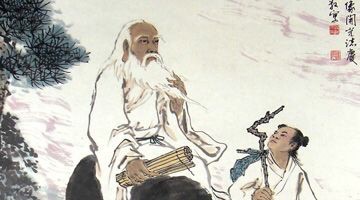
laozi

Koan is a technique for awakening by silencing the conceptual mind.

Traditionally there have been two main schools of Japanese Zen Buddhism – the Rinzai School and the Soto School. The main emphasis of the Soto School was on sitting meditation while that of the Rinzai School was on the Koans. The aim of both was essentially the same – enlightenment or awakening.

WHAT IS A KOAN?

A Koan is a statement, a dialogue, a story or a question which cannot be understood or answered by logical thinking. In fact, logical thinking is the biggest hindrance in understanding the meaning of the Koan. Some famous koans used by Zen masters are

  • What is the sound of one hand clapping?
  • All the ten thousand things return to the one. Where does the one return to?
  • A monk asked Joshu, “Does a dog have Buddha Nature?”. Joshu shouted, “Mu”.
  • Shuzan held out his staff and said, “If you call this staff short, you oppose its reality. But if you don’t call it short, you ignore the fact. Now, what do you call it?”

HOW IS THE KOAN USED?

The Zen student requests the Master to give him a koan for practice. The Master understands the specific mental snags in the student and gives him a koan which is most helpful in his practice. He also explains to the student in private what he must do with the koan. The student is instructed to constantly keep the koan in mind and try to grasp its hidden meaning. He has to think of the koan while walking, eating, sweeping, and while doing all the daily activities.

When the student believes he found the answer or when the student meets the Master during the scheduled times, he must explain what he has understood. If the Master finds evidence to believe that the student has really understood, he will certify the enlightenment of the student else he will drive him away asking him to put in more effort into the koan.

Mumon, a great Zen Master, said to his students that they must make their whole body and mind into the koan in order to penetrate it.

HOW DOES THE KOAN PRODUCE ENLIGHTENMENT?

Although the koan is a paradoxical statement and appears to be some sort of puzzle; it is not something that can be solved using a mental trick. It cannot be understood in conceptual terms at all. The purpose of the koan is to silence the conceptual mind completely as this is essential for awakening.

A statement that one does not understand makes the mind go on hyper drive. The mind turns and twists the question to find out its meaning and find an answer in one way or another. As long as the student keeps giving conceptual answers, the Master keeps sending him away. Even if the student realizes that there is no conceptual answer and says so, the master might tell him that knowing it is one thing but feeling it in one’s bones is another.

However, with constant practice with a koan, the student’s mind finally falls silent on its own accord and then whatever answer he gives will be spontaneous not based on rational thought. This is the first step to awakening.

COLLECTION OF KOANS

The most famous collections of Koans are found in two books – The Blue Cliff Record and The Gateless Gate.

The Six Blind Men and the Elephant

elephant

Once upon a time, there was a king who, wishing to amuse himself, ordered the Royal Elephant to be brought before him. He also ordered some blind men, blind from birth, to be brought near the elephant. He then asked these blind men to touch the elephant and give a description of the elephant to him.

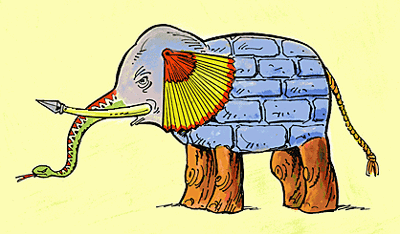
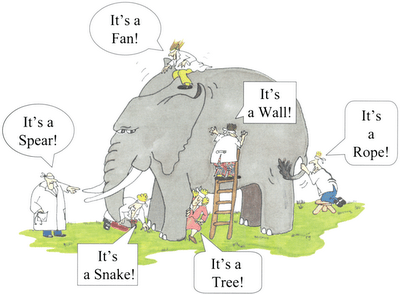
The man who touched the tail said the elephant was like a rope.
The one who touched a leg said it was like a tree.
The one who touched the body said it was like a wall.
The one who touched the ear said the elephant was like a fan.
The one who touched the trunk said it was like a snake.
The one who touched the elephant’s tusks, said it was like a spear.

elephant-blind-compo

Thus, each described the elephant differently, but each was sure that his own version was the true description of the elephant. They did not realize that each one touched only a part of the elephant. Each blind person had only a one-sided truth. They started arguing with each other, each sticking to his own point of view. The argument ended up in quarreling and fighting. The king and his ministers rolled with laughter as the blind men continued to quarrel and fight with each other.

The origins of this story are unknown but it appears in almost all religious literature through the world. There are many many ways to look at this story and understand it. Just goes to prove what the story intends to convey.

When the blind truly open their eyes, they will see there was no elephant there.