Tag Archives: Meditation

The Buddha Speaks on No-Self

One of the central teachings of the Buddha is that of No-Self. This teaching appears in the Anatta-lakkhana Sutta, which means the signs of no-self. Atta is pali word for Atma so Anatta is Anatman in Sanskrit, signifying no-soul or no-self. This teaching went against the grain of existing understanding that every person has an enduring ever-lasting soul which dies and is born again into a new body.

In the Anatta-lakkhana Sutta, the Buddha says: Form is not the self. If the form (of your body) were really the self or the soul, then it would not be a cause of suffering, of pain. Further, if it were really one’s soul or self, one could say – let my form is such. But since form is not self, it is a cause of suffering and you have no control on it.

The Buddha then goes on to say the same for feelings, mental formations, volition and consciousness, the other four aggregates which make up an individual. One by one he refutes each aggregate as the self.

The individual is composed of the aggregates but there is nothing permanent in any aggregate and hence, no self to be found in the individual.

The story goes on to claim that the 5 bhikkhus who listened to this teaching achieved the discernment into the non-selflessness of phenomena. It is possible, those bhikkhus were already wise enough to perceive this truth but for someone who likes to question and doubt, the Q&A session at the end of any talk is the most important part where he can clarify his own understanding by asking questions to the speaker.

Let’s assume, someone in the audience, has some doubts on what the Buddha said. Here is how the conversation might proceed.

Questioner: You say that there is no self. Then does it imply that it is ok to kill someone? You are not killing anyone if there is no one to kill, isn’t it?

Buddha: I say phenomena is made up of aggregates. If you consider non-living things like stones or mud, then there is only a form aggregate. There is no feeling, mental formations, volition or consciousness which can be combined into mind. There is no mind for a stone, only form. You can break a stone into pieces. There is no self in it. No problem. Now consider a living being or we can say sentient being because it has both body (form) and mind (mental formation, feelings, volition and consciousness). If you inflict a wound on such a living being whether human or animal, it is bound to create painful feelings, thoughts of fear, various mental formations like anger or revenge. If you hurt the living being to such an extent that the aggregates which were a part of the being are no longer functioning in harmony, we can say you have killed that being. However, there is no reason to assume a permanent soul or self in this case also. I always say that no living being wants to suffer and you must not make any living being suffer.

Questioner: It may be so. But ultimately, there is no one to kill or there is no one who suffers. Just a re-configuration of aggregates. So I am not clear about the implications of no-self.

Buddha: At a deeper level, no-self is a view, a mindset, a realization, an awakening. If you do not see it, you will see a self. You will see other persons and you will assume their agency. Being affected by someone’s words or actions, you may generate anger or fear which in turn might rouse you to harm them or kill them. However, if you see no-self, if you have the view of no-self, you will not see anyone. You will not ascribe agency to people. Words and actions of others might develop feelings and mental formations in you but you will clearly see them as impermanent aggregates only. This view prevents feelings from cascading into anger, rage to generate enough energy to harm and kill another being. I often give this example that if you are walking in a forest at dusk when visibility is low and you come across a snake on the ground, you may want to stamp on it to kill it. However when the sun rises and you see clearly, it was only a piece of rope not a snake, you will realize your folly.

Questioner: I understood. Thank you. But what if you mistook a snake for a rope? Wouldn’t the snake not bite you?

Buddha: I never said to walk without being alert. If you notice something, check it out or avoid it. In the case you are bitten, realize you are bitten and do whatever you can to save yourself. There is no magic that’s going to happen if you know about no-self.

Questioner: Ok, I got it. I understood what is no-self. I will live accordingly.

Buddha: Beware. It is not enough to just take the teaching of no-self and apply it blindly. You cannot take it as an excuse to either harm others or become less mindful. All actions have consequences. Aggregates behave as per the laws of nature. Water will flow, fire will burn and so on. Once you see aggregates for what they are – impermanent and fleeting with no controller, you will see they are doing their thing. You will attain wisdom. Till the time you see a self, a controller, a someone who is doing things, you will experience suffering. Please investigate deeply.

Questioner: Thank you so much.
Meditation Begins After the Mind is Silent

Meditation today has become a tool, a technique. People talk about meditation as a way of controlling their mind, or calming their mind. There are hundreds of techniques that masquerade as meditation techniques. And there are dozens of teachers teaching meditation and several hundred books on the subject.

Is the goal of meditation really to achieve a silent mind?

It is possible some people might experience a stillness in their mind during meditation as thoughts die down. This is what they assume to be the fruits of meditation. But can they carry that stillness through the day? It is difficult. The daily life once again creates disturbances in the mind, stokes the fires of thought and the mind is once more in chaos. So the person thinks he must deepen his meditation practice and meditate harder, put more effort in his meditation, resolve more strongly to silence the mind, and so on. Then there are those people who cannot achieve any form of stillness of mind during their meditation and they think meditation is useless or they are useless.

In all this merry go round, somewhere the essence of meditation has been lost.

For a moment, let’s keep the word meditation aside and look at life in a simple way. If your mind is agitated due to some reason, will you be able to sit quietly for some time? It would be difficult. Thoughts would come and go and suddenly you will find yourself acting on some thought or saying something or thinking even more. Your mind is not silent. This is the normal life. We go through our day from one thought to another, from one action to another, fueled by inner thoughts or external stimulus of what you see, what others say to you, what they want you to do, and so on.

Now supposing, it is early morning or late evening or a time where you are not disturbed and you are all alone. And you are not doing anything special. How long will you be able to sit like that without your mind wandering all over the universe? It is certain that suddenly you will find yourself doing something. Most people don’t like that aloneness with their own minds and want to keep their mind occupied – for instance watching television or watching movies or doing some hobby work.

Is your mind really silent during these activities? No, it is not. It is merely guided by the flow of images and sounds so it does not have to be on its own. The television soap or the movie is telling a story and your mind is following that. If you are working on your hobby, your mind is working on a goal and therefore is seemingly silent.

But as soon as that external support is over, the mind is active once more and starts to wander and feel agitated. This is the normal human state and nothing to worry about. But some people’s minds are too troubled by old memories or habitual emotions that their mind wants to do something about it – to put an end to their suffering.

This is where, the mind starts to believe that meditation will help silence their mind. But this is a big mistake.

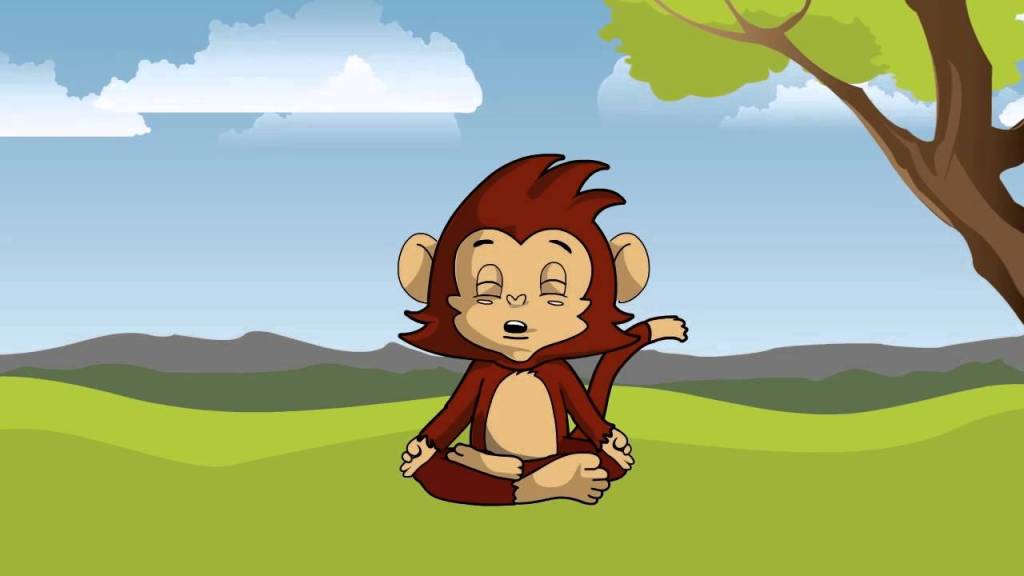
Meditation just becomes one of the ways to keep the mind occupied, like TV or movies. The mind wants to struggle with itself and quieten itself. So it goes around like a dog trying to catch its own tail. So for some time, the mind becomes still but as soon as the meditation session is over, its back to the normal monkey mind once again. It’s like you had put a monkey in a suitcase for 20 min and now opened the suitcase. The monkey would go crazy as soon as it is out of the suitcase. Sometimes, the monkey falls asleep in the suitcase but wakes up after some time.

The point is, so long as you have a monkey, there is no meditation.

There is meditation only when there is no monkey mind. This is the meditation after the mind is silent. This is the real meditation. It is sitting quietly doing nothing.

Dogen, before he became enlightened, had a doubt as to why masters even after attaining enlightenment still practiced sitting meditation. He was totally confused and it because a big koan for him. If meditation is to attain enlightenment, then why meditate after you have attained it? And then he cracked the koan and became enlightened.

So if you can understand this point, you will have a completely different view of meditation. True meditation can happen only after you have a silent mind. It will be difficult to accept this view because the mind then has no recourse to silencing itself (keeping itself occupied in other words) but to face the monkey within.

All efforts to silence the mind, including so called meditation are simply the work of the monkey mind. So now how will you attain a silent mind? I will leave you with that question. Best wishes.

May you realize your enlightenment.

orang-malaysia-dan-jepang-lebih-senang-meditasi-di-bali

Meditation is said to be turning inwards or looking within.

Inside and outside are concepts. By saying “look within”, one creates confusion because where is inside? It is assumed that inside means the mind. Is the mind really inside? Inside what – the body or the brain?

‘Look within’ makes one look inside the brain and gives rise to the notion of a boundary between the inner and the outer… roughly at the skin. Therefore if you try to look within, you will get lost.

Instead, do away with the notions of inner and outer, inside and outside. Meditation then is the observation of the process of observation or the instrument of observation… which is neither in nor out.