The below is an essay I wrote for a competition organized by the Dhamma Bhavan Charitable Trust, Kolhapur in Jan 2025.
“Ehipassiko”
When people asked the Buddha to talk about his teachings, he used to say – Ehipassiko. This is how he invited people to experience what he taught. Ehipassiko is a pali word that means – Come and see for yourself. It means do not intellectualize or get caught in the verbal explanations. But if you follow the path you will experience the insights for yourself. Then there will be no need for any explanation because you will see the truth directly. It is like performing a scientific experiment with precise instructions that produces the expected results. The Buddha’s teaching is like a science of the mind.
The Buddha lived and taught some 2500 years ago. He walked from place to place, village to village, teaching all those who showed an interest and inclination to learn. He taught with great skill, adjusting his teaching to individuals by considering their capabilities. He taught with great love and compassion by employing stories, analogies, and metaphors to convey his insights. Those who understood did not have any qualms about leaving their homes and families to join his Sangha of wandering monks. On the other hand, there were many who became lay followers by adopting the given precepts.
Even after the Buddha’s death, his teaching continued to influence millions. It has spread far and wide all over the world taking different outer forms like the Theravada of Thailand, Burma and Vietnam, Mahayana of Tibet, Chan of China and Zen of Japan.
The Buddha’s Doubt
Given the popularity of Buddhism, it would seem that the Buddha had an easy time sharing his teaching with people. But the fact is that when the Buddha got his enlightenment, at first he was elated that he finally got what he was seeking and he would go and share it with others. However, when he reflected on what he had discovered, he thought to himself – This insight that I have acquired is so subtle, so nuanced, that it will be difficult to convey it to people. They will misunderstand it or miss the point altogether and I will get so frustrated and exhausted trying my best to explain it to people. So let me not teach anything.
It is said that the God Brahma requested the Buddha to teach nonetheless. So the Buddha reviewed the situation with his insight and realized that people have different abilities. There are some who are ready to receive his teachings while there are others who will grasp the meaning with a little bit of practice and there will be others who will need a still longer time. So he started his teaching campaign – also known as setting the wheel of Dhamma in motion.
Even to this day, people express their allegiance to Buddhism by uttering the following.
Buddham Saranam Gacchami
(I take refuge in the Buddha)
Dhammam Saranam Gacchami
(I take refuge in the Dhamma)
Sangham Saranam Gacchami
(I take refuge in the Sangha)
Thanks to the work of multiple scholars, monks and lay people, today we have a well-documented body of teachings of the Buddha called the Sutta Pitaka which includes 34 long discourses, 152 middle length discourses, 7,762 connected discourses, 9,557 numerical discourses and numerous short discourses including the Dhammapada and Jataka. This is just the Theravada literature. There are the Mahayana sutras and the Zen sutras which were contributed by later Buddhist masters.
For a student who wishes to understand what the Buddha taught, there is a life time of material available to go through. But will going through all the sutras help a diligent student to understand the Buddha? Only to some extent. Without getting a personal experience of enlightenment, it is not possible to truly understand what the Buddha discovered. And this is probably the reason that the Buddha had doubts about whether people would understand his teachings.
So what exactly did the Buddha discover when he got enlightened? What was it that he thought it was difficult to convey to others? To appreciate this, first we must know what he was seeking and why he was seeking it.
Siddharth’s Motivation
Gautama the Buddha was born as Siddharth, son of King Shuddhodana of the Shakya clan at the foothills of present day Nepal. At the time of his birth, Sage Asita made a prophesy that Siddharth would either become a great King or a great monk. His father naturally wanted him to be a great king, not a monk. He thought if he brought up Siddharth in the greatest of luxuries and kept him away from the harsh realities of life, then Siddharth would naturally incline towards being a King.
Siddharth grew up in the best of comforts that a prince could get in his time. His father built three different palaces for him – one for the summer season, one for the rainy season and one for the winter season. Siddharth was always surrounded by merriment, dancing girls, choicest of food and servants to get him whatever he wanted. Siddharth was educated in various fields of knowledge and became skilled in the use of swords and bows. He got married to the beautiful Yashodara and had a son named Rahula.
Life was going well for Siddharth except for one thing. He was never allowed to go out in the city. He was always confined to the palaces where his father had ensured that there were no old, sick or sad people, no talk of death and unhappiness which might influence him to think of becoming a monk. His father desperately wanted him to be a king. But secretly Siddharth was longing to see the world beyond his palace. Whenever he asked for permission, it was denied.
As the legend goes, one day Siddharth slipped out of the palace unnoticed with his trusted charioteer Channa for a tour of the city. This excursion turned out to be a life-changing day for him. The life outside the city was nothing that Siddharth had expected. It was a shock for him that there is no merriment or enjoyment outside. People are working hard and doing their jobs. They also looked much poorer and different than the people in the palace. He saw sick people, people in pain; he saw old people with wrinkled skin and grey hair, toothless, bent at the back, walking with the support of a stick; he also saw a funeral procession with a dead man, with other people crying and wailing. He could not understand why people become ill, old and die.
When Channa confirmed that even Siddharth will one day become old and die and there was no escaping that, it was very disturbing for him. Siddharth could not sleep in peace after that experience. He could not imagine that his wife and son would also become old and die. What was the point of living in merry if death is the ultimate destiny? He kept remembering the sight of a monk, with a calm face and peaceful countenance, sitting in meditation under a tree. Channa had explained that the monk was trying to find a solution to life and death. Siddharth immediately knew that he must become like that monk. But he also knew that no one will allow him to follow that path. His father wanted him to be a king like him. Siddharth’s desire for this search was so strong that one night, he left his sleeping wife and son and escaped into the forest in search of teachers who would show him the way to salvation.
Unbelievable or Plausible?
There are some points in the story of Siddharth that seem quite unbelievable.
- How is it possible that a young man of 29 years never became ill himself? No cold, no cough, no fever? How come he never saw his father becoming older and he himself growing from a child to a young man?
- How is it possible that he did not know about death? We know how he saved a swan who was hurt with an arrow shot by his cousin Devadatta. The swan would have died if Siddharth did not tend to it. Further if Siddharth was trained in the art of swordsmanship and archery, was it merely as a sport but not for use in a war to kill others? As a kshatriya, the talk of war and killing would be quite a common thing in conversations.
- How can a person be so selfish so as to leave his wife and young son in pursuit of his own desire for truth?
These may seem unbelievable but not implausible. For instance, consider a detective who is searching for the culprit. The detective has all the clues with him yet he is unable to figure out who the culprit is. Yet in a rare moment of insight and clarity, all the seemingly unconnected clues connect in his mind in a way that leaves no doubt as to who committed the crime. For the detective, this is a Eureka moment, a moment of illumination. We can call it a moment of enlightenment.
Even so for Siddharth, although he may have seen illness, suffering and death before, all the aspects connected for him in that moment of clarity and insight that made him consider his own old age and death. It also gave rise to a desire to seek out a solution after seeing the monk working on it. It was as if all the clues connected for him and showed him a direction to follow.
Whether his act of leaving family was a selfish act or for the greater good is a matter of judgement. If he had chosen to remain and be a king, it would have been a different story altogether. Moreover, as we will see, Siddharth’s previous births all point to his desire to become a Buddha and hence the particular situation in which he acted is not of great consequence. What is important is to remember that the Buddha went in search for a solution for death.
What should rather be truly unbelievable is that the Buddha actually found the solution. Most people cannot believe or even understand that there can be a solution for death, that one can go beyond death. But that is what the Buddha discovered. That is what made Siddharth a Buddha. Buddha means the one who knows. And because what he realized was so subtle, so against the common knowledge that he doubted the ability of people to understand his teaching.
The Struggle for Enlightenment
After Siddharth left his home, he immediately approached the best teachers of his time. He quickly learnt and mastered all the meditation techniques which were taught by those teachers. However, he was not satisfied because he did not get the answers he was looking for. So, refusing the offer of his teachers to continue to stay and teach others, he kept moving on to other teachers. Eventually he realized he must find his own way.
The prevalent understanding of the human being in the time of Siddharth was that each person has an everlasting soul which is pure but due to the desires of the body, the soul (Atman) does not get the chance to meet the Universal soul (Brahman). When a person dies, the soul migrates to another body just like we remove one set of clothes and wear another. Moksha was the idea that the Atman will merge with the Brahman in a moment of raised consciousness and attain liberation. However, it is prevented by the continuous actions or Karma that the body produces. Hence the body must be tamed. To achieve this, exrteme ascetic practices were common among those who were seeking moksha.
Siddharth decided to break the world record for ascetic practices. If this was the way, he will go all the way till the end. So he devoted himself to the most extreme asceticism possible for a human being. It included eating only one grain of rice in a day, breathing only one breath per hour. His resolve was strong and he could practice such austerities to the amazement of his fellow seekers. But eventually his body became like a skeleton and he became very weak. Moreover, even after several years of such austerities he did not get any satisfactory answers to his questions. One day when he almost slipped and drowned in the river, he thought that if he died without finding the answer, it would be a wasted effort. So he must try something else other than working on the body.
Siddharth turned his attention to the mind and found a natural progress in this direction. Very soon he started to get into deeper and deeper states of concentration. With each deeper state of concentration, he was able to calm his mind and get insights never got before while he was punishing his body. With this success and increasing energy, Siddharth, on that full moon night took the following vow and sat in meditation.
“Willingly, let only my skin, sinews, and bones remain, and let the flesh and blood dry up in my body, but I will not relax my energy so long as I have not attained what can be attained by manly strength, by manly energy, by manly exertion”
During that night of intense meditation, Siddharth overcame all the cankers of the mind, all the distracting thoughts, avoided all the traps of delusion and made the final breakthrough. On becoming enlightened, he uttered the following words –
“O house builder, you have been seen; You shall not build the house again. Your rafters have been broken up, Your ridgepole is demolished too.”
What is Enlightenment
Completing a 6 year rigorous effort for seeking the truth, these words somehow fall short of conveying the tremendous achievement of attaining liberation. But obviously it is a metaphorical description of what happened in Siddharth’s mind.
Enlightenment literally means lighting up. When there is light, the darkness is dispelled, and you can see everything clearly.
In the above metaphor, the house is the personal identity or self of the person. Siddharth clearly saw how he constructs the notion of “him”self with all the supporting ideas (rafters) and the core idea (ridgepole) that makes up the “illusory” self. Once that concept is blown away and seen clearly for what it is, what remains is just enlightenment – just light, no shadows. What it means is that the identification with the body-mind aggregates drop away.
This is the core of the Buddha’s enlightenment – the self, what we call us or ourselves, I or me, is a belief or more precisely an identification. The self or I does not exist independently of the body with which there is the identification.
As mentioned above the prevalent understanding was the existence of a permanent pure soul which exists independent of the body and which takes rebirth in different bodies. Buddha refutes this. And he says Ehipassiko – come and see for yourself. He gives a method of meditation and even points out all the milestones that come up on the way of deeper concentration till the very end where you can experience the same realization as the Buddha. It is a repeatable process just like a scientific experiment.
The Implications of Enlightenment
The person who ponders over the implications of this idea, without dismissing it as naïve, will surely appreciate its tremendous significance. Because we are all afflicted by the identification with the self, it requires a keen non-judgmental eye to see through this illusion we have created for ourselves. Simply “getting it” can turn out to be a moment of enlightenment, also called Satori or Kensho in Japanese.
The Buddha says that the world is characterized by 3 things – Anicca, Dukkha and Anatta. Anicca means impermanence – that nothing is permanent. Everything is in a state of flux. Dukkha means suffering or rather a sense of dissatisfaction. This is also the basis of his teaching on the Four Noble Truths – suffering, the cause of suffering, the cessation of cause of suffering and the path leading to the cessation of the cause of suffering. Finally, Anatta means no-self. When we say every “thing” is in a state of flux, Anatta reminds us there is no “thing”. And no “thing” does not mean nothing.
With this double strike off, the mind which is constantly grasping for things, for something to hold on to, now has nothing to hold on to, nothing to grasp and it falls away. Then it is said that you see things “as they are”.
This leads us to the big implication of no-self, which is no birth, no death. If there is no thing, no person, then there is no one who is born and no one who is dying. In the Dhammapada, the Buddha says – Mindfulness is the way to the Deathless (Nibbana); unmindfulness is the way to Death. Those who are mindful do not die; those who are not mindful are as if already dead.
In the teaching of the dependent origination, the Buddha explains how one thing leads to another in an endless chain – how ignorance of the real nature of the self leads to mental formations, how mental formations create consciousness, how consciousness distinguishes shapes and gives names to the forms, how that creates the sense bases which then get into contact with those objects generating feelings, how feelings of like and dislike create desire, how desire creates attachment, how attachment snowballs into becoming which leads to birth and once born, old age and death are sure to follow. So long as ignorance is present, the cycle continues on. Only by cutting the root delusion of the self can the entire chain of becoming and suffering come to an end.
When asked what the Buddha taught, he always used to say that he only showed a path to the end of suffering. The ending of suffering does not mean the disappearance of the body-mind but only the detachment from what happens to the body-mind. The body-mind follows its own process but when there is no identification, then there is neither like or dislike.
And thus Siddharth achieved his goal of finding a solution to the biggest issue in front of any human being – DEATH. No wonder he hesitated to teach because such a declaration might create confusion & misunderstanding. Yet, it is not impossible for sincere seekers of the truth to come to the same realization.
Buddha’s Teaching and Skillful Means
Having a solution but not able to share it with others would be really unfortunate. But Buddha had a lot of compassion for others, especially after enlightenment, when he could see clearly how people were suffering needlessly. Whatever he taught, he ensured that it was to the level of understanding of his listeners. He would teach differently to his closest monks, differently to Kings, differently to common people and differently to followers of other contemporary teachers. With his examples, anecdotes from his past life (Jataka stories) and metaphors, he was able to connect and win over increasing numbers of people to follow his path. He did not expect people to blindly follow him as an authority but encouraged them to first understand and only then accept.
He warned – Do not rely on oral tradition, or on the lineage of teachers, or on holy scriptures, or on abstract logic. Do not place blind trust in impressive personalities or in venerated gurus, but examine the issue for yourselves. When you know for yourselves that something is unwholesome and harmful, then you should reject it. And when you know for yourselves that something is wholesome and beneficial, then you should accept it and put it into practice.
The Noble Eightfold Path, designed by the Buddha, is the sure shot way to attaining the insight of the Buddha.
- Right View
- Right Thought
- Right Speech
- Right Action
- Right Livelihood
- Right Effort
- Right Mindfulness
- Right Concentration
It starts with right view and right thought which are the preparation for the mind for attaining insight. Right speech, right action and right livelihood help to simplify one’s life to an extent such that it gives rise to calmness and avoids any anxiety and stress. Finally with the right effort, right mindfulness and right concentration, one can, with practice achieve the same insight as the Buddha.
The Buddha declared that if a person sincerely practices mindfulness for 7 years, he can attain the highest knowledge here and now. He goes on to say that if one practices for even 6 years or 5 years, 4 years, 3 years, 2 years, 1 year or just 7 months, 6 months, 5 months, 4 months, 3 months, 2 months, 1 month, or even a week, he can experience the highest knowledge here and now.
Buddha placed the greatest emphasis on the cultivation of mindfulness. He says – This is the only way, monks, for the purification of beings, for the overcoming of sorrow and lamentation, for the destruction of suffering and grief, for reaching the right path, for the attainment of Nibbana, namely, the four foundations of mindfulness. The four foundations include the contemplation of the body, feeling, mental objects and consciousness.
The Buddha is considered to be one of the greatest teachers of mankind, simply because of his skill in using the most appropriate means for the student that will open his eyes. The stories of Kisa Gotami, Angulimala, Kasappa and others amply demonstrate Buddha’s skill as a teacher.
Buddha’s Relevance Today
So the question arises whether the Buddha only talked about Nibbana, which the ending of the cycle of birth and death and how relevant that is in our daily life?
If one observes the daily life, it is a constant struggle for survival, whether one is self-employed or running a business or working for someone else. People experience pain and suffering in their relationships. Parents, like Shuddhodana, are striving to give a comfortable life to their children yet in general, people live a less than satisfactory life. How then can Buddha’s insights help to alleviate such suffering? Does everyone have to first meditate and get the same insights before living the daily life?
In the time of the Buddha, many people renounced their household life and joined the Sangha of wandering monks to follow his teachings. They begged for food and devoted the rest of their time to mindfulness and meditation. Even today in countries like Thailand, Myanmar and Vietnam, the same forest tradition is followed. Their goal is to become an Arahat. The Tibetans on the other hand questioned whether it was necessary to leave one’s house to attain realization. They placed emphasis on developing the compassionate mindset of Bodhisattva, who vows not to attain personal Nibbana, until he helps all other beings attain realization. In China and Japan, the Buddha’s teaching evolved in to the approaches of Chan and Zen.
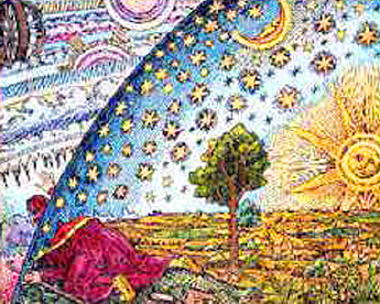
Zen is said to be a special transmission outside the scriptures, without reliance on words and explanations, a direct pointing to the human mind. Zen masters are known to use unorthodox methods to get their students to breakthrough their conceptual minds. Students have to work on finding a solution to questions like “What is the sound of one hand clapping?” or “What was your original face before you were born?”.
What is the meaning of such nonsense questions? Know that while things are in a constant state of flux with no beginning or ending, we through our minds create a start point and an end point with our concepts. For instance a matchstick burns out and becomes ash. Form has changed from the matchstick to ash. However we can say that the matchstick died. We extend the same idea to living beings also. Birth and death are merely concepts. There is no underlying substance that is born or dies. There is only everlasting change of appearances.
The findings of Quantum Physics with its paradoxical implications on the nature of reality resonates with the Buddha’s teachings. Neils Bohr, one of the pioneers of Quantum physics said – Everything we call real is made of things that cannot be regarded as real.
So what the Buddha really points out is that people are mistaking what is impermanent for being permanent and what is harmful for beneficial. Under the delusion of something tangible, they seek material things, cling to life and get addicted to fleeting experiences.
In the movie the Truman show, Truman is in a life size reality show where since the time he was born, he was surrounded by actors. His whole life was being filmed as a reality show for the audience. He initially mistook the acting for real relationships. But one day, he starts to doubt his reality and begins his search for the truth.
Similarly when one deeply realizes one’s delusion, one can be equanimous in the ups and downs of life. Being equanimous, one can experience real inner joy, be friendly towards others and have compassion towards those who are not yet free from this delusion. Thus one can live a life free of unnecessary mental anguish.
The Buddha gives the following four assurances if one lives the righteous life based on the Noble Eightfold Path
- If there is a life after death, and if the law of karma is effective, you will be reborn in a great place
- If there is no life after death, and even if the law of karma is not effective, you will still be able to live this present life in peace and harmony
- If evil things happen to you, then because you don’t have evil thoughts, you will not experience any suffering
- If evil things don’t happen to you, then you will anyway live a good life.
Listening to the Buddha’s teachings gives tremendous peace of mind, encourages one to live right and points one to the goal of human life.
The Buddha gave the 5 precepts – refrain from killing or harming any living being, refrain from taking what is not given, refrain from sexual misconduct or the misuse of the senses, refrain from lying, abusive speaking or exaggerating and refrain from alcohol and other intoxicating drugs. These are the basis for living a happy life. The purpose of these rules is not to impose limitations but to help the mind to settle down and become calm. If someone kills another or steals something or drinks alcohol and tells lies, such a person’s mind will be agitated and will not find peace because it will be flooded with thoughts. Such a mind cannot discover the truth about oneself and life. Similarly, just following the teachings and precepts without striving for enlightenment will not be the best use of this life’s opportunity.
Remember that the Buddha said that his teaching is like a raft. You can use it to cross the river of suffering, but you must not get so attached to it that you carry it around with you. There is no use just learning how a raft is built and how it floats on water, but you must use it to cross the river of your mind’s suffering.
Buddha’s teaching can never lose its relevance and significance in any age for any person.
May all beings be happy
May all beings be free of suffering
May all beings achieve enlightenment.



 Big Picture Zen