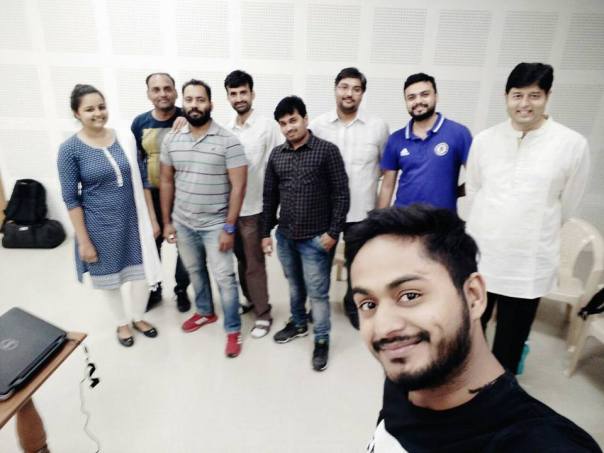
From Left to Right: Karishma, Neel, Bharat, Maulik, Kunal, Dhrupit, Soham and Harshit.
From Left to Right: Karishma, Neel, Bharat, Maulik, Kunal, Dhrupit, Soham and Harshit.
This is the true joy in life, the being used for a purpose recognized by yourself as a mighty one; the being a force of nature instead of a feverish, selfish little clod of ailments and grievances complaining that the world will not devote itself to making you happy.
I am of the opinion that my life belongs to the whole community, and as long as I live it is my privilege to do for it whatever I can.
I want to be thoroughly used up when I die, for the harder I work the more I live. I rejoice in life for its own sake. Life is no “brief candle” for me. It is a sort of splendid torch which I have got hold of for the moment, and I want to make it burn as brightly as possible before handing it on to future generations.
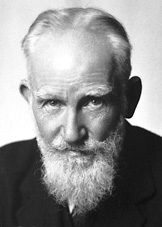
George Bernard Shaw
This is a powerful quote from G B Shaw’s play Man and Superman. Werner Erhard uses this quote often in his talks and why not? In less than 150 words, Shaw manages to highlight the petty mindset of humanity and at the same time calls for finding true joy in making the maximum contribution one can before one dies.
George Bernard Shaw often remarked that he hated Shakespeare and so it is interesting possibility that the remark that life is no “brief candle” is a retort to a quote from Shakespeare’s Macbeth –
Out, out, brief candle! Life’s but a walking shadow, a poor player that struts and frets his hour upon the stage and is heard no more. It is a tale told by an idiot, full of sound and fury, signifying nothing.

For a human being to attain enlightenment, there are five requirements that must be fulfilled. If any one of these requirements is not met, then the conditions are not met for insight to happen. What are these five key requirements?
Every person has some natural inclination. Some people equate this with karma from past life. Whatever that might be, some people are more inclined towards self-inquiry than others. In some cases, certain experiences in life provide such a big shock to a person that he has no choice but to turn inward to find out the meaning of life.
This inclination when nurtured builds momentum as the person reads, listens and gets in touch with others on the path of self-inquiry. The condition of suitable inclination is fulfilled when the inclination is pure and not tainted with some ulterior motive. The desire must be to discover the truth for what it is, not to achieve a worldly end. The individual must be willing to walk the extra mile for achieving enlightenment.
If suitable inclination is not there then the person will be distracted by the world around him and will not be able to proceed in a focused manner towards enlightenment.
Enlightenment requires the full energy available to a human being. If energy is divided into multiple things, then enlightenment is not possible. Therefore, a person must be in his peak physical and mental health to go deep into self-inquiry. This is especially important for meditation.
Most people think they can keep spirituality for their old age after they have completed their life’s work. But by that time, most people develop a number of physical ailments which create hindrances. Even the mind through years of conditioning, is not ready to unlearn what has been learnt and learn something new. Every new idea is filtered through biases built over the years. In such a state, the human body does not have the requisite energy to attempt enlightenment.
A man is in his prime during his late twenties and early thirties. The body is at its physical peak and can provide the maximum throughput of energy when called for. The mind is alert, in a learning mode and even though conditioned by the influences of the world, it has the possibility of breaking through that conditioning.
A person desiring enlightenment must depend on his own attitude and approach. Even if there exists an enlightened master to guide him, the person cannot let go of critical evaluation of whatever advice he is given. The right attitude is to experiment, test, try, experience and learn. There must be sincerity in the effort, seriousness in the intention and silence in action.
Enlightenment is something to be experienced individually. It cannot be given by a guru to a disciple. Therefore, the individual must depend on his own understanding at all times.
Many people have the time, have the inclination, and are in their prime, and yet because they depend on another for guidance, they do not reach enlightenment.
A person is born into an environment which comprises of his family, the family’s economic condition, the societal influence, the country and education. The environment is supposed to provide for the basic necessities of life – food, clothing, security. Once these necessities are provided for, a person can give some time and space for the exploration into oneself, which is the starting point for enlightenment.
If a person is born in a country embroiled in a civil war, or if a person is born into utter poverty, then he does not get the time and space which is needed for inquiry because is he too busy running for safety or food.
But if a person is born into reasonable environment where the basic necessities are available, then there is a possibility of devoting some time and space to the inquiry into oneself. However, just having this space and time is not enough. A lot of people have this space and time, but they are busy filling it with more work or more entertainment.
Most people are enticed by the show of the world – the money, the things which money can buy, the women, fame, status in life and so on. Such people’s attention is distracted by everything around them. They will follow their whims and fancies without any reflection or consideration of consequences or learning anything from their past experiences.
Disenchantment is not renunciation. It is simply the realization that more money or more worldly things do not equate to genuine happiness. And this realization has to be based on personal experience not merely a theoretical idea. This does not mean that a person shuns money or gives up material comforts. The individual simply realizes that there is a limit to the effectiveness of such comforts and that there is no end to them.
So these five conditions are key for the attainment of enlightenment. When these five conditions are met, then the possibility of enlightenment arises. There is no guarantee. Just the possibility.

We all need help in some or the other way in what we wish to achieve. Right from childhood, someone has helped us to walk, to eat, to read, to write, to speak and to play. We have also been told directly (through instructions) and indirectly (through actions) how to live life, how to understand things, how to draw conclusions and how to make sense of what happens to us.
When we do something wrong, we are told what is right and how to correct it. When we are young, we blindly accept everything we are told by parents and teachers. As we grow up and as our knowledge increases, every new information that comes our way is evaluated on the basis of what has already been told to us. So we start to agree or disagree with new information. To change our mind, we demand more concrete proof.
Once the knowledge is engraved in rules and policies, it is even more difficult to make changes. Many people cannot change their views despite all the proof to the contrary. However, help is always available when someone wants to listen. As the saying goes: You can take the horse to the water but cannot make him drink it. In the same way, help is available when you are thirsty.
Help does not have a specific form. It is not necessary that what helped one person will help another in exactly the same way. It depends on where the person is, in what state of mind, and what he has achieved before. It is a common realization for many people that they find new insights from the same book when they read it the second time and a third time. The book is the same but in the first reading, not all levels of meaning were apparent. As the level of the reader increased, he discovered more meaning in the second reading. In rare instances, if a reader has deeper understanding, he can gain new insights from a book which even the author had not intended to express.
To awaken we need help in different ways again and again. In the final analysis, it is you yourself who has helped you, not anyone else. We can learn immensely from books, movies, stories and metaphors
What is life without books! Reading is our only source of knowledge – knowledge which we cannot experience ourselves. And we must read a lot – different styles, different subjects, even from different ages. The more the variety we read the more our minds open up to new concepts. While it is true that concepts imprison us, it is also true that only through other concepts the road to freedom opens up.
Movies are not just for entertainment. There are some movies that help us reflect on our lives and show us things which the usual movies don’t.
The purpose of telling a story is to convey a coded message. While the story can serve to entertain and pass time, it is the responsibility of the listener to grasp the meaning which is woven in the story, even if the story teller does not make it apparent. Stories serve to develop the faculty of attention in the listener.
Metaphors and analogies are excellent means for explaining a concept. Drawing a parallel from what one already understands, makes it easy to grasp what one does not understand.
I wish you good luck in your endeavor.
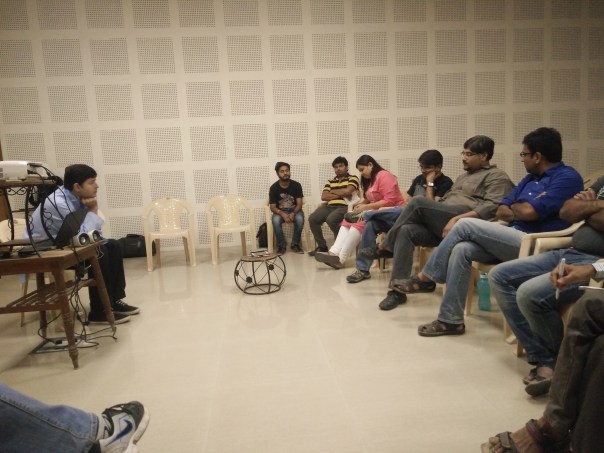
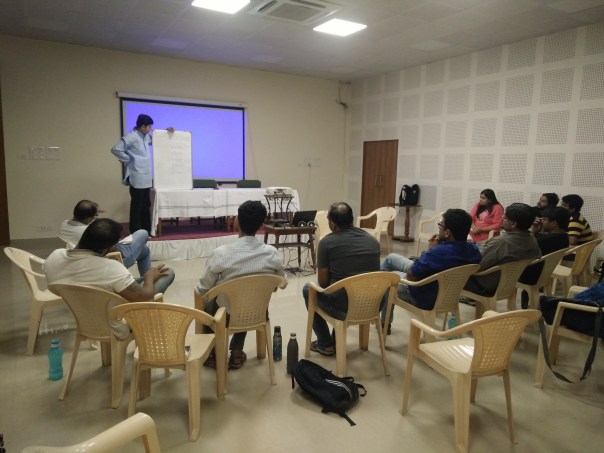

From Left to Right: Kunal, Bharat, Neel, Mukesh, Devang, Sonali, Nilesh, Karishma, Maulik, Harshit and Dhrupit
 Big Picture Zen