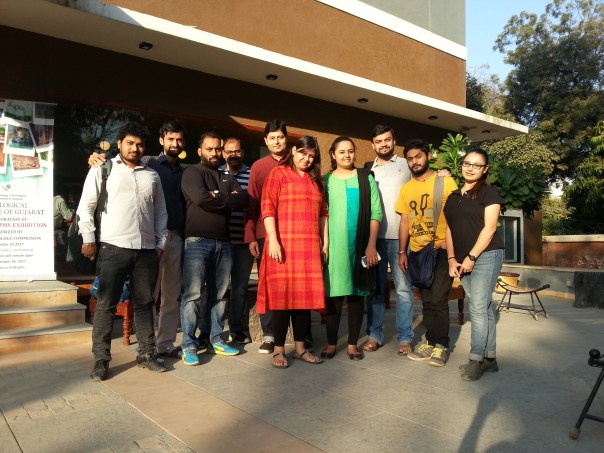
From left to right: Kunal, Maulik, Bharat, Devang, Sonali, Karishma, Soham, Harshit, Shreya
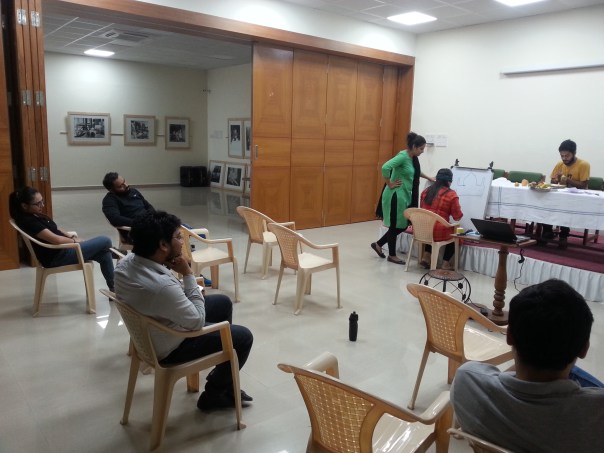
Above: An exercise in giving precise instructions
From left to right: Kunal, Maulik, Bharat, Devang, Sonali, Karishma, Soham, Harshit, Shreya
Above: An exercise in giving precise instructions

Another birthday. Another year gone by. Another revolution around the sun completed today. Come to think of it, we never imagine ourselves having completed a trip round the sun whenever we celebrate our birthdays – but that’s the truth of the matter. A year has gone by and a year is defined by the time the earth takes to go around the sun. So we are on this gigantic spaceship called earth hurtling into space at incredible speed and once every revolution, we celebrate the event. But what is so exciting about completing one circle around the sun? Of course people wish you – many many happy circles to go (returns of the day) – have a great rotation (day)
A birthday is a very slippery concept if you go a little beneath the skin. We are all made to believe that we were born on the day we emerged from the mother’s womb. But if birth is the same as coming alive then were we not alive the day before we came out of the womb or even a month before that? We were quite alive even then. So when were you really truly born / become alive? There are many possible answers.
Scientists point out that each cell in our bodies is replaced once every 7 years. That means we are a new person every 7 years and must celebrate our birthday only once in 7 years. Too less!
Going further the Meditators say that everything changes every moment, so from that view, we are born every moment and die every moment so every day is a birthday. Too much!
I am sure wise people would have deliberated about all this and coming to a consensus, would have arbitrarily decided one event as the birthday.
Now that the decision is made, whatever it may be, a birthday is definitely a time to feel good. Many people remember you at least once a year and reach out to wish you. It is a nice feeling. There is cake and the snacks and all the friends and family with you as you become the center of attention. Probably that’s the origin of the saying – every dog has its day!
Director – Oliver Hirschbiegel
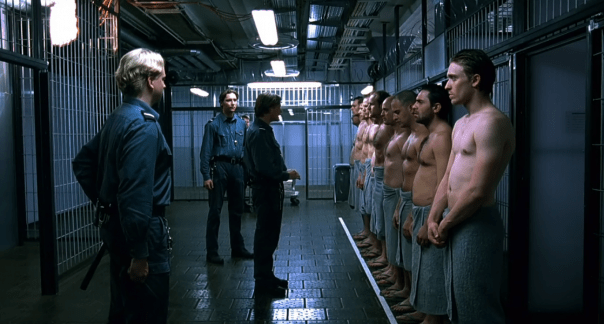
This is a German movie. Das Experiment translates to The Experiment. The experiment is about observing human behavior in a simulation of a prison environment.
In 1971, Philip Zimbardo a professor at Stanford conducted a real life prison experiment using college students in order to study the psychological effect of perceived power. This film and many others are inspired by those events.
In Das Experiment, there is a professor who recruits 20 paid volunteers for the experiment of which 8 are selected to play the role of prison guards and 12 selected to play the role of prisoners. He sets one rule that there must be no violence of any kind during the simulation. The job of the prison guards is to maintain law and order and the job of the prisoners is to be locked up in their cells and to follow some arbitrary rules that the prison guards would make.
The movie depicts how the situation deteriorates over the course of a few days as the volunteers start taking their roles seriously, forgetting that they are doing this for money as volunteers in the experiment. As the story develops, it starts to focus on the battle between one dominant prisoner Tarek who tries to break the rules and one sadist prison guard Berus who will go to any extent to subjugate Tarek. Eventually the story takes a violent turn resulting in deaths and injuries. At the end, both Tarek and Berus comment to each other – you started it all.
But if you watch the film, you will not be able to find out where it all started and who was to blame. Maybe it was the setting of the experiment, maybe it was that the volunteers forgot who they were and took their roles too seriously, maybe it was the fact that both prisoners and guards were given their specific uniforms and were told to behave as them.
In real life also, whenever we take our roles too seriously, we forget who we are and resort to physical and vocal violence. We can even take this analogy further. In life we are born into a specific country, a community, a religion and we start taking that position seriously and become prisoners of that thinking.
Just imagine if the prison experiment was conducted on a mass scale across generations, then prisoners and prison guards would no longer know that it was all an experiment. Prison guards would start to believe that they were chosen by God while prisoners would believe that they are being unjustly tortured.
Pushing the analogy to its limits. Self-realization is when we wake up from this identification of who we are – whether a doctor or an entrepreneur or a factory worker, or a man or a woman or a Catholic or a Jain – and intuitively know that we are THAT. In that moment, all our assumed pretenses fall away and we will truly become a nobody. And even if we have to live out a role in the society, we will be able to do that without the associated anxieties and stress.
In the film, Tarek’s co-prisoner Steinhoff (#38) displays this level of awareness during the whole experiment. He is constantly aware that he is only there for the experiment and avoids getting involved in the escalating situation with the prison guards. In the end he also helps the other prisoners escape from the cells.
Warning: The film contains several scenes depicting male and female nudity. So watch responsibly. Also use subtitles as the film is in German
 Big Picture Zen