Category Archives: Buddhism

The Buddha Speaks on No-Self

One of the central teachings of the Buddha is that of No-Self. This teaching appears in the Anatta-lakkhana Sutta, which means the signs of no-self. Atta is pali word for Atma so Anatta is Anatman in Sanskrit, signifying no-soul or no-self. This teaching went against the grain of existing understanding that every person has an enduring ever-lasting soul which dies and is born again into a new body.

In the Anatta-lakkhana Sutta, the Buddha says: Form is not the self. If the form (of your body) were really the self or the soul, then it would not be a cause of suffering, of pain. Further, if it were really one’s soul or self, one could say – let my form is such. But since form is not self, it is a cause of suffering and you have no control on it.

The Buddha then goes on to say the same for feelings, mental formations, volition and consciousness, the other four aggregates which make up an individual. One by one he refutes each aggregate as the self.

The individual is composed of the aggregates but there is nothing permanent in any aggregate and hence, no self to be found in the individual.

The story goes on to claim that the 5 bhikkhus who listened to this teaching achieved the discernment into the non-selflessness of phenomena. It is possible, those bhikkhus were already wise enough to perceive this truth but for someone who likes to question and doubt, the Q&A session at the end of any talk is the most important part where he can clarify his own understanding by asking questions to the speaker.

Let’s assume, someone in the audience, has some doubts on what the Buddha said. Here is how the conversation might proceed.

Questioner: You say that there is no self. Then does it imply that it is ok to kill someone? You are not killing anyone if there is no one to kill, isn’t it?

Buddha: I say phenomena is made up of aggregates. If you consider non-living things like stones or mud, then there is only a form aggregate. There is no feeling, mental formations, volition or consciousness which can be combined into mind. There is no mind for a stone, only form. You can break a stone into pieces. There is no self in it. No problem. Now consider a living being or we can say sentient being because it has both body (form) and mind (mental formation, feelings, volition and consciousness). If you inflict a wound on such a living being whether human or animal, it is bound to create painful feelings, thoughts of fear, various mental formations like anger or revenge. If you hurt the living being to such an extent that the aggregates which were a part of the being are no longer functioning in harmony, we can say you have killed that being. However, there is no reason to assume a permanent soul or self in this case also. I always say that no living being wants to suffer and you must not make any living being suffer.

Questioner: It may be so. But ultimately, there is no one to kill or there is no one who suffers. Just a re-configuration of aggregates. So I am not clear about the implications of no-self.

Buddha: At a deeper level, no-self is a view, a mindset, a realization, an awakening. If you do not see it, you will see a self. You will see other persons and you will assume their agency. Being affected by someone’s words or actions, you may generate anger or fear which in turn might rouse you to harm them or kill them. However, if you see no-self, if you have the view of no-self, you will not see anyone. You will not ascribe agency to people. Words and actions of others might develop feelings and mental formations in you but you will clearly see them as impermanent aggregates only. This view prevents feelings from cascading into anger, rage to generate enough energy to harm and kill another being. I often give this example that if you are walking in a forest at dusk when visibility is low and you come across a snake on the ground, you may want to stamp on it to kill it. However when the sun rises and you see clearly, it was only a piece of rope not a snake, you will realize your folly.

Questioner: I understood. Thank you. But what if you mistook a snake for a rope? Wouldn’t the snake not bite you?

Buddha: I never said to walk without being alert. If you notice something, check it out or avoid it. In the case you are bitten, realize you are bitten and do whatever you can to save yourself. There is no magic that’s going to happen if you know about no-self.

Questioner: Ok, I got it. I understood what is no-self. I will live accordingly.

Buddha: Beware. It is not enough to just take the teaching of no-self and apply it blindly. You cannot take it as an excuse to either harm others or become less mindful. All actions have consequences. Aggregates behave as per the laws of nature. Water will flow, fire will burn and so on. Once you see aggregates for what they are – impermanent and fleeting with no controller, you will see they are doing their thing. You will attain wisdom. Till the time you see a self, a controller, a someone who is doing things, you will experience suffering. Please investigate deeply.

Questioner: Thank you so much.

Gautam Buddha – His Life, Work, Thoughts and Current Relevance

The below is an essay I wrote for a competition organized by the Dhamma Bhavan Charitable Trust, Kolhapur in Jan 2025.

“Ehipassiko”

When people asked the Buddha to talk about his teachings, he used to say – Ehipassiko. This is how he invited people to experience what he taught. Ehipassiko is a pali word that means – Come and see for yourself. It means do not intellectualize or get caught in the verbal explanations. But if you follow the path you will experience the insights for yourself. Then there will be no need for any explanation because you will see the truth directly. It is like performing a scientific experiment with precise instructions that produces the expected results. The Buddha’s teaching is like a science of the mind.

The Buddha lived and taught some 2500 years ago. He walked from place to place, village to village, teaching all those who showed an interest and inclination to learn. He taught with great skill, adjusting his teaching to individuals by considering their capabilities. He taught with great love and compassion by employing stories, analogies, and metaphors to convey his insights. Those who understood did not have any qualms about leaving their homes and families to join his Sangha of wandering monks. On the other hand, there were many who became lay followers by adopting the given precepts.

Even after the Buddha’s death, his teaching continued to influence millions. It has spread far and wide all over the world taking different outer forms like the Theravada of Thailand, Burma and Vietnam, Mahayana of Tibet, Chan of China and Zen of Japan.

The Buddha’s Doubt

Given the popularity of Buddhism, it would seem that the Buddha had an easy time sharing his teaching with people. But the fact is that when the Buddha got his enlightenment, at first he was elated that he finally got what he was seeking and he would go and share it with others. However, when he reflected on what he had discovered, he thought to himself – This insight that I have acquired is so subtle, so nuanced, that it will be difficult to convey it to people. They will misunderstand it or miss the point altogether and I will get so frustrated and exhausted trying my best to explain it to people. So let me not teach anything.

It is said that the God Brahma requested the Buddha to teach nonetheless. So the Buddha reviewed the situation with his insight and realized that people have different abilities. There are some who are ready to receive his teachings while there are others who will grasp the meaning with a little bit of practice and there will be others who will need a still longer time. So he started his teaching campaign – also known as setting the wheel of Dhamma in motion.

Even to this day, people express their allegiance to Buddhism by uttering the following.

Buddham Saranam Gacchami
(I take refuge in the Buddha)
Dhammam Saranam Gacchami
(I take refuge in the Dhamma)
Sangham Saranam Gacchami
(I take refuge in the Sangha)

Thanks to the work of multiple scholars, monks and lay people, today we have a well-documented body of teachings of the Buddha called the Sutta Pitaka which includes 34 long discourses, 152 middle length discourses, 7,762 connected discourses, 9,557 numerical discourses and numerous short discourses including the Dhammapada and Jataka. This is just the Theravada literature. There are the Mahayana sutras and the Zen sutras which were contributed by later Buddhist masters.

For a student who wishes to understand what the Buddha taught, there is a life time of material available to go through. But will going through all the sutras help a diligent student to understand the Buddha? Only to some extent. Without getting a personal experience of enlightenment, it is not possible to truly understand what the Buddha discovered. And this is probably the reason that the Buddha had doubts about whether people would understand his teachings.

So what exactly did the Buddha discover when he got enlightened? What was it that he thought it was difficult to convey to others? To appreciate this, first we must know what he was seeking and why he was seeking it.

Siddharth’s Motivation

Gautama the Buddha was born as Siddharth, son of King Shuddhodana of the Shakya clan at the foothills of present day Nepal. At the time of his birth, Sage Asita made a prophesy that Siddharth would either become a great King or a great monk. His father naturally wanted him to be a great king, not a monk. He thought if he brought up Siddharth in the greatest of luxuries and kept him away from the harsh realities of life, then Siddharth would naturally incline towards being a King.

Siddharth grew up in the best of comforts that a prince could get in his time. His father built three different palaces for him – one for the summer season, one for the rainy season and one for the winter season. Siddharth was always surrounded by merriment, dancing girls, choicest of food and servants to get him whatever he wanted. Siddharth was educated in various fields of knowledge and became skilled in the use of swords and bows. He got married to the beautiful Yashodara and had a son named Rahula.

Life was going well for Siddharth except for one thing. He was never allowed to go out in the city. He was always confined to the palaces where his father had ensured that there were no old, sick or sad people, no talk of death and unhappiness which might influence him to think of becoming a monk. His father desperately wanted him to be a king. But secretly Siddharth  was longing to see the world beyond his palace. Whenever he asked for permission, it was denied.

As the legend goes, one day Siddharth slipped out of the palace unnoticed with his trusted charioteer Channa for a tour of the city. This excursion turned out to be a life-changing day for him. The life outside the city was nothing that Siddharth had expected. It was a shock for him that there is no merriment or enjoyment outside. People are working hard and doing their jobs. They also looked much poorer and different than the people in the palace. He saw sick people, people in pain; he saw old people with wrinkled skin and grey hair, toothless, bent at the back, walking with the support of a stick; he also saw a funeral procession with a dead man, with other people crying and wailing. He could not understand why people become ill, old and die.

When Channa confirmed that even Siddharth will one day become old and die and there was no escaping that, it was very disturbing for him. Siddharth could not sleep in peace after that experience. He could not imagine that his wife and son would also become old and die. What was the point of living in merry if death is the ultimate destiny? He kept remembering the sight of a monk, with a calm face and peaceful countenance, sitting in meditation under a tree. Channa had explained that the monk was trying to find a solution to life and death. Siddharth immediately knew that he must become like that monk. But he also knew that no one will allow him to follow that path. His father wanted him to be a king like him. Siddharth’s desire for this search was so strong that one night, he left his sleeping wife and son and escaped into the forest in search of teachers who would show him the way to salvation.

Unbelievable or Plausible?

There are some points in the story of Siddharth that seem quite unbelievable.

  1. How is it possible that a young man of 29 years never became ill himself? No cold, no cough, no fever? How come he never saw his father becoming older and he himself growing from a child to a young man?
  2. How is it possible that he did not know about death? We know how he saved a swan who was hurt with an arrow shot by his cousin Devadatta. The swan would have died if Siddharth did not tend to it. Further if Siddharth was trained in the art of swordsmanship and archery, was it merely as a sport but not for use in a war to kill others? As a kshatriya, the talk of war and killing would be quite a common thing in conversations.
  3. How can a person be so selfish so as to leave his wife and young son in pursuit of his own desire for truth?

These may seem unbelievable but not implausible. For instance, consider a detective who is searching for the culprit. The detective has all the clues with him yet he is unable to figure out who the culprit is. Yet in a rare moment of insight and clarity, all the seemingly unconnected clues connect in his mind in a way that leaves no doubt as to who committed the crime. For the detective, this is a Eureka moment, a moment of illumination. We can call it a moment of enlightenment.

Even so for Siddharth, although he may have seen illness, suffering and death before, all the aspects connected for him in that moment of clarity and insight that made him consider his own old age and death. It also gave rise to a desire to seek out a solution after seeing the monk working on it. It was as if all the clues connected for him and showed him a direction to follow.

Whether his act of leaving family was a selfish act or for the greater good is a matter of judgement. If he had chosen to remain and be a king, it would have been a different story altogether. Moreover, as we will see, Siddharth’s previous births all point to his desire to become a Buddha and hence the particular situation in which he acted is not of great consequence. What is important is to remember that the Buddha went in search for a solution for death.

What should rather be truly unbelievable is that the Buddha actually found the solution. Most people cannot believe or even understand that there can be a solution for death, that one can go beyond death. But that is what the Buddha discovered. That is what made Siddharth a Buddha. Buddha means the one who knows. And because what he realized was so subtle, so against the common knowledge that he doubted the ability of people to understand his teaching.

The Struggle for Enlightenment

After Siddharth left his home, he immediately approached the best teachers of his time. He quickly learnt and mastered all the meditation techniques which were taught by those teachers. However, he was not satisfied because he did not get the answers he was looking for. So, refusing the offer of his teachers to continue to stay and teach others, he kept moving on to other teachers. Eventually he realized he must find his own way.

The prevalent understanding of the human being in the time of Siddharth was that each person has an everlasting soul which is pure but due to the desires of the body, the soul (Atman) does not get the chance to meet the Universal soul (Brahman). When a person dies, the soul migrates to another body just like we remove one set of clothes and wear another. Moksha was the idea that the Atman will merge with the Brahman in a moment of raised consciousness and attain liberation. However, it is prevented by the continuous actions or Karma that the body produces. Hence the body must be tamed. To achieve this, exrteme ascetic practices were common among those who were seeking moksha.

Siddharth decided to break the world record for ascetic practices. If this was the way, he will go all the way till the end. So he devoted himself to the most extreme asceticism possible for a human being. It included eating only one grain of rice in a day, breathing only one breath per hour. His resolve was strong and he could practice such austerities to the amazement of his fellow seekers. But eventually his body became like a skeleton and he became very weak. Moreover, even after several years of such austerities he did not get any satisfactory answers to his questions. One day when he almost slipped and drowned in the river, he thought that if he died without finding the answer, it would be a wasted effort. So he must try something else other than working on the body.

Siddharth turned his attention to the mind and found a natural progress in this direction. Very soon he started to get into deeper and deeper states of concentration. With each deeper state of concentration, he was able to calm his mind and get insights never got before while he was punishing his body. With this success and increasing energy, Siddharth, on that full moon night took the following vow and sat in meditation.

“Willingly, let only my skin, sinews, and bones remain, and let the flesh and blood dry up in my body, but I will not relax my energy so long as I have not attained what can be attained by manly strength, by manly energy, by manly exertion”

During that night of intense meditation, Siddharth overcame all the cankers of the mind, all the distracting thoughts, avoided all the traps of delusion and made the final breakthrough. On becoming enlightened, he uttered the following words – 

“O house builder, you have been seen; You shall not build the house again. Your rafters have been broken up, Your ridgepole is demolished too.”

What is Enlightenment

Completing a 6 year rigorous effort for seeking the truth, these words somehow fall short of conveying the tremendous achievement of attaining liberation. But obviously it is a metaphorical description of what happened in Siddharth’s mind.

Enlightenment literally means lighting up. When there is light, the darkness is dispelled, and you can see everything clearly.

In the above metaphor, the house is the personal identity or self of the person. Siddharth clearly saw how he constructs the notion of “him”self with all the supporting ideas (rafters) and the core idea (ridgepole) that makes up the “illusory” self. Once that concept is blown away and seen clearly for what it is, what remains is just enlightenment – just light, no shadows. What it means is that the identification with the body-mind aggregates drop away.

This is the core of the Buddha’s enlightenment – the self, what we call us or ourselves, I or me, is a belief or more precisely an identification. The self or I does not exist independently of the body with which there is the identification.

As mentioned above the prevalent understanding was the existence of a permanent pure soul which exists independent of the body and which takes rebirth in different bodies. Buddha refutes this. And he says Ehipassiko – come and see for yourself. He gives a method of meditation and even points out all the milestones that come up on the way of deeper concentration till the very end where you can experience the same realization as the Buddha. It is a repeatable process just like a scientific experiment.

The Implications of Enlightenment

The person who ponders over the implications of this idea, without dismissing it as naïve, will surely appreciate its tremendous significance. Because we are all afflicted by the identification with the self, it requires a keen non-judgmental eye to see through this illusion we have created for ourselves. Simply “getting it” can turn out to be a moment of enlightenment, also called Satori or Kensho in Japanese.

The Buddha says that the world is characterized by 3 things – Anicca, Dukkha and Anatta. Anicca means impermanence – that nothing is permanent. Everything is in a state of flux. Dukkha means suffering or rather a sense of dissatisfaction. This is also the basis of his teaching on the Four Noble Truths – suffering, the cause of suffering, the cessation of cause of suffering and the path leading to the cessation of the cause of suffering. Finally, Anatta means no-self. When we say every “thing” is in a state of flux, Anatta reminds us there is no “thing”. And no “thing” does not mean nothing.

With this double strike off, the mind which is constantly grasping for things, for something to hold on to, now has nothing to hold on to, nothing to grasp and it falls away. Then it is said that you see things “as they are”.

This leads us to the big implication of no-self, which is no birth, no death. If there is no thing, no person, then there is no one who is born and no one who is dying. In the Dhammapada, the Buddha says – Mindfulness is the way to the Deathless (Nibbana); unmindfulness is the way to Death. Those who are mindful do not die; those who are not mindful are as if already dead.

In the teaching of the dependent origination, the Buddha explains how one thing leads to another in an endless chain – how ignorance of the real nature of the self leads to mental formations, how mental formations create consciousness, how consciousness distinguishes shapes and gives names to the forms, how that creates the sense bases which then get into contact with those objects  generating feelings, how feelings of like and dislike create desire, how desire creates attachment, how attachment snowballs into becoming which leads to birth and once born, old age and death are sure to follow. So long as ignorance is present, the cycle continues on. Only by cutting the root delusion of the self can the entire chain of becoming and suffering come to an end.

When asked what the Buddha taught, he always used to say that he only showed a path to the end of suffering. The ending of suffering does not mean the disappearance of the body-mind but only the detachment from what happens to the body-mind. The body-mind follows its own process but when there is no identification, then there is neither like or dislike.

And thus Siddharth achieved his goal of finding a solution to the biggest issue in front of any human being – DEATH. No wonder he hesitated to teach because such a declaration might create confusion & misunderstanding. Yet, it is not impossible for sincere seekers of the truth to come to the same realization.

Buddha’s Teaching and Skillful Means

Having a solution but not able to share it with others would be really unfortunate. But Buddha had a lot of compassion for others, especially after enlightenment, when he could see clearly how people were suffering needlessly. Whatever he taught, he ensured that it was to the level of understanding of his listeners. He would teach differently to his closest monks, differently to Kings, differently to common people and differently to followers of other contemporary teachers. With his examples, anecdotes from his past life (Jataka stories) and metaphors, he was able to connect and win over increasing numbers of people to follow his path. He did not expect people to blindly follow him as an authority but encouraged them to first understand and only then accept.

He warned – Do not rely on oral tradition, or on the lineage of teachers, or on holy scriptures, or on abstract logic. Do not place blind trust in impressive personalities or in venerated gurus, but examine the issue for yourselves. When you know for yourselves that something is unwholesome and harmful, then you should reject it. And when you know for yourselves that something is wholesome and beneficial, then you should accept it and put it into practice.

The Noble Eightfold Path, designed by the Buddha, is the sure shot way to attaining the insight of the Buddha.

  1. Right View
  2. Right Thought
  3. Right Speech
  4. Right Action
  5. Right Livelihood
  6. Right Effort
  7. Right Mindfulness
  8. Right Concentration

It starts with right view and right thought which are the preparation for the mind for attaining insight. Right speech, right action and right livelihood help to simplify one’s life to an extent such that it gives rise to calmness and avoids any anxiety and stress. Finally with the right effort, right mindfulness and right concentration, one can, with practice achieve the same insight as the Buddha.

The Buddha declared that if a person sincerely practices mindfulness for 7 years, he can attain the highest knowledge here and now. He goes on to say that if one practices for even 6 years or 5 years, 4 years, 3 years, 2 years, 1 year or just 7 months, 6 months, 5 months, 4 months, 3 months, 2 months, 1 month, or even a week, he can experience the highest knowledge here and now.

Buddha placed the greatest emphasis on the cultivation of mindfulness. He says – This is the only way, monks, for the purification of beings, for the overcoming of sorrow and lamentation, for the destruction of suffering and grief, for reaching the right path, for the attainment of Nibbana, namely, the four foundations of mindfulness. The four foundations include the contemplation of the body, feeling, mental objects and consciousness.

The Buddha is considered to be one of the greatest teachers of mankind, simply because of his skill in using the most appropriate means for the student that will open his eyes. The stories of Kisa Gotami, Angulimala, Kasappa and others amply demonstrate Buddha’s skill as a teacher.

Buddha’s Relevance Today

So the question arises whether the Buddha only talked about Nibbana, which the ending of the cycle of birth and death and how relevant that is in our daily life?

If one observes the daily life, it is a constant struggle for survival, whether one is self-employed or running a business or working for someone else. People experience pain and suffering in their relationships. Parents, like Shuddhodana, are striving to give a comfortable life to their children yet in general, people live a less than satisfactory life. How then can Buddha’s insights help to alleviate such suffering? Does everyone have to first meditate and get the same insights before living the daily life?

In the time of the Buddha, many people renounced their household life and joined the Sangha of wandering monks to follow his teachings. They begged for food and devoted the rest of their time to mindfulness and meditation. Even today in countries like Thailand, Myanmar and Vietnam, the same forest tradition is followed. Their goal is to become an Arahat. The Tibetans on the other hand questioned whether it was necessary to leave one’s house to attain realization. They placed emphasis on developing the compassionate mindset of Bodhisattva, who vows not to attain personal Nibbana, until he helps all other beings attain realization. In China and Japan, the Buddha’s teaching evolved in to the approaches of Chan and Zen.

Zen is said to be a special transmission outside the scriptures, without reliance on words and explanations, a direct pointing to the human mind. Zen masters are known to use unorthodox methods to get their students to breakthrough their conceptual minds. Students have to work on finding a solution to questions like “What is the sound of one hand clapping?” or “What was your original face before you were born?”.

What is the meaning of such nonsense questions? Know that while things are in a constant state of flux with no beginning or ending, we through our minds create a start point and an end point with our concepts. For instance a matchstick burns out and becomes ash. Form has changed from the matchstick to ash. However we can say that the matchstick died. We extend the same idea to living beings also. Birth and death are merely concepts. There is no underlying substance that is born or dies. There is only everlasting change of appearances.

The findings of Quantum Physics with its paradoxical implications on the nature of reality resonates with the Buddha’s teachings. Neils Bohr, one of the pioneers of Quantum physics said – Everything we call real is made of things that cannot be regarded as real.

So what the Buddha really points out is that people are mistaking what is impermanent for being permanent and what is harmful for beneficial. Under the delusion of something tangible, they seek material things, cling to life and get addicted to fleeting experiences.

In the movie the Truman show, Truman is in a life size reality show where since the time he was born, he was surrounded by actors. His whole life was being filmed as a reality show for the audience. He initially mistook the acting for real relationships. But one day, he starts to doubt his reality and begins his search for the truth.

Similarly when one deeply realizes one’s delusion, one can be equanimous in the ups and downs of life. Being equanimous, one can experience real inner joy, be friendly towards others and have compassion towards those who are not yet free from this delusion. Thus one can live a life free of unnecessary mental anguish.

The Buddha gives the following four assurances if one lives the righteous life based on the Noble Eightfold Path

  1. If there is a life after death, and if the law of karma is effective, you will be reborn in a great place
  2. If there is no life after death, and even if the law of karma is not effective, you will still be able to live this present life in peace and harmony
  3. If evil things happen to you, then because you don’t have evil thoughts, you will not experience any suffering
  4. If evil things don’t happen to you, then you will anyway live a good life.

Listening to the Buddha’s teachings gives tremendous peace of mind, encourages one to live right and points one to the goal of human life.

The Buddha gave the 5 precepts – refrain from killing or harming any living being, refrain from taking what is not given, refrain from sexual misconduct or the misuse of the senses, refrain from lying, abusive speaking or exaggerating and refrain from alcohol and other intoxicating drugs. These are the basis for living a happy life. The purpose of these rules is not to impose limitations but to help the mind to settle down and become calm. If someone kills another or steals something or drinks alcohol and tells lies, such a person’s mind will be agitated and will not find peace because it will be flooded with thoughts. Such a mind cannot discover the truth about oneself and life. Similarly, just following the teachings and precepts without striving for enlightenment will not be the best use of this life’s opportunity.

Remember that the Buddha said that his teaching is like a raft. You can use it to cross the river of suffering, but you must not get so attached to it that you carry it around with you. There is no use just learning how a raft is built and how it floats on water, but you must use it to cross the river of your mind’s suffering.

Buddha’s teaching can never lose its relevance and significance in any age for any person.

May all beings be happy
May all beings be free of suffering
May all beings achieve enlightenment.

Ae Bhai Zara Dekh Ke Chalo

Bollywood songs and spirituality – there seems to be no connection between the two. 80% of the song are romantic songs where the male and female actors express their love for each other or grieving songs because they did not get the love they desired. Other 19% are different genres of songs – travel, dance, kids, or situational. Very few, less than 1% songs would be devotional or related to God, Ishwar or Allah.

Now, if you have a spiritual bent of mind, and if you have never turned over this idea in your mind, let me suggest to you that if you replace the lover in the songs with God, most of these so called romantic Bollywood songs can as well be sung for the love of God. Yes, with no change of lyrics but just a change in direction or rather just a change of image in your mind.

Let me share some examples. Listen to these songs and replace the man or the woman with God, Ishwar, Allah or simply a higher power.

सजदे में यूँ ही झुकता हूँ
तुमपे ही आ के रुकता हूँ
क्या ये सबको होता है

हमको क्या लेना है सबसे
तुमसे ही सब बातें अब से
बन गए हो तुम मेरी दुआ

खुदा जाने के मैं फ़िदा हूँ
खुदा जाने मैं मिट गया
खुदा जाने ये क्यूँ हुआ है
के बन गए हो तुम मेरे खुदा

From Bachna Ae Haseeno (2008)

हम तेरे बिन अब रह नहीं सकते
तेरे बिना क्या वजूद मेरा
तुझसे जुदा गर हो जाएँगे
तो खुद से ही हो जाएंगे जुदा
क्योंकि तुम ही हो
अब तुम ही हो
ज़िन्दगी अब तुम ही हो
चैन भी, मेरा दर्द भी
मेरी आशिकी अब तुम ही हो

From Aashiqui 2 (2013)

तू आता है सीने में
जब-जब साँसें भरती हूँ
तेरे दिल की गलियों से
मैं हर रोज़ गुज़रती हूँ
हवा के जैसे चलता है तू,
मैं रेत जैसे उड़ती हूँ
कौन तुझे यूँ प्यार करेगा
जैसे मैं करती हूँ?

From M S Dhoni: The Untold Story (2016)

Pick any song you like. See how easy it is to get into a spiritual mindset by simply changing the direction of your love.

What is love? Love is love, if we don’t categorize it as parental love or sexual love or compassionate love. You can love a person, love an animal, love an activity or love a higher force.

All of Rumi’s compositions were about love. For instance this one below

“I want to see you.
Know your voice.
Recognize you when you
first come ’round the corner.
Sense your scent when I come
into a room you’ve just left.
Know the lift of your heel,
the glide of your foot.
Become familiar with the way
you purse your lips
then let them part,
just the slightest bit,
when I lean in to your space
and kiss you.
I want to know the joy
of how you whisper
“more”

Rumi

Or this one

“This is how I would die
into the love I have for you:
As pieces of cloud
dissolve in sunlight.”

Rumi

So you never thought you could get enlightened by humming Bollywood songs in the shower? I hope you are convinced of the possibility now. You were just thinking of the wrong person all this while.

I particularly like the song – Ae bhai jara dekh ke chalo from Mera Naam Joker, picturised on Raj Kapoor and sung by Manna Dey with music by Shanker Jaikishan. It not only is an entertaining song but also carries a deep meaning, if you care to think about it, as deep as Buddha’s teachings. I don’t know with what feelings the lyricist Neeraj (Gopaldas Saxena) composed this song but I am sure he definitely had some insight. Anyway, here is how this song can be interpreted spiritually.

Ae Bhai Zara Dekh Ke Chalo

ए भाई ज़रा देखके चलो
आगे ही नहीं पीछे भी
दायें ही नहीं बाएं भी
ऊपर ही नहीं
नीचे भी ए भाई

Hey human, be mindful, be watchful, be aware of what you are doing. Do not be distracted by what is on your left or right or up or down. Whatever you do, wherever you go, maintain your awareness. You might trip and fall and hurt yourself or you might hurt others. So be watchful.

तू जहां आया है वो तेरा
घर नहीं गली नहीं
गाँव नहीं कुचा नहीं
रास्ता नहीं बस्ती नहीं

The place where you have come – this earth – is not your home, not your village, city, street or residence. Do not attach yourself to this place and its attractions. It is not what it seems. You may think it is your home or your city but it is not so.

दुनिया है और प्यारे
दुनिया यह एक सरकस है
और इस सर्कस में
बड़े को भी चोटे को भी
खरे को भी खोटे को भी
मोठे को भी पतले को भी
निचे से ऊपर को
ऊपर से नीचे को
बराबर आना जाना पड़ता है

Dear friend, this world can be compared to a circus. And in a circus whether you are young or old, rich or poor, honest or dishonest, the rules are the same. Everyone experiences ups and downs in life. No one is spared. You can desire for a more comfortable life and so you may run after some sort of success or wealth but getting that or having that will not change how life works. You will still face losses sometime and gains sometime, happiness sometimes and grief sometimes.

और रिंग मास्टर के कोड़े पर
कोड़ा जो भूख है
कोड़ा जो पैसा है
कोड़ा जो किस्मत ह
तरह तरह नाच कर
दिखाना यहाँ पड़ता है
बारबार रोना और
गण यहाँ पड़ता है
हीरो से जोकर
बन जाना पड़ता है

And in a circus there is a ringmaster, the one who makes the animals dance to his whip – the whip being hunger, money, and fate. You have to sing and dance to the tune of this whip. With time, a hero may become a joker and a joker may become a hero. It is all a part of this circus.

गिराने से डरता है क्यों
मरने से डरता है क्यों
ठोकर तू जब न खायेगा
पास किसी गम को न
जब तक बुलाएगा
ज़िन्दगी है चीज़ क्या
नहीं जान पायेगा
रोता हुआ आया है
रोता चला जाएगा

So if this is a circus, why are you afraid? Why do you fear failure? Why do you fear death? Unless you experience loss or suffering, you will not know what is life. You will continue to cry all your life that life has not been fair to you. You will complain about other people, the government, the society, and your fate. But you will not experience insight into life if you do not experience the ending of any experience – a relationship or a good phase of life. Because life is characterized by change and impermanence. Everything that starts must end. When you understand this, you will stop complaining and start smiling & accepting what life is.

कैसा है करिश्मा
कैसा खिलवाड़ है
जानवर आदमी से
ज़्यादा वफ़ादार है
खाता है कोड़ा भी
रहता है भूखा भी
फिर भी वो मालिक पर
करता नहीं वार है
और इंसान यह माल
जिस का खाता है
प्यार जिस से पाटा है
गीत जिस के गाता है
उसी के ही सीने में
भोकता कतार है

What an irony it is that dumb animals are more loyal than humans. An animal will suffer the beatings of his master, will stay hungry but will never hurt his master. But a human will hurt the same person whose money he enjoys, whose love he experiences and even whose praises he sings. Humans are the product of this world, they come out of this world, they are born in this world because of this world and yet they speak bad about their life and exploit everyone for their selfish goals.

हाँ बाबू, यह सरकस है
शो तीन घंटे का
पहला घंटा बचपन है,
दूसरा जवानी है
तीसरा बुढ़ापा है

So buddy, this circus is a 3 part show – first phase is childhood, second youth and third old age.

और उसके बाद – माँ नहीं, बाप नहीं
बेटा नहीं, बेटी नहीं,
तू नहीं, मैं नहीं,
कुछ भी नहीं रहता है रहता है
जो कुछ वो – ख़ाली-ख़ाली कुर्सियाँ हैं
ख़ाली-ख़ाली ताम्बू है,
ख़ाली-ख़ाली घेरा है
बिना चिड़िया का बसेरा है,
न तेरा है, न मेरा है

After that, nothing remains, neither mother, father, son, daughter, you and me. Nothing. It is all empty. The house is empty, there is no audience, just an empty nest, which is neither yours nor mine.

Death is the trigger for all spiritual inquiries. Siddharth Gautama, overwhelmed by the prospect of death coming to himself and his family, left everything in his search for the meaning of life and death. In every genuine spiritual teaching, the idea of death is one of the central points for introspection.

Gurdjieff likened humans to goats living in ignorance even while they are being taken to the butcher. How can you enjoy life when you know you are going to die one day and do not know when that day will come. Death is certain but when and how it will come is not certain.

And when life ends, all your achievements, all your wealth, all your legacy – what happens to that? Does it stay with you? Nope. It is all empty. It was empty all along even while the circus was going on. 

To know this emptiness is not the end of motivation for life or the end of the life energy. You may think emptiness is nihilistic but that is only because you have not gone to the very depth. Knowing emptiness deeply, you will no longer be attached. You will in fact be free for the first time. Since there is no you, to rephrase, there will be freedom and an end to suffering. You will not suffer from the ups and downs of life. You will be equanimous in the face of comfort and adversity both. Isn’t that a worthwhile goal, something that every human must aim for?

So, Ae bhai, please, Jara Dekh Ke Chalo! Won’t you?

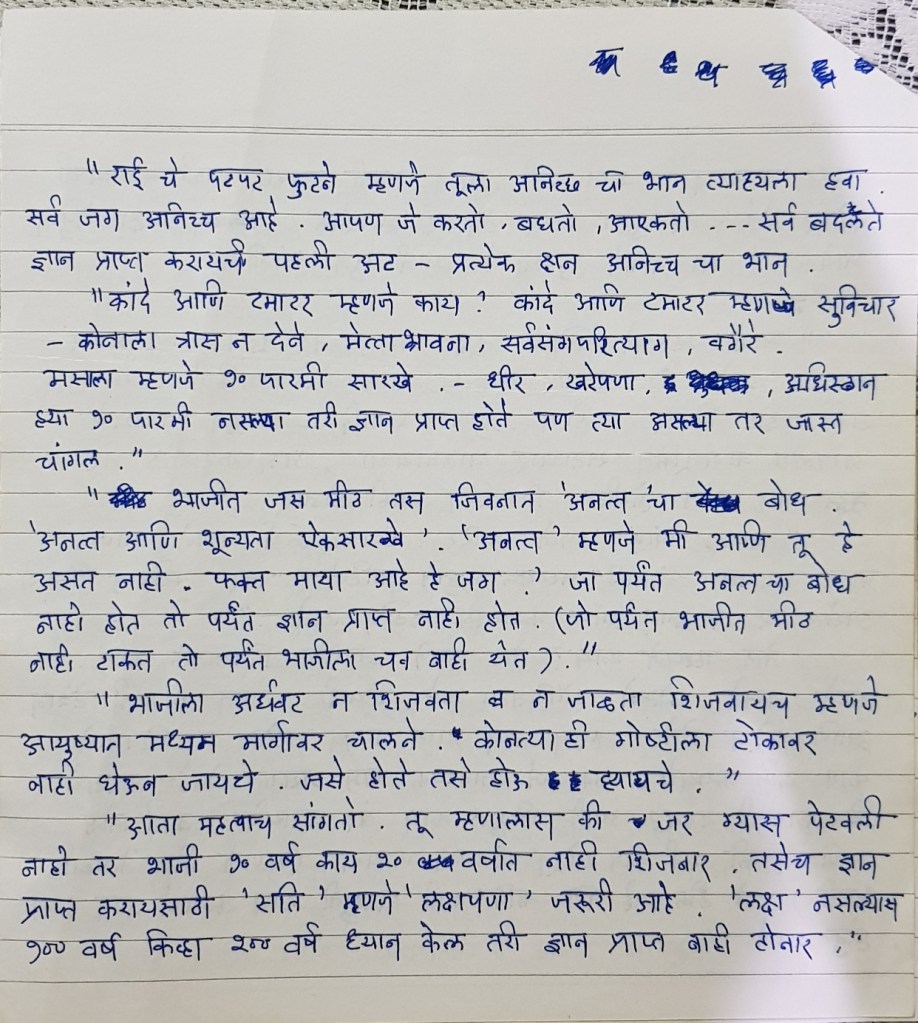
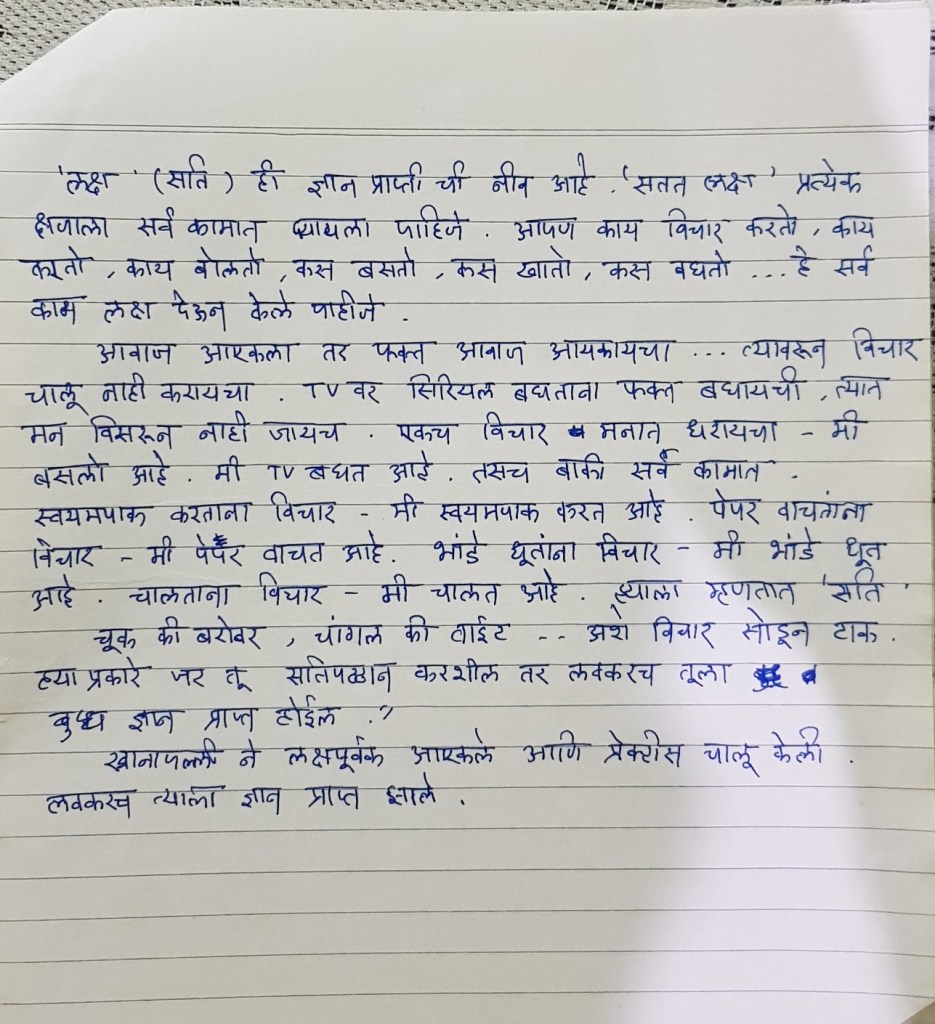
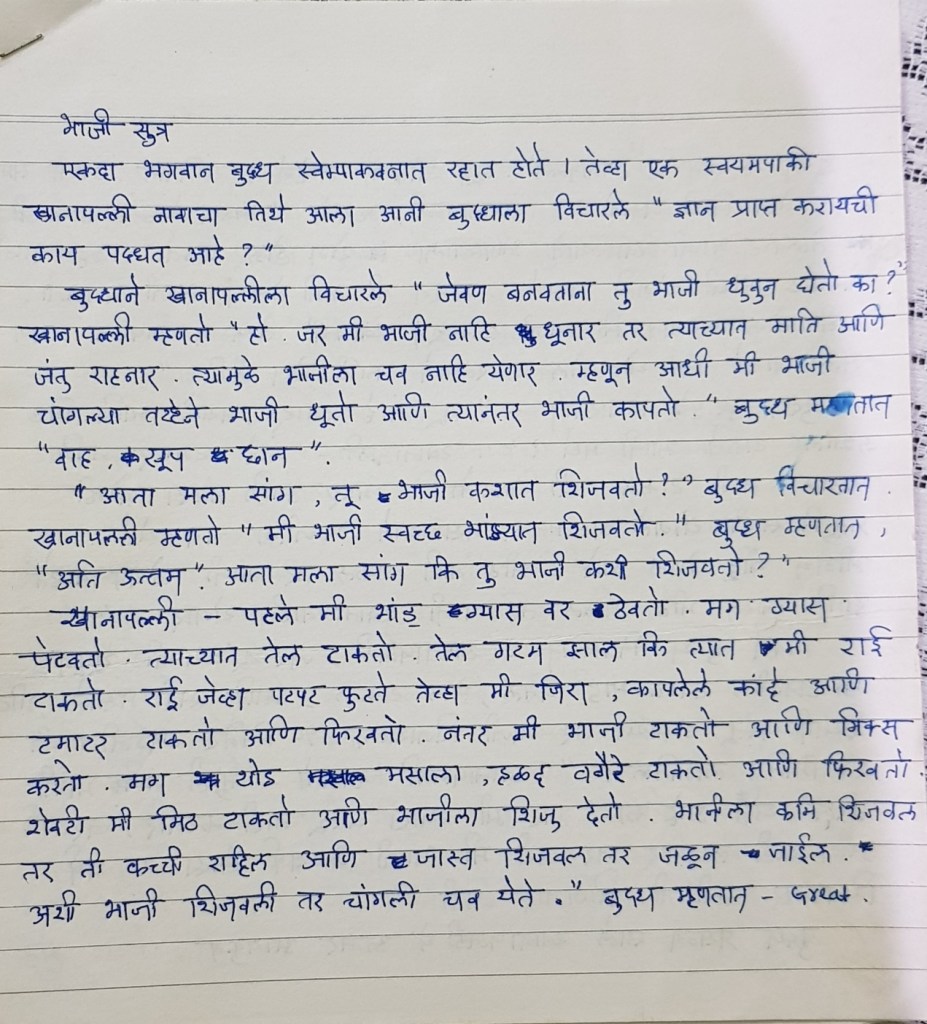
The Bhaaji Sutra (Marathi)

I wrote this sometime in 2003-04 after having attained a significant confidence in having understood the Buddha’s message as well as his teaching style. Further, I was having difficulty in explaining the realization to my family – my mother and father and sister. So I decided to write this “Bhaaji Sutra” – an imaginary conversation of the Buddha with one lay disciple.

I wrote this deliberately in Marathi so they could understand. I don’t remember whether I gave it to them to read but yesterday, my mother shared that she found those pages somewhere in the house and said she liked it very much and would share it with other women at the Buddha Vihar she visits.

I felt good that she found and read the story and also liked it but was disappointed when the writer was more appreciated than the writing and its meaning. It is not easy to teach Buddha’s message.

Meanwhile, you can enjoy the story. Bhaaji in Marathi meaning cooked vegetables.

What is Zen Counseling?

I would define counseling as a process in which one human being helps another to solve a personal problem or discover a direction to solve a troublesome issue. There are many kinds of specialized counseling – relationship counseling, career counseling, psychological counseling, parent-child counseling, teenage counseling, and so on.

In all counseling, it is assumed that the counselor has more experience, more knowledge, more insight about a subject and is therefore in a superior position than the client. One goes to a counselor expecting to receive customized advice or personalized solutions from someone who knows the patterns of such problems and the generic solutions to those. And what does the counselor do? He hears the problems of the client and maps it to some similar problems in his past experiences, searches for an appropriate solution for that and gives that advice to the client.

A canned solution can never solve a unique problem.

But most counselors learn only canned approaches and solutions which they offer to their clients – because those solutions are in vogue, in current fashion or currently acceptable.

But let me ask a question. Can one person help another person just by virtue of being another human being? Without being an expert, without being more experienced in any skill or domain? Is there a quality in which every human being in equally skilled? What is the action that every person can do equally well – in all circumstances, always, in any relationship, in any environment, through any means of communication?

Yes, there is this skill, this ability, this faculty which is equal in all human beings – it is not thinking, it is not talking, it is not walking or acting

It is LISTENING.

Anyone can listen, young or old, fair or dark, male or female, today or tomorrow, 10,000 years in the history or 10,000 years in the future, anyone can listen.

Everything else might be different, the way we speak, the way we think, the language we speak or the content of our thoughts. But the way to listen cannot be different in any age for anyone. Every human being can listen.

And with listening, one human being can help another. Anyone can help anyone without any special skills on knowledge or expertise or experience. The power of listening to solve problems is the most under-appreciated power in human beings. In fact, listening is not considered to be of any significance in daily life. I say that almost all human problems arise because we do not listen enough, and we do not listen deeply.

How does listening help another person?

  1. Listening conveys acceptance: As human beings, we are unique in our thoughts, likes, dislikes, experiences and desires. We want others to accept us as we are. Listening to another shows that you accept the other person as he/she is.
  2. Listening does not judge: Given a person’s problem or situation, if we judge that as good or bad, it puts an end to the discussion. Any judgement is a conclusion and stops further conversation. You don’t feel understood if the person listening to you is constantly judging you. But when you listen attentively without judging then the speaker opens up. He/she starts to trust you and opens up more.
  3. Listening gives space: In today’s world, everyone wants to speak and get his thoughts out there in front of other people. Advertisements, slogans, speeches – everyone seems to be speaking and no one seems to be listening. This suffocates the mind. Mind needs space for creativity, for problem solving. But when there is no space, mind reacts, gets into a survival mode and deteriorates into emotional outbursts. When you listen, it gives space for the other person to look at his own thoughts, to unwind, to untie the knots within.
  4. Listening is compassionate: When you listen, you show an interest in the other person. Since you want to know more, you ask questions, you clarify things. All this displays compassion and empathy towards another.
  5. Listening is freedom: In normal conversation, there seems to be a compulsion to say something, to respond with an answer or a suggestion. But when you are listening you are free. You don’t have to respond to any pressure. Listening is therapeutic. Listening is relaxing.

Zen Counseling is based on this power of listening to help other people solve their problems. It combines listening with the fundamental insights and principles of Zen Buddhism to provide a very potent and very effective way to problem solving.

Zen Buddhism considers every human being to be a Buddha.

A Buddha is an awakened one, one whose mind is awake. An implication of this premise is that for any person who as a problem, the solution to that problem is within his own mind. No external answer will suffice.

Therefore, in Zen Counseling, the first rule for a counselor is to consider the client as a Buddha. And the second rule is not to offer any advice.

The Zen Counselor simply listens in a relaxed manner. As the client talks about his / her problem, the Zen Counselor continues to listen. And in this listening process, in the space that is created, in the acceptance and the non-judgmental atmosphere, the client starts to unravel his problem in his own awareness. As the problem becomes clear, the client will start to see the solution emerge.

The life situation of the client, the experiences of the client and the specific attitude and personality of the client determines the solution.

Any solution offered by the Zen Counselor is not going to be effective because it will be colored by his own biases and past experiences or no experiences. Therefore, a Zen Counselor never offers any advice. And that is the power of Zen Counseling.

It is effective in any circumstance, any age, for anyone, young or old, for any problem – career, relationship, finance, goal setting, sometimes even physical pain.

Zen Counseling is the way of the Buddha. It is surprisingly effective in solving problems or helping people find a direction.

Meditation Begins After the Mind is Silent

Meditation today has become a tool, a technique. People talk about meditation as a way of controlling their mind, or calming their mind. There are hundreds of techniques that masquerade as meditation techniques. And there are dozens of teachers teaching meditation and several hundred books on the subject.

Is the goal of meditation really to achieve a silent mind?

It is possible some people might experience a stillness in their mind during meditation as thoughts die down. This is what they assume to be the fruits of meditation. But can they carry that stillness through the day? It is difficult. The daily life once again creates disturbances in the mind, stokes the fires of thought and the mind is once more in chaos. So the person thinks he must deepen his meditation practice and meditate harder, put more effort in his meditation, resolve more strongly to silence the mind, and so on. Then there are those people who cannot achieve any form of stillness of mind during their meditation and they think meditation is useless or they are useless.

In all this merry go round, somewhere the essence of meditation has been lost.

For a moment, let’s keep the word meditation aside and look at life in a simple way. If your mind is agitated due to some reason, will you be able to sit quietly for some time? It would be difficult. Thoughts would come and go and suddenly you will find yourself acting on some thought or saying something or thinking even more. Your mind is not silent. This is the normal life. We go through our day from one thought to another, from one action to another, fueled by inner thoughts or external stimulus of what you see, what others say to you, what they want you to do, and so on.

Now supposing, it is early morning or late evening or a time where you are not disturbed and you are all alone. And you are not doing anything special. How long will you be able to sit like that without your mind wandering all over the universe? It is certain that suddenly you will find yourself doing something. Most people don’t like that aloneness with their own minds and want to keep their mind occupied – for instance watching television or watching movies or doing some hobby work.

Is your mind really silent during these activities? No, it is not. It is merely guided by the flow of images and sounds so it does not have to be on its own. The television soap or the movie is telling a story and your mind is following that. If you are working on your hobby, your mind is working on a goal and therefore is seemingly silent.

But as soon as that external support is over, the mind is active once more and starts to wander and feel agitated. This is the normal human state and nothing to worry about. But some people’s minds are too troubled by old memories or habitual emotions that their mind wants to do something about it – to put an end to their suffering.

This is where, the mind starts to believe that meditation will help silence their mind. But this is a big mistake.

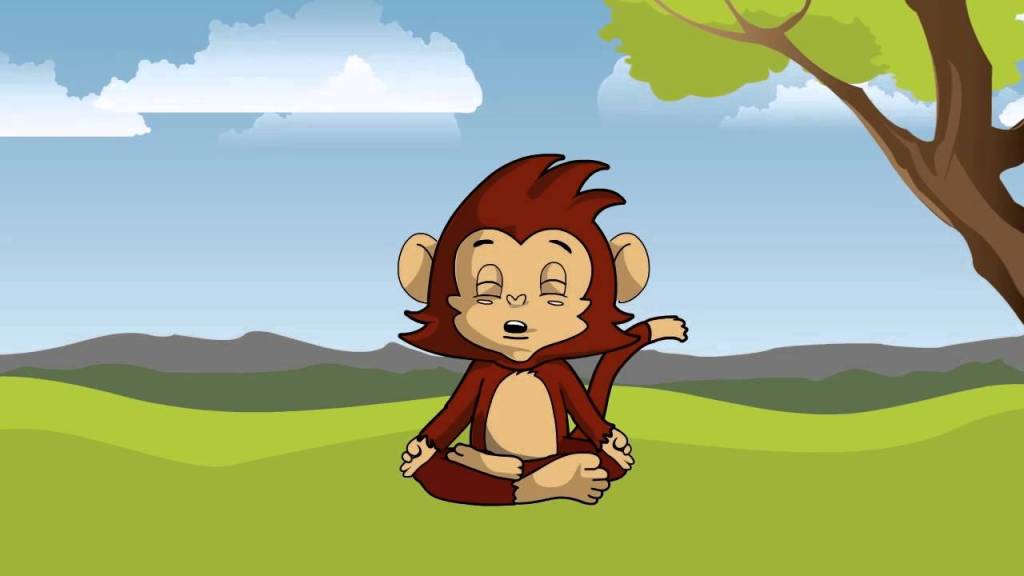
Meditation just becomes one of the ways to keep the mind occupied, like TV or movies. The mind wants to struggle with itself and quieten itself. So it goes around like a dog trying to catch its own tail. So for some time, the mind becomes still but as soon as the meditation session is over, its back to the normal monkey mind once again. It’s like you had put a monkey in a suitcase for 20 min and now opened the suitcase. The monkey would go crazy as soon as it is out of the suitcase. Sometimes, the monkey falls asleep in the suitcase but wakes up after some time.

The point is, so long as you have a monkey, there is no meditation.

There is meditation only when there is no monkey mind. This is the meditation after the mind is silent. This is the real meditation. It is sitting quietly doing nothing.

Dogen, before he became enlightened, had a doubt as to why masters even after attaining enlightenment still practiced sitting meditation. He was totally confused and it because a big koan for him. If meditation is to attain enlightenment, then why meditate after you have attained it? And then he cracked the koan and became enlightened.

So if you can understand this point, you will have a completely different view of meditation. True meditation can happen only after you have a silent mind. It will be difficult to accept this view because the mind then has no recourse to silencing itself (keeping itself occupied in other words) but to face the monkey within.

All efforts to silence the mind, including so called meditation are simply the work of the monkey mind. So now how will you attain a silent mind? I will leave you with that question. Best wishes.

May you realize your enlightenment.

Zen Counseling Training

This is a famous zen poem and has been one of my favourites for the many years that I have been studying zen. I really thought I had penetrated to the core of this poem. But that was not true and I realized the true meaning of this poem in the Zen Counselling course I attended during 15 to 18 Aug at the Integral Space, Lower Parel, Mumbai.

The training was organized by Loving Foundation’s Dr Ronak Gandhi, a four times black belt in Zen Archery and who is on a mission to spread love. Zen is not so well known in India and apart from Osho’s followers, not many profess to follow it. There are no zen monasteries to talk about, no zen masters as such, although I remember having been to Bodhi Zendo, a zen monastery near Kodaikanal and met Zen Master Ama Samy, but that’s the exception.

So I was really intrigued with the Zen Counselling course that I came across on Google and instantly felt like I should go there. But I had my reservations. Because I knew I had a deep understanding of zen from my study and practice over 15 years and so had a doubt whether this was true zen. Seeing that the teacher was a Japanese person added to the mystique of the course. After speaking with Dr Ronak, I confirmed my participation.

Kenichi Ishimaru is the founder of Zen Counselling and there are only a few videos with him speaking on You Tube. The thing that caught my attention was the premise of Zen Counselling that every client is a Buddha. And this is a high class understanding, in fact the highest understanding in Zen. So I went for it.

With Dr Ronak Gandhi and Kenichi San and Kyoko

And what a time it was! Those four days with Kenichi San and the 22 fellow students. I solved all my problems, hesitations, mental blocks, diffidence, attitudes towards women and discovered my true way. I learnt more from the live experience of listening to the master, watching his demonstrations and his answers to our questions than in all my readings of zen of the last decade. Kenichi san lives zen and teaches zen. And he does not teach theory because zen is a matter of experience so all the teaching was actually learning through personal experience. 

Standing from left: Rinkal, Kyoko, Aabhas, Alpana, Meghna, Ridhima, Sanjeev, Ashish, Mona, Shruti, Pankti, Reyes, Dixit, Subodh. Sitting from left: Zia, Geet, Gauri, Antara, Kamalika, Reet, Namrita, Aditi

Zen Counselling is the most powerful technique (if one can call it a technique) to solve any problem of any individual. When an individual has a problem, he suffers. When the problem is solved, he is happy and free. But in contrast to other forms of counselling, in Zen Counselling, the counsellor does not give any kind of advice. The premise is very clear and it is non-negotiable – the client’s problem can be solved only by the client. The counsellor can only support with a few intelligent techniques based on listening, being relaxed and asking questions to clarify the problem. In the process of Zen Counselling, the client solves the problem for himself by clarifying it in his own mind with the support of the counsellor. And I have experienced this magic of solving problems without doing anything, in all my practice sessions.

This experience of Zen Counselling has given me the power and confidence to go out and help others. I had reached a conclusion long time back that people are not listening. And therefore, I always hesitated to speak to anyone about zen and my work on Big Picture Zen. But now with all my problems solved, I am free to talk and free to listen.

I have always been a good listener but that was not enough. But the listening approach that I learnt in Zen Counselling was nothing short of magic. And I realized that the way to another person’s heart is through our ears – through listening. There is no value I can place on this skill and technique. This is priceless. This skill is what makes a real loving human being.

To me, this clarified to me many zen stories and also the way Buddha would have helped people, and not just theoretically but now I can also do it. All the disconnected pieces in my mind have now connected into a whole. Now I can truly see with my ears and listen with my eyes.

Ever since I had my awakening experience around 2003, I have been very keen to share it with others and get others to become curious about it and strive for it. But nobody listened. And I had almost given up. I was also thinking upside down about helping others. The reason I was reading all kinds of books on human psychology was to be able to learn how to help others. But that’s not the real way.

My zen mind was always against learning things to teach others because the end goal was to drop all knowledge. So how can I help someone drop all knowledge by giving him knowledge of any kind – zen or otherwise? I was caught in this koan for many years.

Zen Counselling opened me up to direct experience and then at last, I reached the point where I had nothing to say anymore. This was like a second satori to me. It became a clear fact not a statement of belief that every person is a Buddha. Now knowledge or no knowledge is no hindrance. Everything is perfect as is.

Sitting quietly doing nothing, the Zen Counselor listens relaxed, the client shares his problem and the solution appears by itself

The Five Questions of a Sincere Seeker

meditation-14643615474iA

A sincere seeker of truth is someone who is actively seeking for the truth. A sincere seeker is someone for whom discovering the truth is a very important and central goal of his life. So a sincere seeker will search for the truth in books, in gurus, in meditation and in conversation with others. A sincere seeker is serious about his search because he knows that the truth will give him the meaning of his life. This is not to say that a sincere seeker’s life has problems and therefore he is seeking the truth. That may be the case. But what I am saying is that a sincere seeker realizes that life must have something more to offer than the routine struggle for survival and he is seeking for that something beyond the ordinary.

Many people have written about this subject and a sincere seeker would do well to read all such literature. However, reading must be done with an open mind and not with a biased mind. This is an important point because any sort of bias – religious or personal – distorts the truth.

Many gurus speak on the subject of truth and today an unlimited amount of videos and audios are available on the Internet that the sincere seeker can access. But the very fact that so much material is available makes the task even more difficult because now the seeker has to literally search for the proverbial needle in the haystack. This cannot be a practical approach since it would take many lifetimes to read, hear and watch all the material on the Internet.

The benefits of reading and hearing from others cannot be discounted in any way. However, a sincere seeker must realize that the real work is inner work. In ancient times when there was not so much reading to be done, the seekers would only approach the task through the means of direct practice. And direct practice is even now the only way to self-realization. Mere reading and listening to Gyan will not help in any way.

I am recommending the following five questions that a sincere seeker of truth must ask of himself during his search.

WHO AM I?

This is a central question that appears again and again in most spiritual advices given by teachers across time and space. And no doubt it is the most important question to answer. However, note that the answer is not going to be in words because the answer is an experience or a direct realization of who you are. Later you might put it into words to convey it to another but those words will not transfer the realization to another. This has been the chief hurdle in the relationship between teacher and student.

So how do you ask this question? Who am I? What answer do you get? Probably you will say you are your name. And that is a good place to begin to discover who you are not. You could have any name but your parents gave you that specific name and now you think you are that. Then you might say you are your body and your mind. But please realize that the body is made of what you eat and the mind is made of what you sense (see, hear, smell, feel) and remember. Both body and mind will return to dust when you die. So is that it? If death really ended everything then there is no requirement for the spiritual search and no point in asking the question who am I. But if you simply think you are the immortal soul that keeps changing clothes in every birth, then you are no closer to answering the question than saying I am my name. Saying something and experiencing something are two different things. Saying something does not change your life. Anybody can say – I am the soul. But does it change his life? No. So remember that the experience of who you really are is important because that has the ability to change your life, your viewpoint and your experience. Remember also that going in search of the soul is another futile effort because you do not know what it is. How can you search for something you know nothing about. So there are very many complications in this question and a sincere seeker must be aware of them and not fall into their trap.

So a good way to answer this question is not to answer it but keep the question in mind as you go about your daily life. Do not answer but strengthen the question. Translate the question into the activities you are doing. Who am I? Who is walking? Who is speaking? Who is reading? Who is thinking? If you do like this for a long time, the answer might dawn on you suddenly. You will know for yourself.

Who am I is a very powerful and effective question. Teachers such as Ramana Maharshi and Nisargadatta Maharaj have taught their students using only this question as the instrument.

Who am I is the key question but it can also be approached in a gentle manner by asking four other questions – where am I, what do I really want, why do I want it and how do I get it.

WHERE AM I?

This question is a good starting point for all those sincere seekers who find the who am I question a little daunting. Where am I does not literally ask which city or which house you are in, but refers to the context in which you find yourself. Where am I is about observing the world around you, observing what people around you are doing and what they are busy in. Where am I is a question about what age and time you are living in – what is the economic, political, social and religious environment, what is the prevalent psychology of people in the world.

If you are here, it means you are a part of that environment. You have been brought up in that environment with those beliefs and thoughts. Where am I in a sense is the reflection of the question who am I in the outer world. The whole world is reflected in you and you reflect the whole world. You may not be able to understand this at the moment but by understanding the world, you can get some understanding of yourself. Know as much as possible about the world – the way people live, the way people relate, the way people fight with each other, the way people express love, and the way people try to search for truth. Learn everything you can. Knowing where you are gives you a big picture perspective on everything and also your search for the truth.

J Krishnamurti in his talks usually pointed out to the things happening in the world. He was trying to tell his audience where they were and how the world reflected their inner mental turbulence. 

WHAT DO I REALLY WANT?

The next question is what do you want. And I want to break it into two questions – what do you want and what do you REALLY want? There is a big difference between the two questions. For the first question you could answer that you want money, a good job, a good spouse, a good life in general. Most people do not go deeper into this question because in order to get what they want, they have to spend all their energy. But as a sincere seeker of truth you must ask the question what do I REALLY want. Behind all the wants and needs and desires, what is it that I want ultimately? Is it happiness? Is it peace of mind? Is it supreme bliss? Is it self-realization? Is it truth?

Whatever it is that you really want, you must be able to explore that and make sure that it is something you truly want. When this is reasonably clear in your mind, then your actions will start reflecting your choice. You will start moving away from what you want superficially to what you want deep down. Allow this process to happen.

The Buddha talked about how our desire – what we want – is the root cause of our suffering. 

WHY DO I WANT IT?

This question is to be used in conjunction with the question what do I really want. The why do I want question helps to sort out the genuine want from the superficial want. For every answer you give to the question what do I want, you must ask why do you want it. This will take you to deeper levels of your psyche. However, beware of fooling yourself. If you are not honest with the answers to why you want it, you will not be able to go deeper. The why question is like a pickaxe which helps you to dig into the what question. The why question can hurt if you have created layers and layers of pretense about who you are and where you are and what you want. Do not underestimate the why question. It is a very powerful tool and you must develop your skill in using it.

The 5 Why technique was popularized by Toyota Motor Corporation as a means of getting at the root cause of any problem.

HOW DO I GET IT?

When you get the answer to the question of what do I want and why I want it then you can decide on how you can get it. The how is a conscious effort not dependent on vague expectations from the others in your life and God or destiny. A sincere seeker must realize that if one wants something, then one must consciously work on it without any complaints and blame. He should not expect anyone else in the world to support him in his task. He is truly alone in his search. Whatever path he chooses, he must take complete responsibility for choosing it and have no regrets on choosing that. He must accept whatever is the outcome of the path he has chosen without trying to manipulate the results.

From an awakened perspective, the how really does not make sense because the journey is really from the here to the here. How does one get from here to here or from the present to the present? There really is no way because you are already here. The problem is you do not know it and the journey is from ignorance to enlightenment. And it happens in an instant after a long period of effort. Sounds a little contradictory but that’s the way it is.

So the above five questions are powerful instruments in the toolkit of a sincere seeker of truth.

May you realize your true self.


Being Dharma

41ULCnFkFrL

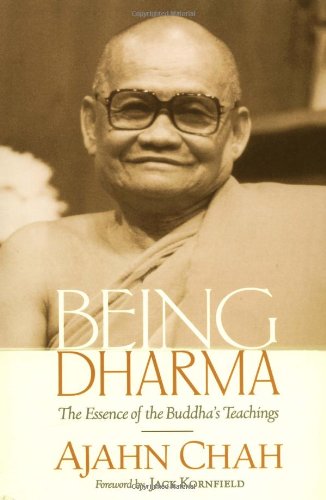
Being Dharma – The Essence of the Buddha’s Teaching by Ajahn Chah

Buddhism as we know branched out into 3 main followings, depending upon the inclination of the followers. The Theravada or the path of the elders is considered to be the original teachings of the Buddha, probably because the monks who follow it stick to the same rules as set during the time of the Buddha. They live in the forest, go to the town to beg for food and spend the day and night in solitary meditation. Other major branches include the Tibetan Buddhism, which takes Buddhism even beyond the teachings of the Buddha and Zen Buddhism, which makes no bones about its intention of pointing to the reality directly and nothing else.

Ajahn Chah was a renowned teacher of the Theravada school. He lived in the forests of Thailand and is the teacher of many western Buddhist monks. The hallmark of a good teacher is his ability to make complex theory into simple ideas and Ajahn Chah is one of the best teachers in this.

The book Being Dharma is a succinct exposition of the whole teaching of the Buddha. It covers just enough for any sincere seeker to grasp the insights. Ajahn Chah does not spend time in metaphysical discussions but directly addresses the heart of the matter. In this regard, he resembles a zen master.

The book is organized in the following chapters – hearing dharma, understanding dharma, practicing dharma, seeing dharma and being dharma. The contents are also as easy as the chapter titles.

Just like in the meditation practice, you are told to return to the breath whenever the mind is distracted, this is one book, I return to whenever I get lost in multiple other books. It always helps me to regain my center.

Quotes from Being Dharma

First one learns Dharma, but does not yet understand it; then one understands it, but has not yet practiced. One practices, but has not seen the truth of Dharma; then one sees Dharma, but one’s being has not yet become Dharma.


When there is no person, there are no problems. There is no need for solutions, because there are no problems to solve anymore and no one to solve them.


No matter where you are, no matter what your situation, it is possible for you to be practicing Dharma well


We are called Joe or Alice or perhaps Prince so-and-so, but if we realize the Dharma then we too are Buddha, no different from him.


That which we are talking about does not arise and does not cease. It abides as it is. Or to put it simply, it is not born and does not die.


People are born with physical form and mind. In the beginning these things are born, in the middle they change, and in the end they are extinguished. This is their nature. We can’t do much to alter these facts.


Renunciation – The Last Step

171666658-56a0c4c95f9b58eba4b3a8a2

The most debated topic when it comes to spirituality is renunciation. No wonder, there are many misconceptions about it.

Renunciation, the way it is understood by most people, is the act of leaving home and family life in order to pursue the spiritual life – to live the life of a wandering hermit in search of the ultimate truth. The central question is whether it is necessary to renounce worldly life in order to achieve enlightenment.
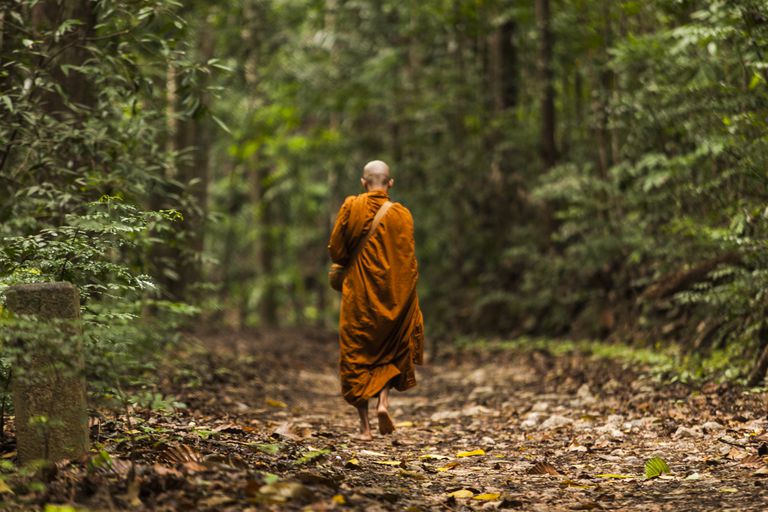
Before we enter the debate on the pros and cons of renunciation, we must understand some basics about enlightenment. Enlightenment is the same for all human beings. In fact self-realization is about discovering your true self, beyond the illusory person that you think you are. So the question is about the approach – whether leaving family is going to help you to achieve that.

Let’s pause for a moment and reflect on the situation. We know that we have to be born in a family setting. No human being is born without a mother and a father and if he has grown up to get enlightened, then we can be sure, he or she has spent significant time in the care of the family and society. If there was no family, no society, then there would be no enlightened individuals also.

Society at times or rather at all times is a place full of chaos, where every individual is seeking his self-centered happiness and does not hesitate to harm others and cheat others to get what he wants.  Children are prepared through education to get ready to enter the society and sustain its existence. Customs of marriage and rituals of coming of age are all significant for the sustenance of the society.

One cannot force anyone to exit the society, except as an outcast for breaking some of the agreements of the society. So by default, everyone is condemned to live in the society despite its cruelties. All one can do is to further one’s own goals, hoping one gets through life without serious incidents. The whole desire for enlightenment has no place in this structure. Society does not encourage the seeking for truth. Its existence depends on the illusion of progress and civilization.

A PRACTICAL SOLUTION

When an individual who perceives these illusions promoted by the society, he tries to understand what is going on. He comes across other individuals who talk of a true life, self-realization, etc and he is intrigued. He tries to find answers in the society but quickly comes to the conclusion that nobody knows anything about it.

His mind is boiling with the question and he is not finding any outlet because he has to fulfill the responsibilities of his life. He cannot focus on anything unless he gets an answer and therefore needs time and space to go within to explore. However, life has no mercy. It is unrelenting in its demands for survival and sustenance of the family and societal institutions.

Therefore, the only practical way out for a person is to renounce the family and go off to live alone in search of the truth. This has been happening in India throughout history. All those who had this inner calling have promptly renounced their worldly life and went into the forest. Whether they were successful in their search or not is another question.

The search for one’s true self requires meditation for long periods so if you are sitting and doing nothing while at home, other people will think you are lazy and a shirker. They do not appreciate the inner calling of the person. On the other hand, if you are in the forest, away from the home life, then  there is no one to disturb you in your meditation. You have voluntarily retired from all responsibilities so you can focus singlemindedly on your goal.

The Buddha used to say that going from the home to the homeless life was the fastest way to self-realization. Hundreds and thousands of young men left their homes to join the Buddha’s Sangha. Even today, many people leave their homes and join a spiritual order, whether Buddhism or Christianity or Hinduism.

Point to note is that if a person is leaving home just to avoid the arduous responsibilities, then that is not the right renunciation. It is right renunciation only when the individual’s intention is to realize his true self. Only then is the renunciation a practical choice because there is no other way to live in the society and seek the higher reality.

So the question naturally arises. Is enlightenment impossible without this renunciation of worldly life? It is not impossible. There have been many cases of family people getting enlightened by hearing the teachings of masters.

In fact Gurdjieff actively promoted the fourth way, a way of self-realization while living the ordinary life. He was of the opinion that the situation one finds oneself in in one’s life is the most appropriate situation to start the struggle against sleep in order to awaken.

The truth about awakening is one of conditions. If a man is living in conditions that are conducive to enlightenment, then it will happen whether he is living at home or in the forest. And if the conditions are not suitable, then awakening will give him a slip even if he has renounced worldly life.

THE MIDDLE WAY

So is there a middle way between renouncing and not renouncing? Yes, definitely there is a way for the intelligent person who knows the conditions to be created. These conditions include first and foremost unobstructed time and space for meditation. If a man is able to organize this time wherein he is able to devote time to meditation with the sincere aim of awakening, then he will be in a much better position than a man who has renounced the world and is living troubled with the thought of where to get his next meal in the forest.

True renunciation is the renunciation of the idea of ‘I’. This can be done anywhere. The only problem of living in the society is that others remind you of being you all too often for you to practice the inner renunciation of ‘I’. However, for a person who is able to maintain self-awareness in all his worldly interactions, he will not be troubled. Within his mind, he has renounced while he is still performing ‘self’-less actions in the world outside.

If at some time, the awakened person wants to really change his way of life and live away from society, then the outer renunciation is only a formality. True renunciation has already happened when the person stopped identifying himself with his body and mind.

Therefore, it can be said that renunciation is the last obvious step rather than the first courageous step.