All posts by Big Picture Zen

Unknown's avatar

About Big Picture Zen

Center for Self-inquiry and Awakening is a space for inner exploration and self-realization.

Where There is a Will, There is a Way

maxresdefault_1_orig

One day a thirsty crow was searching for water. It found a pitcher in which there was water but could not drink from it since the water level was very low. So he looked around, found some stones and pebbles and dropped it into the pitcher. This caused the water level to rise and the crow drank the water.

We all know the story of the thirsty crow – one of the most famous of Aesop’s fables. The moral of the story is said to be – Where there is a will, there is a way.

While this story has been in our collective consciousness for so many years, I doubt if many would have listened to it with a critical ear. I really wonder whether the story can really be true in a practical sense, even if the concept is palatable scientifically.

Imagine a round pitcher with a little water. I really doubt that by putting in pebbles and stones the water level will rise so much for the crow to be able to reach it. Beyond a point, the water will stay within the gaps between the stones. Adding more stones will not help at all.

This raises a number of questions which must be answered to justify the story

  • What was the shape of the pitcher?
  • What was the initial water level?
  • What size and weight of pebbles can a crow pick up in its beak?
  • How many pebbles are needed to be put in to raise the water level by one centimeter?

Even if we are able to get some answers to these questions, I am unable to come to terms with the moral of the story. Why is the moral always – where there is a will, there is a way?

I would say the following morals would make more sense

  • Necessity is the mother of invention
  • Think out of the box
  • Never leave a pitcher with water outside, a crow might put stones into it.
  • Jugaad your way to get what you want

I am shocked that we tell our children stories and don’t ask them to think critically on them. We even given them pre-cooked conclusions. Not only that, we also never pause to consider the truth of what we have been told as innocent stories.

By the way, some scientists went ahead and did an experiment with crows and pitchers and found some interesting results.

Refer
Research Paper on the Experiment done on Crows
Video of the Study

Genuine Spirituality is an Action not a Reaction

DSC_0020

People who have turned “spiritual” need to consider this very important aspect.

By spiritual, I am referring to people who engage in reading spiritual books, going to a spiritual teacher, spending time at a satsang, joining a spiritual club or going for a meditation retreat and in general who think of themselves as “spiritual” not ordinary. There are people who engage in such activities on a regular basis and for whom it has become a part of life in terms of hanging out with similar individuals. Such people are always quoting some saying from the sacred texts, or something they have read or something their guru has spoken or sharing some of their “spiritual” experiences or simply complaining that the world is going to the dogs because of the lack of spirituality.

For such people, it is quite important to honestly clarify to themselves their true motivation for turning spiritual.

We can distinguish three contexts. First, there is the habitual spirituality, which is nothing but a habit learnt from childhood about following certain rituals and pujas. You see your mother and father going to the temple or church and you have learnt to do that. Some of you might choose different Gods and Goddesses to follow as you grow up, depending on your affinity, but it is a habit nonetheless. There is no thought behind that habit but just a belief. Seeking blessings from every temple you see while traveling is a sign of this habitual spirituality.

Second, there is the spirituality that emerges as a reaction to life. People, who have been deeply hurt in life due to certain experiences, turn to spirituality for solace and comfort. People who are living a hard life turn to spirituality with the hope of finding some happiness. Such people usually form clubs and groups where they can find similar people and get the opportunity to feel related. The interest in spirituality is sustained so long as the circumstances in life remain the same. Because life is full of suffering, people seek happiness through spirituality. They read books, memorize quotes from it, go to gurus and practice meditation. If the life was good, such people would not be interested in spirituality at all. People remember God only when life becomes a challenge. So this kind of spirituality is a reaction to life.

Genuine spirituality is not a reaction to life. It is a positive action towards living a life full of understanding and happiness amidst all the challenges and hardships. Genuine spirituality seeks to understand and act from that understanding. It is not afraid to be alone and does not seek comfort in a group. It does not run around from book to book or guru to guru to speak the latest fashionable truths. Genuine spirituality does not make a display of its genuineness or spirituality. Therefore, it is difficult to spot. A completely ordinary being can be the most developed spiritual person without anyone being aware of it.

The road to genuine spirituality starts from the inner recognition of our habitual or reactive spirituality. When we realize that we are only calling ourselves spiritual and want to be recognized as such by others, and when we see the utter un-spirituality of it, we are at peace with ourselves. Then we can be genuinely spiritual even while doing the most ordinary things in life and are able to handle the most difficult situations in life with ease.

The Emperor’s New Clothes

theEmperorsNewClothes

The emperor’s birthday was nearing and many celebrations were planned in his honor. For this special occasion, the emperor wanted to look his best & wanted a new dress stitched for him. Tailors from across the kingdom were invited to present their designs. Although tailors came from far and wide, the Emperor did not like any of their designs. He announced a big reward for the person who could make the most unique dress for him.

Then one day a stranger appeared in the court & claimed to have the most unique fabric in the world with which he would make the emperor’s birthday suit. The specialty of the fabric was that it could be seen only by one who was wise and could not be seen by one who was foolish. He produced a sample of the fabric from his bag and displayed it to everyone in the court. Although no one could see or touch the fabric, they all exclaimed that they had never seen such a thing. Even the emperor could not say anything for fear of being discovered to be foolish. He had to agree that it was indeed a special fabric most suitable for his birthday. The stranger was then allowed to spend several weeks weaving the imaginary clothes.

On the day of the emperor’s birthday, he got ready to wear his unique clothes. He got down to his inner wear & the stranger put the new clothes on him. Although no one could see the clothes they all appreciated the dress because they did not want to appear foolish. Even the emperor could not say anything. He even rewarded the stranger for his superb work.

Dressed in this invisible suit, the emperor rode his royal horse through the city wearing acknowledging the birthday wishes of his people. All his citizens, seeing the emperor wearing his inner wear on his horse, were in a shock. But no one said anything for fear of attracting his wrath. Suddenly one child in the crowd started laughing & pointing to the emperor said – Look there. the king is not wearing any clothes. The king is not wearing any clothes. ha ha hah!

The emperor immediately realized the truth & rushed back to his palace in shame.

In the very effort to appear wise, shines our stupidity.

Life is such. When there is a great desire for something, it makes us blind. We ignore the truth staring in front of our eyes. We do not believe our own intuition but believe what someone else is saying.

Fear of being termed foolish makes us do things & say things which are contrary to what is. We accept other people’s interpretation of the situation even if we are able to see the same situation differently. The underlying assumption is that the crowd cannot be wrong, all at the same time.

The crowd on the other hand is afraid of itself. So only a small child, pure of heart, without any preconceptions, one who has not yet become a part of the crowd, is not afraid to speak the truth.

We are all like that Emperor who goes about the world displaying our good qualities, nobility, holiness, acumen and spirituality without realizing that others, even though they may see through our nakedness, pretend to see our clothes.

Nakedness is our truth. Even if we wear layers of clothes, fundamentally we are naked inside. How can we ignore that fact? When all the traditional dresses and functional uniforms are taken off, we are all the same.

Going further when we divest ourselves of our stories about who we are in terms of name, family, education, designation & achievements; fundamentally we are pure emptiness, the stuff of what existence is made of. From this place you will never see any clothes however hard someone like that stranger would make you believe that the clothes exist. Because now you can really see and the child in you starts laughing.

The Presence of the Absence of Ego

presence

There is much going on in the world with the ego.

People with ego are supposedly a nuisance. People without ego are supposed to be saints. Some people are seeking to destroy their own ego. Some are engaged in destroying other people’s ego. What is this ego? Does it really exist?

We can all agree that the ego cannot be seen directly. You cannot look at a person & know whether he has ego or not. Ego is supposed to be seen in action. It is implied to exist in a person when you observe his behavior or reactions to other people. Pride, Anger, Jealousy & other outward expressions are taken to be the result of having an ego. But the ego is never seen directly.

With so much talk about the ego, people already believe they have a personal ego. Not just that, egos are measured in sizes. There are tiny egos; there are small egos; there are large egos & there are gigantic egos. Egos are also measured in the amount of possessions one has, the type of car one drives, the type of house one lives in, and even the size of body parts.

There is much going on in the world with the ego.

Some people are not ashamed of their egos & are happy to increase it everyday. They believe ego is the source of their happiness. Some others who believe or are told that ego is the source of their suffering start to follow practices to destroy their ego. They understand that to be free of anger, hatred & other unwanted emotions, their ego must be destroyed. There is no dearth of teachers or ego fumigation experts who come up with meditation practices & other therapies to help their disciples to get free from ego.

Some wise men even point out that the whole attempt to get rid of the ego is an action of the ego itself so you are only boosting it in the process of eliminating it.

There is much going on in the world with the ego.

The point to realize is that the ego is just a name given to certain outward expressions of people or their behavior. These expressions are usually reactions to circumstances or to other people. And reactions are a natural process. When it rains, clothes get wet. When your car hits something, it gets scratches. Now scratches do not exist. There is only the car & its metal body which is disfigured. Scratch is the name given to that disfigurement or the removed paint. But a scratch does not exist by itself. But if you see around, you will find so many solutions to remove scratches. You cannot remove scratches. You can only try to re-form the metal shape to its original form or paint the surface.

Similarly there is no ego entity. You can neither increase or decrease your ego. You can only watch your behavior & correct it. Do not go on the invisible witch hunt of eliminating the ego.

There is much going on in the world with the ego.

Worldly Knowledge vs. Ultimate Knowledge

3764362_1_orig

Human beings have the unique privilege of being born with the capacity to learn. Using signs, symbols, language and science, we have gathered a lot of knowledge over the centuries. This knowledge has transformed our lives through its application in technology, medicine and engineering.

​As we know more and more, we realize there is always something more to know. In every theoretical discipline – physics, chemistry, mathematics and so on – the search for more knowledge continues. There does not seem to be an end to knowledge. Although many scientists are diligently seeking a unified theory which will be the mother of all theories and will answer all the questions, their quest has not been successful so far. This does not mean that one day they will be successful. Scientific discoveries in the field of Quantum dynamics tend to point to the conclusion that there might be fundamental limits to knowledge.

Despite such limits, knowledge can always increase endlessly. Such is the nature of worldly knowledge. The increase in the amount of this worldly knowledge has also increased the number of years young human beings have to spend in school. There is ever increasing amount of knowledge we need to imbibe before we are ready for working in the world. Beyond a point, one must choose a specialization and literally know a lot about very little.

One must observe this carefully in the world.

Realizing this some people go in search of spiritual knowledge – the knowledge of God. The case is the same in this field also. There is endless knowledge of meditation, consciousness, soul, higher energy and so on. It is crucial for one to realize that such knowledge is equally worldly. It has the same nature of being never ending.

​As one understands this, one begins to investigate how knowledge is created. One sees clearly how simple sensory inputs are concretized, symbolized, given a name and then woven to form the fabric of knowledge. Much of this is done by one person and then later just informed to others through the process of education, without the actual sensory experience.

By investigating deeper into this, the grip of knowledge on oneself weakens. Everything one knows is put under the microscope of the mind, questioned and understood in its entirety. Knowledge literally falls away and there is freedom from all that is known. All that remains is bare experience – the experience of the air on the skin, the sound on the ear, the object on the eye, and the taste on the tongue. The mind will still name the experience but not in the same way as before. There is a certain knowing of the knowing – a constant moving knowing state not an accumulating process. This is ultimate knowledge.

Kiss The Sky (1988)

Director – Roger Young

1852527

Sex and Spirituality somehow have a deep connection – Some people find spirituality in sex while others say it cannot be found in sex. This film shows that deep connection in a marvelous manner. The story revolves around two middle aged executives who are tired of their routine – family, mortgage and job. They think they have lost their freedom in the course of making life work for themselves and their wives. They decide to go to the Philippines to find freedom or at least a good holiday (from a man’s perspective).

Their lives are changed forever when they meet the beautiful Andy and later the Zen monk Kozan. All men will very easily relate to the dialogues in the film and not just the sensuous chemistry between the main characters. The film brings out the essential conundrum faced by men – doing everything so seriously in life with the best of intentions and yet not finding that inner satisfaction, either in their jobs or with their wives. The monk suggests to give up the search for the better asking the rhetorical question – whats so wrong with life that you need to struggle to make it better?

Half Full or Half Empty

4878178-orig_orig

The example of the glass which is half full or half empty is often used to show how people view the same situation differently.

​However, instead of giving equal importance to both the views, we tend to prefer the view that the glass is half full. Those who see the glass as half empty are advised to be more optimistic and see the glass as half full. Nonetheless, the statement that the glass is half empty is equally true.

The half full glass has no more space while the half empty glass has scope to take up more liquid. From this perspective, the half empty view seems to be more positive and optimistic than the half full view.

Yet again, the half full glass of water has the capacity to dissolve salt so it definitely has space within and we cannot say that the space is occupied fully by water. And similarly, the half empty glass is already filled with air so it was never empty, right from the beginning.

Now lets say, we pour out the water and suck out the air from the glass. What is remaining is called vacuum, which is supposed to be empty, really empty. But scientists say that even a vacuum is not empty – it consists of micro particles which are in some sort of flux.

So what does this tell us. That in this universe, there is nothing really empty. The notion of emptiness must always be qualified – empty of what? Like in the case of the half full glass, we can rightly say that it is half empty of water.

Similarly in the Buddhist concept of emptiness, the emptiness is the absence of an enduring self. However, that does not negate phenomena and therefore, emptiness is only in relation to fullness and in itself, it cannot be. Therefore, this is also known as the emptiness of emptiness.

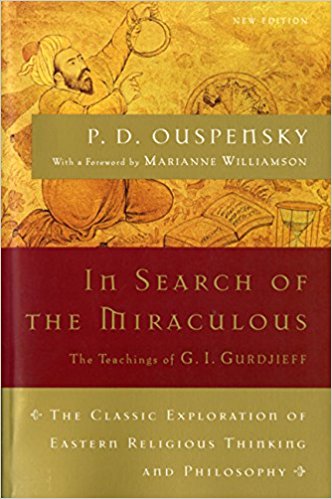
In Search of the Miraculous

51lYBJrYUBL._SX330_BO1,204,203,200_

In Search of the Miraculous by P D Ouspensky

When I first came across this book, the title “In Search of the Miraculous” had a strange impression on me. It made a permanent home in my mind and would not leave. It seemed as if the search for the miraculous was my own search and I had at last found what I was looking for though I could not really articulate what I felt.

Among all the books I have read, this book stands out as one of the most intriguing, fascinating and challenging. The ideas of Gurdjieff, explained so lucidly by Ouspensky in this book, can make a life changing impression on someone really seeking the meaning of life.

Most books are just re-telling of the same thoughts again and again in slightly modified words. The concepts of awakening are also the same whether you read buddhism, hinduism or any other ism. This book really makes you sit up and take notice. If you have watched a movie many times and then suddenly someone writes a review which explains the movie in a radically new way, you pay attention. You start wondering if that is true. That’s the effect of this book. It wakes up the mind’s capacity to wonder.

Quotes from In Search of the Miraculous

Everything happens. All that befalls a man, all that is done by him, all that comes from him—all this happens. And it happens in exactly the same way as rain falls as a result of a change in the temperature in the higher regions of the atmosphere or the surrounding clouds, as snow melts under the rays of the sun, as dust rises with the wind. Man is a machine. All his deeds, actions, words, thoughts, feelings, convictions, opinions, and habits are the results of external influences, external impressions. Out of himself a man cannot produce a single thought, a single action. Everything he says, does, thinks, feels—all this happens. Man cannot discover anything, invent anything. It all happens.


Immortality is not a property with which man is born. But man can acquire immortality. All existing and generally known ways to immortality can be divided into three categories:

  1. The way of the fakir.
  2. The way of the monk.
  3. The way of the yogi.

But all the ways, the way of the fakir as well as the way of the monk and the way of the yogi, have one thing in common. They all begin with the most difficult thing, with a complete change of life, with a renunciation of all worldly things. A man must give up his home, his family if he has one, renounce all the pleasures, attachments, and duties of life, and go out into the desert, or into a monastery or a yogi school. From the very first day, from the very first step on his way, he must die to the world; only thus can he hope to attain anything on one of these ways. The fourth way requires no retirement into the desert, does not require a man to give up and renounce everything by which he formerly lived.


Man has no permanent and unchangeable I. Every thought, every mood, every desire, every sensation, says ‘I.’


A man must begin observing himself as though he did not know himself at all, as though he had never observed himself

Beware of Your Self

When we see a warning like “Beware of Dog”, we are instantly alert and look around for any dangerous dogs. In the same way, the warning “Beware of Your Self” should make us alert and watch our dangerous selves.

Am I really saying that our self is dangerous? Yes, quite true. Not just dangerous but deadly and poisonous and can lead to death.

The self which is also called ego is a fictional notion. It does not exist apart from the notion of ego or self. It is neither body nor mind. It comes into its notional existence when others start calling it by its name and start talking about it.

As a child, its parents and relatives start calling it by a name and over a period of time, the child starts believing that he/she is that name. With the name the whole story starts building around it – what I do, what I wear, what I eat, where I go, what happens to me and so on.

With the self comes the other automatically. The self likes or dislikes others, loves or hates others, plays with other people and things and so on. Everything he/she does strengthens the notion of the self. In fact, the world, the society, the culture and the education are all engaged in building up a better, stronger, independent self.

The self then creates, builds, kills and destroys. It continues the sustenance of itself and other selves. The self, with science, makes medicines to prolong itself and also bombs to destroy other selves.

This illusion of self is dangerous. Because of its assumption of separateness, it creates division and conflict between one self and another. It can know no peace of mind and is always acting to sustain itself, always in the race to making itself bigger, better, smarter and wealthier than others. Slowing down creates panic in the self and it starts to engage in more and more activity.

The self feels it is alone and has to stand up against the whole world. So it forms groups of like-minded selves and fights other groups. The groups can be religion, companies, countries and you name it.

The self is the source of all the confusion, conflict and sadness in the world. Ironically, the self does everything in order to attain happiness but ends up doing the exact opposite. Where there is the self, there is danger – grave danger.

That is why I say – beware of your self.

Jain Zen – Getting Down from the Elephant

The origin of the Jain religion is in a story that is so Zen-like.

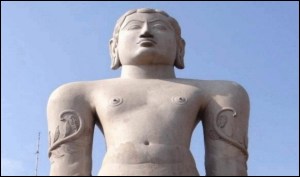
The first Tirthankar of the Jains, Rishabdev, left a major part of his property to his two sons, Bharata and Bahubali, and renounced the world. Bharata had ambitions and he conquered the rest of India and also asked Bahubali to surrender his share. Bahubali had a great ego and he refused and it was decided to settle the matter in a one on one combat.

Bahubali turned out to have the upper hand and right at the moment when he was about to kill Bharata, he realized the futility of it all. He stood at the same place and entered meditation. It is said that he stood there for a year and still did not attain enlightenment. Tribute has been paid to his meditative position through the various Bahubali statues in India, the most famous being the one at Shravanbelagola.

So when one stands in the same position for a year, he will lose his clothes and creepers will grow on him. Bahubali’s sisters got worried and asked their father Rishabdev what to do. He said, nothing can be done unless Bahubali gets off the elephant first. So the sisters went to Bahubali and asked him when he will get off the elephant. Hearing this, Bahubali got instantly enlightened. He is said to be the first person to get enlightened in this cosmic era.

The analogy is apparent to those who understand but the point is that the story is so Zen-like. Zen, as we know it, came much later but the essense of what we call Zen is clearly seen in this story.