Yesterday, late in the afternoon, after a sumptuous lunch, I was doing nothing (i.e. scrolling reels). I came across Shakespeare’s quote from King Lear
I paused to reflect – Am I doing something or doing nothing? I started to feel a bit uneasy & guilty. However, the next reel raised my spirit.
I relaxed on reading that. It was very sound advice but it lasted only a few reels until I came across Henry David Thoreau.
I had to read that a few times before it sank in. Having nothing to do, I must still do something. What could that be? As I was reflecting on what to do, I got the answer on the 12th reel.
Zen sayings have a magical effect. They stop your thinking and make you wonder. I couldn’t agree more. Everything happens on its own. Who am I to do something?
Energized by that I now aimed for perfection. However just then Robert Schuller, the author of ‘Tough Times Never Last but Tough People Do’ pitched in
Oh. Is it so? Doubts started to creep in about my doing nothing even though I did it perfectly. How can one handle such criticism? As I browsed through reels striving to achieve clarity. Aristotle made an appearance and helped me find inner peace by pointing out in a typically Greek way
I thought to myself that there must be some truth to his advice since no one criticized him for so many centuries for putting the Earth in the center of the Universe. I continued scrolling further…
Even before I could figure out what that ‘SOMETHING’ to do was…
I thought I finally found that ‘SOMETHING’ to do – ‘NOTHING’!
In a way the previous two quotes seemed to cancel each other. I wonder what Keillor and Lounsbrough would have discussed over a cup of coffee.
But I don’t like to regret my actions later. What if I was supposed to DO SOMETHING but I did NOTHING. Or what if I was supposed to DO NOTHING but did SOMETHING? Wouldn’t it be a disaster?
To hell with that.
Things were really getting heated up (My phone was also feeling warm in my hands). It was like nearing the climax of a mystery. Anytime now it would become crystal clear what I needed to do.
To Do or Not To do That is the Question!
The anticipation brought me to Warren Buffet, arguably the greatest ‘INVESTOR OF ALL TIME’ [unlike me]
I was going to settle on that as the final word when I heard my wife shout from the other room
I had asked you in the morning to get some fruits and vegetables. DID YOU GET IT?
Have you ever felt like life is just going around in circles? The routines, the struggles, the repeating thought patterns, the same troublesome emotions, the same “new beginnings” that end up eventually in the same rut that one feels the need to start again.
At first, being in a pattern can feel safe, it is familiar, predictable, and gives a sense of rhythm. But after a while, the safety of the pattern turns into the suffocation of repetition.
Going in circles is deceptive. You feel you are moving but are always in the same place. You feel the momentum of motion, but in reality, you are orbiting the same thoughts, patterns, and habits. The scenery changes slightly – new job titles, different faces, altered circumstances – but the essence of your life remains the same.
Faster or Slower, it’s still the Circle
When we notice this pattern, our instinct is often to change the speed. We think: “If I push harder, go faster, and achieve more, I’ll break free.” Or sometimes the opposite: “If I slow down, practice patience, and let things unfold, maybe I’ll escape the monotony.”
But here’s the hard truth: whether you speed up or slow down, you are still moving in the same circle. Velocity does not change trajectory. The only way out of a circle is not acceleration or deceleration, it is deviation. You have to go off on a tangent.
The Tangent
A tangent is radical. It does not continue the curve; it breaks away from it. It looks like rebellion, disruption, or even recklessness from inside the circle. And that is exactly what makes it powerful.
But here’s what we often underestimate: going off on a tangent is not easy. There is a strong gravitational pull that keeps us tied to the center, the comfort of familiarity, the approval of others, the inertia of habit. Breaking away feels like tearing yourself from an invisible tether. You may step out briefly, but very soon, the force of conformity pulls you back.
That’s why tangents are often short-lived. People quit their jobs, leave a relationship, or embark on a bold new path, but before long, they find themselves in another circle that looks strikingly like the one they left. The old cycle has been replaced by a new one, and the illusion of freedom doesn’t last.
Tangent as both Freedom and Responsibility
From the perspective of the circle, a tangent looks like absolute freedom. You’ve escaped! You’re no longer bound to the endless loop. But once you are truly on the tangent, a deeper demand arises – the demand to see for yourself.
The circle gave you the comfort to close your eyes. It told you how to behave, what to expect, and what was acceptable. You did not have to think for yourself. The tangent offers no such guidance. It gives you freedom, but also the responsibility of discovery, of finding your own path. You cannot lean on the crowd anymore; you must rely on the integrity of your own mind.
This is what Ralph Waldo Emerson meant when he said:
Society everywhere is in Conspiracy against every one of its members. The virtue in most request is conformity. Self-reliance is its aversion. One who would gather immortal palms must not be hindered by the name of goodness, but must explore if it be goodness. Nothing is at last sacred but the integrity of your own mind.
The circle is society’s conspiracy of conformity. The tangent is self-reliance – the courage to explore goodness not as it is defined for you, but as you must discover for yourself.
The Hidden Trap: Circles Disguised as Tangents
There is another subtle danger here. Sometimes what looks like a tangent is just another circle waiting in disguise. You may think you’ve escaped by changing careers, moving cities, choosing a new partner or adopting new beliefs. But unless the movement is inwardly awake and conscious, it is easy to get trapped again – another orbit, another loop, another pattern.
The lesson here is that true tangents are not one-time events. They are not just about leaving a particular job, person, or place. They are about cultivating the courage to question, to step aside, to not be lulled into conformity every single day.
Being Always on a Tangent
To be truly free is to keep breaking the circles as they form. It means watching when you are being pulled back by habit or by society’s voice and daring, once again, to step out. Every day brings opportunities for tangents, small ones and large ones.
When you say no to a familiar but draining pattern, you’ve taken a tangent.
When you question a belief that everyone around you holds, you’ve taken a tangent.
When you dare to listen to your own integrity over collective approval, you’ve taken a tangent.
The point is not to escape once and be done with it once and for all, but to live in such a way that tangents become your mode of life. And to realize and accept that others might think you are crazy not to follow the path of the circle.
Breaking away from circles, going off on a tangent
So if your life feels like it’s going around in circles, recognize that speeding up or slowing down will not change the geometry. The only real move is to break away. And yes, it’s uncomfortable. Yes, it comes with the risk of being misunderstood. Yes, you may even end up in another circle. But in the act of choosing the tangent, you awaken to yourself.
Life’s vitality comes not from perfect routines or flawless circles, but from the courage to keep breaking them. The tangent is not just the way out, it is the way to be alive. The real point is not about going off on a tangent but to not get trapped in a circle.
P.S. The Illusion of the Circle and the Tangent
If you really investigate the circle, you will find it is not some solid structure that traps you. It is made only of people moving in circles, repeating patterns, conforming to expectations. The circle has no independent existence. It is only maintained because we keep walking on it, following others blindly. And so, while it seems difficult to break free, the truth is that nothing actually binds you. The circle dissolves the moment you become aware.
Mostly we keep ourselves so busy so as to keep our deepest questions submerged under the surface of our daily consciousness. The questions poke their nose time and again but we push them back with some or the other busyness or temporary gratification.
What questions are these? The question of boredom, dissatisfaction, lack of direction, uneasiness about everything, fear and insecurity. These are just the surface questions. We don’t even touch the real deeper questions.
We search for the answers in some book or in the words of some guru or spiritual teacher. We may listen to their talks or spend few days in some silent retreat. And we may keep doing the same for years together without any substantial benefit, except the ability to more easily push back the questions with canned answers that we collected from our efforts.
The truth is that the answers cannot be found in words and sutras. You cannot find them in the past or the future, neither at home nor in the wilderness, neither in temple nor in a brothel. The answer is not of space and time. It is not of belief or doubt, neither of God or nature. It cannot be found by logical reasoning or blind faith. It cannot be found by striving or sitting in meditation. It cannot be found on Google or ChatGPT
The answer you are seeking is a reaction to a question. So long as the question exists you will seek an answer. The question will not allow you to rest in peace. But the fact is that to find the answer, you must first understand the question and the questioner.
Most spiritual seekers engage themselves with trying to find the answer to the question – “Who am I?” but in reality, they need to seek the answer to the question – “Who is asking the question who am I?”
The question must be asked without words. If you ask the question in words, you will get the answer in words but that answer cannot satisfy your hunger. You must get the wordless answer – direct sight! So you must ask the wordless question.
Turn your whole being into a question. Become the question, don’t just repeat the words in your mind. When you do this, you become still. And stillness is the invitation to the answer you are seeking!
Today, India is celebrating its 75th independence day. It is a big day. 75 years ago, the British got out of the car and handed over the steering wheel to Indian people. So yes, we are independent of the British rule. We have our own government now. We have our own constitution, our own rules, our own dreams to follow and our own identity in the world. Our independent India allows us freedom to choice of education, freedom to run our business, and freedom to choose the government.
But are we truly free? Free as an individual? Inner independence!
Aren’t we still in the prison of divisive views, wrong understanding, and ignorance? Aren’t we still in the prison of afflicting or troublesome emotions like hate, jealousy, lust, anger and pride? Aren’t we still in the prison of reactive behavior, biases and prejudices? Aren’t we in the prison of egoistic thinking, self-delusion, and attachments?
Who will struggle for our inner independence? There is no one else. We have to struggle with our inner prison on our own. Another person cannot get us out. We have to break the walls, open the lock and walk out.
The biggest hurdle in this struggle is the perception that one is free already. Just because there is outer independence, does not mean there is inner independence. Since we believe that we are already free, there seems to be no need for any struggle.
The struggle may begin when one becomes aware of one’s being in the inner prison. The choice is clear. Stay in the prison, do what the guards tell you to do so as to avoid any punishments and carry on the life in prison thinking there is no way out. The other choice is to break the patterns of conformity and try to break free. The world will prevent it. Others who are with you in the prison will dissuade you from attempting to escape.
Fighting with the powers does not help. The powers are too strong. Just like India’s independence was won with the power of non-violence and non-cooperation, so must the inner struggle be carried out with non-judgmental awareness and non-cooperation with your inner compulsive desires.
Inner freedom is possible and it is your birthright. You must aim for that. Inner freedom allows you to be your true self without pretending to be someone else, it allows you to love everyone without limitations and it allows you to lead a conscious life leading to inner joy.
Experience is a continuous process. It is always there from the time we are born till we die. It is always there from the time we wake up to the time we sleep. It is also there during our sleep. However, the nature of our experience changes during different times of the day and age. Each experience is not the same.
Come to think of it, how do we know we have experienced something? Because it stands out from the rest of the stream of experience isn’t it? We only notice the peaks of experience. If nothing has happened in the past one hour, it does not mean we have not experienced anything.
However, if suddenly there is a loud crash on the road and you are jolted from your sofa, then you say you experienced a loud noise. You may run out to the balcony to see what happened. If you see someone you know has met with an accident, you will experience something more than if you see some stranger involved in the accident.
If life is just a series of events that you experience day in and day out, then are you in control of what experiences you get? It seems not. Is our mind or brain just a box meant to receive sights and sounds and tastes and smells and experiences?
Are our experiences just a reaction to the external world? It does seem so. If it is hot outside, we feel miserable. If it is chilly outside, we feel uncomfortable. If someone says “You are a great person” you experience some emotion of happiness or pride. But if someone says “you are a lousy person” you may experience anger or sadness.
Is our inner life so tightly connected with what we see, hear or feel that we have no control on our own experience? It does seem to be the case. But we never pay attention to this. It seems so natural for us to blame some person or some condition for the experience we are having.
It should therefore come as a big surprise to you if I declare that you can experience any emotion you want in any situation. Since you have never exercised your ability to choose the emotion you want, it may seem difficult at first. Moreover, the external world is constantly throwing sensory impressions at you and you are constantly experiencing something or the other depending on your prior experiences and habitual tendencies. Further, you are continuously blaming something or someone for your experiences so the thought of being responsible for your own experiences never occurs to you.
To get out of this negative loop, we need to remember that we can choose our experience. The first step in that direction is to notice our current experience. If you notice what you are experiencing right now, then only you will be in a position to replace it with another experience. So the next question is obviously, with what experience would you like to replace your current experience?
It is not worthwhile to imagine replacing a sad experience with a happy one on the flick of a switch. It would seem odd that while others are crying because they have lost someone in an accident and you suddenly burst out happy and laughing. That is not the kind of experience changing I am talking about. What is reasonable to be able to do is that while others are crying, you may not experience that level of anguish. And even if you are crying, you may notice that you are crying. Noticing itself is a big thing. Noticing itself if maintained as pure noticing, will bring about a change in the experience.
If you continue to notice, you do not need to choose another emotion to replace your current experience with. The natural process will automatically bring you to a stable experience. That experience, if practiced, is also known as a equanimous calm or inner joy. This experience when practiced through non-judgmental noticing becomes unshakeable in due course.
Then you will not experience the ups and downs of your earlier emotional roller coaster which was totally under the influence of external events and persons. Now, there is an experience of a constant source of energy and joy underneath your outer appearance and which is not a result of any forced effort. But it is just there and you continue to notice the same.
This inner joy is your true nature. You will know yourself as this inner joy and not be caught up with your name and designation and other egoistic identifiers. There is no name for this inner joy but this is your true nature.
May you find this inner joy. There is nothing more valuable than this in the whole universe.
Meditation
today has become a tool, a technique. People talk about meditation as a way of
controlling their mind, or calming their mind. There are hundreds of techniques
that masquerade as meditation techniques. And there are dozens of teachers
teaching meditation and several hundred books on the subject.
Is the goal of meditation really to achieve a silent mind?
It is
possible some people might experience a stillness in their mind during
meditation as thoughts die down. This is what they assume to be the fruits of
meditation. But can they carry that stillness through the day? It is difficult.
The daily life once again creates disturbances in the mind, stokes the fires of
thought and the mind is once more in chaos. So the person thinks he must deepen
his meditation practice and meditate harder, put more effort in his meditation,
resolve more strongly to silence the mind, and so on. Then there are those
people who cannot achieve any form of stillness of mind during their meditation
and they think meditation is useless or they are useless.
In all this merry go round, somewhere the essence of meditation has been lost.
For a
moment, let’s keep the word meditation aside and look at life in a simple way.
If your mind is agitated due to some reason, will you be able to sit quietly
for some time? It would be difficult. Thoughts would come and go and suddenly
you will find yourself acting on some thought or saying something or thinking
even more. Your mind is not silent. This is the normal life. We go through our
day from one thought to another, from one action to another, fueled by inner
thoughts or external stimulus of what you see, what others say to you, what
they want you to do, and so on.
Now
supposing, it is early morning or late evening or a time where you are not
disturbed and you are all alone. And you are not doing anything special. How
long will you be able to sit like that without your mind wandering all over the
universe? It is certain that suddenly you will find yourself doing something.
Most people don’t like that aloneness with their own minds and want to keep
their mind occupied – for instance watching television or watching movies or
doing some hobby work.
Is your
mind really silent during these activities? No, it is not. It is merely guided
by the flow of images and sounds so it does not have to be on its own. The
television soap or the movie is telling a story and your mind is following
that. If you are working on your hobby, your mind is working on a goal and
therefore is seemingly silent.
But as
soon as that external support is over, the mind is active once more and starts
to wander and feel agitated. This is the normal human state and nothing to
worry about. But some people’s minds are too troubled by old memories or
habitual emotions that their mind wants to do something about it – to put an
end to their suffering.
This is where, the mind starts to believe that meditation will help silence their mind. But this is a big mistake.
Meditation
just becomes one of the ways to keep the mind occupied, like TV or movies. The
mind wants to struggle with itself and quieten itself. So it goes around like a
dog trying to catch its own tail. So for some time, the mind becomes still but
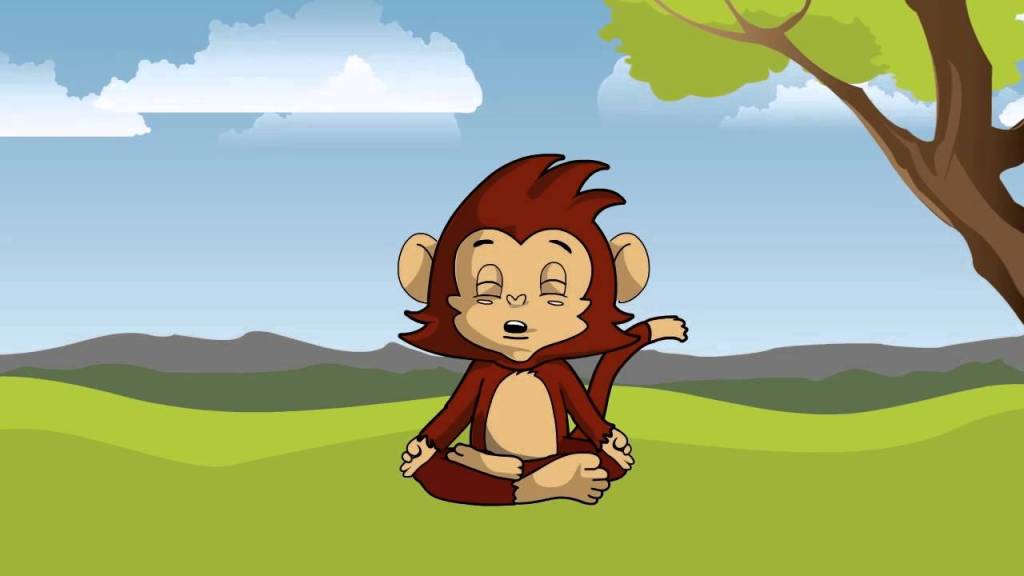
as soon as the meditation session is over, its back to the normal monkey mind
once again. It’s like you had put a monkey in a suitcase for 20 min and now
opened the suitcase. The monkey would go crazy as soon as it is out of the
suitcase. Sometimes, the monkey falls asleep in the suitcase but wakes up after
some time.
The point is, so long as you have a monkey, there is no meditation.
There is
meditation only when there is no monkey mind. This is the meditation after the
mind is silent. This is the real meditation. It is sitting quietly doing
nothing.
Dogen,
before he became enlightened, had a doubt as to why masters even after
attaining enlightenment still practiced sitting meditation. He was totally
confused and it because a big koan for him. If meditation is to attain
enlightenment, then why meditate after you have attained it? And then he
cracked the koan and became enlightened.
So if you
can understand this point, you will have a completely different view of
meditation. True meditation can happen only after you have a silent mind. It
will be difficult to accept this view because the mind then has no recourse to
silencing itself (keeping itself occupied in other words) but to face the
monkey within.
All
efforts to silence the mind, including so called meditation are simply the work
of the monkey mind. So now how will you attain a silent mind? I will leave you
with that question. Best wishes.
Essentially this line spells one thing, that there are two sides to
a coin. One is the dark one, the negative and scary side, while the other, is
the bright one, the positive one that is so encouraging and reassuring.
Life throws a million chances and opportunities at us just like this
one, where we either fly or end up falling. So what is it that life is trying
to teach? Is it sheer luck or is there something more to it? The answer
probably lies in the way we try to perceive each incident. Every situation can
be seen from two sides – the positive as well as the negative.
For instance when we experience happiness on winning a game or
gaining a promotion do we really think of the flip side of it? Probably not,
because we are too immersed in the happy moment. The flip side of a win can be
that we may have to double the efforts to make sure that we keep winning the
game which means more hard work. The flip side of a promotion can be that we
must handle greater responsibility and work more at proving ourselves as a
worthy choice. We might fail at these things can’t we. On the other side when we suddenly lose someone dear to us, we
fall into a grief so deep that we hardly realise that it is strengthening us
from the inside and making us resilient to stand up again even when we are
hurt. That is a powerful positive side to a bad incident.
So in effect, what we must learn and appreciate about each
experience is that every time it happens, it teaches us something. What use is
anything that happens in life, if we do not rise up higher in our understanding
and realisation through the experience? Just like a coin even life has two
sides and we must accept each with grace.
We must always remember that the good times come for a price that
must be paid and the bad times come with lessons that must be learnt.
One
fine day, I explained about the two sides of a coin to Neha and asked her to
write about it. While, what she has written above summarizes what I explained
to her, she did not think about it deeply and thus missed the essence. The two
sides of a coin is an oft-used analogy to help people understand that life is
not one-sided. It is used especially to advise people who are habituated to
look at life from a single viewpoint or who are caught in a specific life
situation. The fact that reminding people of this analogy gives them relief is
the proof they need that they were stuck in one sided views.
However,
the point that this analogy misses is that a coin does not have two sides
(surprised!?). It just appears to have two sides. It actually has more than 2
sides. Consider the thickness at the circumference. That’s the third side.
Further, if you observe the coin under a microscope, you will see infinitely
more surfaces and sides.
So the point is not to jump to the conclusion that life is colorful and not black and white, which is fine to a certain extent. But what is more difficult to do, and what is needed, is to stop counting the colors or the sides.
Now, one might quickly jump to another conclusion (a conclusion is a kind of a solidified hardened view and most people like to jump to it) that we should take life as it comes. Unfortunately, that too is a view that can be countered by its opposite (two sides of the coin view – take control of your life) or the multi-color view of life (experience everything that life has to offer).
While these views can help us in many ways, ultimately, they are mere views. Is it possible to be free of all views? Because only when you can be free of all views, can you see life in all its pristine beauty and know you are ‘that which views’ and ‘that which is viewed’.
A sincere seeker of truth is someone who is actively seeking for the truth. A sincere seeker is someone for whom discovering the truth is a very important and central goal of his life. So a sincere seeker will search for the truth in books, in gurus, in meditation and in conversation with others. A sincere seeker is serious about his search because he knows that the truth will give him the meaning of his life. This is not to say that a sincere seeker’s life has problems and therefore he is seeking the truth. That may be the case. But what I am saying is that a sincere seeker realizes that life must have something more to offer than the routine struggle for survival and he is seeking for that something beyond the ordinary.
Many people have written about this subject and a sincere seeker would do well to read all such literature. However, reading must be done with an open mind and not with a biased mind. This is an important point because any sort of bias – religious or personal – distorts the truth.
Many gurus speak on the subject of truth and today an unlimited amount of videos and audios are available on the Internet that the sincere seeker can access. But the very fact that so much material is available makes the task even more difficult because now the seeker has to literally search for the proverbial needle in the haystack. This cannot be a practical approach since it would take many lifetimes to read, hear and watch all the material on the Internet.
The benefits of reading and hearing from others cannot be discounted in any way. However, a sincere seeker must realize that the real work is inner work. In ancient times when there was not so much reading to be done, the seekers would only approach the task through the means of direct practice. And direct practice is even now the only way to self-realization. Mere reading and listening to Gyan will not help in any way.
I am recommending the following five questions that a sincere seeker of truth must ask of himself during his search.
WHO AM I?
This is a central question that appears again and again in most spiritual advices given by teachers across time and space. And no doubt it is the most important question to answer. However, note that the answer is not going to be in words because the answer is an experience or a direct realization of who you are. Later you might put it into words to convey it to another but those words will not transfer the realization to another. This has been the chief hurdle in the relationship between teacher and student.
So how do you ask this question? Who am I? What answer do you get? Probably you will say you are your name. And that is a good place to begin to discover who you are not. You could have any name but your parents gave you that specific name and now you think you are that. Then you might say you are your body and your mind. But please realize that the body is made of what you eat and the mind is made of what you sense (see, hear, smell, feel) and remember. Both body and mind will return to dust when you die. So is that it? If death really ended everything then there is no requirement for the spiritual search and no point in asking the question who am I. But if you simply think you are the immortal soul that keeps changing clothes in every birth, then you are no closer to answering the question than saying I am my name. Saying something and experiencing something are two different things. Saying something does not change your life. Anybody can say – I am the soul. But does it change his life? No. So remember that the experience of who you really are is important because that has the ability to change your life, your viewpoint and your experience. Remember also that going in search of the soul is another futile effort because you do not know what it is. How can you search for something you know nothing about. So there are very many complications in this question and a sincere seeker must be aware of them and not fall into their trap.
So a good way to answer this question is not to answer it but keep the question in mind as you go about your daily life. Do not answer but strengthen the question. Translate the question into the activities you are doing. Who am I? Who is walking? Who is speaking? Who is reading? Who is thinking? If you do like this for a long time, the answer might dawn on you suddenly. You will know for yourself.
Who am I is a very powerful and effective question. Teachers such as Ramana Maharshi and Nisargadatta Maharaj have taught their students using only this question as the instrument.
Who am I is the key question but it can also be approached in a gentle manner by asking four other questions – where am I, what do I really want, why do I want it and how do I get it.
WHERE AM I?
This question is a good starting point for all those sincere seekers who find the who am I question a little daunting. Where am I does not literally ask which city or which house you are in, but refers to the context in which you find yourself. Where am I is about observing the world around you, observing what people around you are doing and what they are busy in. Where am I is a question about what age and time you are living in – what is the economic, political, social and religious environment, what is the prevalent psychology of people in the world.
If you are here, it means you are a part of that environment. You have been brought up in that environment with those beliefs and thoughts. Where am I in a sense is the reflection of the question who am I in the outer world. The whole world is reflected in you and you reflect the whole world. You may not be able to understand this at the moment but by understanding the world, you can get some understanding of yourself. Know as much as possible about the world – the way people live, the way people relate, the way people fight with each other, the way people express love, and the way people try to search for truth. Learn everything you can. Knowing where you are gives you a big picture perspective on everything and also your search for the truth.
J Krishnamurti in his talks usually pointed out to the things happening in the world. He was trying to tell his audience where they were and how the world reflected their inner mental turbulence.
WHAT DO I REALLY WANT?
The next question is what do you want. And I want to break it into two questions – what do you want and what do you REALLY want? There is a big difference between the two questions. For the first question you could answer that you want money, a good job, a good spouse, a good life in general. Most people do not go deeper into this question because in order to get what they want, they have to spend all their energy. But as a sincere seeker of truth you must ask the question what do I REALLY want. Behind all the wants and needs and desires, what is it that I want ultimately? Is it happiness? Is it peace of mind? Is it supreme bliss? Is it self-realization? Is it truth?
Whatever it is that you really want, you must be able to explore that and make sure that it is something you truly want. When this is reasonably clear in your mind, then your actions will start reflecting your choice. You will start moving away from what you want superficially to what you want deep down. Allow this process to happen.
The Buddha talked about how our desire – what we want – is the root cause of our suffering.
WHY DO I WANT IT?
This question is to be used in conjunction with the question what do I really want. The why do I want question helps to sort out the genuine want from the superficial want. For every answer you give to the question what do I want, you must ask why do you want it. This will take you to deeper levels of your psyche. However, beware of fooling yourself. If you are not honest with the answers to why you want it, you will not be able to go deeper. The why question is like a pickaxe which helps you to dig into the what question. The why question can hurt if you have created layers and layers of pretense about who you are and where you are and what you want. Do not underestimate the why question. It is a very powerful tool and you must develop your skill in using it.
The 5 Why technique was popularized by Toyota Motor Corporation as a means of getting at the root cause of any problem.
HOW DO I GET IT?
When you get the answer to the question of what do I want and why I want it then you can decide on how you can get it. The how is a conscious effort not dependent on vague expectations from the others in your life and God or destiny. A sincere seeker must realize that if one wants something, then one must consciously work on it without any complaints and blame. He should not expect anyone else in the world to support him in his task. He is truly alone in his search. Whatever path he chooses, he must take complete responsibility for choosing it and have no regrets on choosing that. He must accept whatever is the outcome of the path he has chosen without trying to manipulate the results.
From an awakened perspective, the how really does not make sense because the journey is really from the here to the here. How does one get from here to here or from the present to the present? There really is no way because you are already here. The problem is you do not know it and the journey is from ignorance to enlightenment. And it happens in an instant after a long period of effort. Sounds a little contradictory but that’s the way it is.
So the above five questions are powerful instruments in the toolkit of a sincere seeker of truth.
But truth is not something that can be seen as some image.
It is not something that can be heard as some sound.
It is not something that can be smelled or tasted.
It is not something that can be touched.
So in what way do people expect to find the truth?
Is it an idea?
Is it some thought that is considered as the truth?
Is it an experience?
Note that in order to be sure that one has found the truth, one must be in a position to recognize it.
How can one recognize the truth if one has never had an experience of it before, when one does not know what it is?
Some say that truth is to be found within
True we can search for it within but what does one expect to find.
When the search begins one does not know what one is searching for & there are many falsities masquerading as the truth. So how does one differentiate ?
What if truth is right there in front of us but we miss it & go on seeking somewhere else ?
These are some questions that every sincere seeker of truth must investigate. He or she must not accept or discard anything without proper investigation.
For a human being to attain enlightenment, there are five requirements that must be fulfilled. If any one of these requirements is not met, then the conditions are not met for insight to happen. What are these five key requirements?
SUITABLE INCLINATION
Every person has some natural inclination. Some people equate this with karma from past life. Whatever that might be, some people are more inclined towards self-inquiry than others. In some cases, certain experiences in life provide such a big shock to a person that he has no choice but to turn inward to find out the meaning of life.
This inclination when nurtured builds momentum as the person reads, listens and gets in touch with others on the path of self-inquiry. The condition of suitable inclination is fulfilled when the inclination is pure and not tainted with some ulterior motive. The desire must be to discover the truth for what it is, not to achieve a worldly end. The individual must be willing to walk the extra mile for achieving enlightenment.
If suitable inclination is not there then the person will be distracted by the world around him and will not be able to proceed in a focused manner towards enlightenment.
SUITABLE HEALTH
Enlightenment requires the full energy available to a human being. If energy is divided into multiple things, then enlightenment is not possible. Therefore, a person must be in his peak physical and mental health to go deep into self-inquiry. This is especially important for meditation.
Most people think they can keep spirituality for their old age after they have completed their life’s work. But by that time, most people develop a number of physical ailments which create hindrances. Even the mind through years of conditioning, is not ready to unlearn what has been learnt and learn something new. Every new idea is filtered through biases built over the years. In such a state, the human body does not have the requisite energy to attempt enlightenment.
A man is in his prime during his late twenties and early thirties. The body is at its physical peak and can provide the maximum throughput of energy when called for. The mind is alert, in a learning mode and even though conditioned by the influences of the world, it has the possibility of breaking through that conditioning.
SUITABLE ATTITUDE
A person desiring enlightenment must depend on his own attitude and approach. Even if there exists an enlightened master to guide him, the person cannot let go of critical evaluation of whatever advice he is given. The right attitude is to experiment, test, try, experience and learn. There must be sincerity in the effort, seriousness in the intention and silence in action.
Enlightenment is something to be experienced individually. It cannot be given by a guru to a disciple. Therefore, the individual must depend on his own understanding at all times.
Many people have the time, have the inclination, and are in their prime, and yet because they depend on another for guidance, they do not reach enlightenment.
SUITABLE ENVIRONMENT
A person is born into an environment which comprises of his family, the family’s economic condition, the societal influence, the country and education. The environment is supposed to provide for the basic necessities of life – food, clothing, security. Once these necessities are provided for, a person can give some time and space for the exploration into oneself, which is the starting point for enlightenment.
If a person is born in a country embroiled in a civil war, or if a person is born into utter poverty, then he does not get the time and space which is needed for inquiry because is he too busy running for safety or food.
But if a person is born into reasonable environment where the basic necessities are available, then there is a possibility of devoting some time and space to the inquiry into oneself. However, just having this space and time is not enough. A lot of people have this space and time, but they are busy filling it with more work or more entertainment.
SUITABLE DISENCHANTMENT
Most people are enticed by the show of the world – the money, the things which money can buy, the women, fame, status in life and so on. Such people’s attention is distracted by everything around them. They will follow their whims and fancies without any reflection or consideration of consequences or learning anything from their past experiences.
Disenchantment is not renunciation. It is simply the realization that more money or more worldly things do not equate to genuine happiness. And this realization has to be based on personal experience not merely a theoretical idea. This does not mean that a person shuns money or gives up material comforts. The individual simply realizes that there is a limit to the effectiveness of such comforts and that there is no end to them.
So these five conditions are key for the attainment of enlightenment. When these five conditions are met, then the possibility of enlightenment arises. There is no guarantee. Just the possibility.







 Big Picture Zen