
Tag Archives: life
May the Real Birthday Stand Up

Another birthday. Another year gone by. Another revolution around the sun completed today. Come to think of it, we never imagine ourselves having completed a trip round the sun whenever we celebrate our birthdays – but that’s the truth of the matter. A year has gone by and a year is defined by the time the earth takes to go around the sun. So we are on this gigantic spaceship called earth hurtling into space at incredible speed and once every revolution, we celebrate the event. But what is so exciting about completing one circle around the sun? Of course people wish you – many many happy circles to go (returns of the day) – have a great rotation (day)
A birthday is a very slippery concept if you go a little beneath the skin. We are all made to believe that we were born on the day we emerged from the mother’s womb. But if birth is the same as coming alive then were we not alive the day before we came out of the womb or even a month before that? We were quite alive even then. So when were you really truly born / become alive? There are many possible answers.
- You are born when you come out of the womb. This is the most widely accepted day as birthday. But here also there are slight complications. What if you are an American baby born in India. If you are born on 16th in India, it is 15th in America. So is your birthday 16th or 15th?
- You are born when you became a fetus from an embryo – typically around the 9th week after the start of pregnancy. A fetus is recognizable as a human being while an embryo is not. This is the point of debate between those who think abortion is a choice versus those who think abortion is tantamount to murder.
- You are born when you were conceived. i.e when sperm met egg. Why not? After all, both sperm and egg are living cells with the unique DNA that will determine what color your eyes will be. So if a cell is a living thing, why wait till it becomes a fetus to declare it a person?
- You are born when your mom and dad thought of making a baby. Every action is born of a preceding thought. So it would not be totally wrong to say that you were not born as a thought first. If they had not thought about it, you would not be born.
- You are born when your ego is born. Till then you are only a vegetable. Psychologists say that a child develops his ego / personality by the age of 5 which more or less remains the same through the rest of his / her life.
- You are born when you are told you were born. Till that time you did not even know there was a thing like birthday. People tell you – you were born on 16th and therefore you accept that. So this is the semantic origin of birthday.
- You are born when you become conscious of yourself. Now this is a tricky proposition. It is very difficult to determine that. Most people live their lives unconsciously and therefore the spiritual masters say that you are truly born only when you die (ego death). And so many people are attempting to give birth to themselves by struggling to kill their ego.
- You are born when your soul is born. They say that the soul is never born and never dies but only changes bodies as if they are clothes. So unfortunately, your soul can never celebrate its birthday.
Scientists point out that each cell in our bodies is replaced once every 7 years. That means we are a new person every 7 years and must celebrate our birthday only once in 7 years. Too less!
Going further the Meditators say that everything changes every moment, so from that view, we are born every moment and die every moment so every day is a birthday. Too much!
I am sure wise people would have deliberated about all this and coming to a consensus, would have arbitrarily decided one event as the birthday.
Now that the decision is made, whatever it may be, a birthday is definitely a time to feel good. Many people remember you at least once a year and reach out to wish you. It is a nice feeling. There is cake and the snacks and all the friends and family with you as you become the center of attention. Probably that’s the origin of the saying – every dog has its day!
Self Help

We all need help in some or the other way in what we wish to achieve. Right from childhood, someone has helped us to walk, to eat, to read, to write, to speak and to play. We have also been told directly (through instructions) and indirectly (through actions) how to live life, how to understand things, how to draw conclusions and how to make sense of what happens to us.
When we do something wrong, we are told what is right and how to correct it. When we are young, we blindly accept everything we are told by parents and teachers. As we grow up and as our knowledge increases, every new information that comes our way is evaluated on the basis of what has already been told to us. So we start to agree or disagree with new information. To change our mind, we demand more concrete proof.
Once the knowledge is engraved in rules and policies, it is even more difficult to make changes. Many people cannot change their views despite all the proof to the contrary. However, help is always available when someone wants to listen. As the saying goes: You can take the horse to the water but cannot make him drink it. In the same way, help is available when you are thirsty.
Help does not have a specific form. It is not necessary that what helped one person will help another in exactly the same way. It depends on where the person is, in what state of mind, and what he has achieved before. It is a common realization for many people that they find new insights from the same book when they read it the second time and a third time. The book is the same but in the first reading, not all levels of meaning were apparent. As the level of the reader increased, he discovered more meaning in the second reading. In rare instances, if a reader has deeper understanding, he can gain new insights from a book which even the author had not intended to express.
To awaken we need help in different ways again and again. In the final analysis, it is you yourself who has helped you, not anyone else. We can learn immensely from books, movies, stories and metaphors
BOOKS
What is life without books! Reading is our only source of knowledge – knowledge which we cannot experience ourselves. And we must read a lot – different styles, different subjects, even from different ages. The more the variety we read the more our minds open up to new concepts. While it is true that concepts imprison us, it is also true that only through other concepts the road to freedom opens up.
MOVIES
Movies are not just for entertainment. There are some movies that help us reflect on our lives and show us things which the usual movies don’t.
STORIES
The purpose of telling a story is to convey a coded message. While the story can serve to entertain and pass time, it is the responsibility of the listener to grasp the meaning which is woven in the story, even if the story teller does not make it apparent. Stories serve to develop the faculty of attention in the listener.
METAPHORS
Metaphors and analogies are excellent means for explaining a concept. Drawing a parallel from what one already understands, makes it easy to grasp what one does not understand.
I wish you good luck in your endeavor.
On the Treadmill of Life
The curious thing about man is that he is always seeking something. He may seek one thing today and another thing tomorrow but he is constantly seeking. The objective of the seeking is always to move from a state of discomfort and dissatisfaction to a state of comfort and satisfaction.
Man is never satisfied with what is – the current experience. As man observes his surroundings and assesses his present situation, in itself and in comparison with others, sooner or later, he starts to experience discomfort and dissatisfaction. Not liking this experience he starts to seek out a state of comfort and satisfaction.
And on this path, he inevitably gets on the treadmill of life which runs with 3 controls – Quantity, Quality and Variety. These are the only three buttons on the treadmill. At any given moment, man perceives that his satisfaction is going to be derived from pushing one of these three buttons.
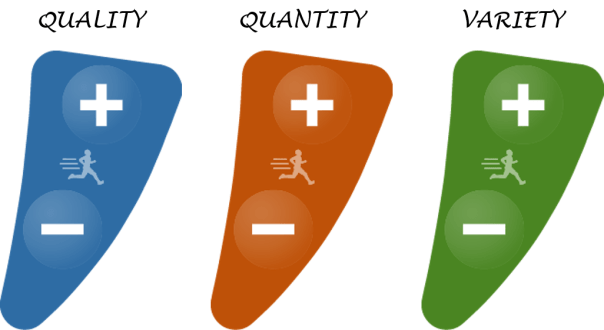
At one point, he might think that he needs a higher quantity of something in order to be satisfied. At another time, he might think that he needs a better quality of something in order to be comfortable. And yet at another time, he will seek out a different variety of something to attain satisfaction. A little more sometimes, something different at another time or something better the next time. This is how man runs on the treadmill of life. He keeps running, yet never arrives at his desired destination.
If you look around you, almost every man is on his personal treadmill. And this permeates all his life, in whatever he may be doing.
Consider money – a thing that no man is ever satisfied with how much he has. So he will usually run after more money. When that fails, he will try to invest in different types of money such as Gold or Bitcoins. He will also try to invest in money instruments which promise better ROI – mutual funds, share markets and other financial tikdams.
When it comes to dissatisfaction with his house, a man may try to move into a bigger house or furnish his existing house to give a premium feel or he might just move from one type of house to another – maybe from an apartment to an independent bungalow.
Relationships are always a big source of discomfort, so a man might want to improve the quality of his existing relationship by spending quality time with his partner. Some men might want to associate with multiple partners as that gives them satisfaction while others might want a different partner in their life.
When bored of eating the same dal and rice every day, a man might want to eat a different delicacy to satisfy his appetite. At other times, he might want to simply go on an eating binge to satisfy his desire. Some might want a better quality of rice and dal to feel satisfied.
Same is true of experiences – people choose the place of vacation depending on what they think will satisfy them – more time at the same place, or a more luxurious experience of staying or going off to a new place altogether.
Consider knowledge – some people want more knowledge to feel good, some people want more insights about their knowledge while some people want to acquire knowledge of a variety of subjects to feel good.
People live their life on the treadmill – choice of clothes to buy, choice of movies to watch, choice of a health and fitness program, choice of a company to work for and so on.
Even with organizations, the direction of effort is always determined by one of the 3 buttons. At one time, the organization may want more – more revenue, more profits, more headcount. At other times, it may want better quality – better manpower, better customers, better work-life balance. While at other times, it may look for a different outcome – different business lines, different country to work in, a different CEO and so on.
As the treadmill moves, on one day, quantity will determine our satisfaction, on another day, quality will determine our comfort and yet on another day, variety will decide our level of satisfaction.
As one becomes comfortable with a certain quantity or quality or variety, it becomes a threshold below which there is discomfort. Therefore, man is constantly on the treadmill to seek out more, better or different and pushing his threshold of comfort farther and farther. Eventually, the law of diminishing returns kicks in and man has to expend more effort, time and money to derive the same incremental satisfaction.
Some people are able to observe this circus and want to step off the treadmill. They are attracted to spirituality and meditation as a means of achieving ultimate satisfaction and comfort. But this is a booby trap. People still remain on the treadmill except now they want to do more meditation and yoga, or improve the quality of their concentration or simply try following a variety of spiritual practices. People do not realize that they are still on the same treadmill.
The true escape from this treadmill and the true gateway to satisfaction and comfort is awareness of current experience. Simple bare awareness of the current experience.
Awareness is awareness. There is nothing like more quantity of awareness or a better quality of awareness or a different variety of awareness. And therefore when you are aware, you are not on the treadmill.
With awareness, there comes about a radical change in our perception of things. What seemed desirable and worth striving for no longer seems to be so. Many people are afraid of this state thinking that it will take all the life force and the motivation to perform, away from them. It is not so. People do not realize that it is the treadmill which is making them run and that they are not free to go anywhere else. With awareness, man can be truly free, not bound to the treadmill, not allowing quality, quantity or variety to determine his satisfaction and comfort.
Then, looking at his surroundings with awareness, man experiences comfort and satisfaction in the current situation itself. He has the freedom to create something new, not simply more, better or different.
Renunciation – The Last Step
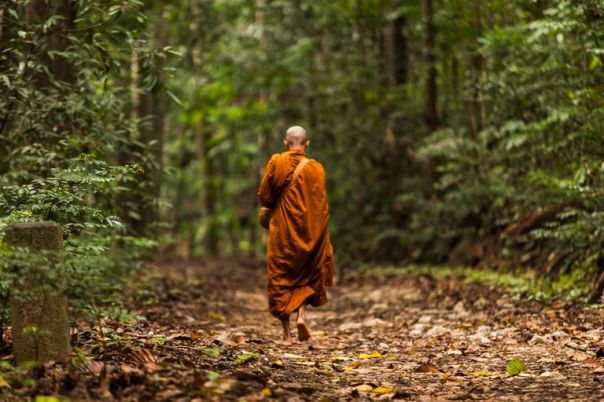
The most debated topic when it comes to spirituality is renunciation. No wonder, there are many misconceptions about it.
Renunciation, the way it is understood by most people, is the act of leaving home and family life in order to pursue the spiritual life – to live the life of a wandering hermit in search of the ultimate truth. The central question is whether it is necessary to renounce worldly life in order to achieve enlightenment.
Before we enter the debate on the pros and cons of renunciation, we must understand some basics about enlightenment. Enlightenment is the same for all human beings. In fact self-realization is about discovering your true self, beyond the illusory person that you think you are. So the question is about the approach – whether leaving family is going to help you to achieve that.
Let’s pause for a moment and reflect on the situation. We know that we have to be born in a family setting. No human being is born without a mother and a father and if he has grown up to get enlightened, then we can be sure, he or she has spent significant time in the care of the family and society. If there was no family, no society, then there would be no enlightened individuals also.
Society at times or rather at all times is a place full of chaos, where every individual is seeking his self-centered happiness and does not hesitate to harm others and cheat others to get what he wants. Children are prepared through education to get ready to enter the society and sustain its existence. Customs of marriage and rituals of coming of age are all significant for the sustenance of the society.
One cannot force anyone to exit the society, except as an outcast for breaking some of the agreements of the society. So by default, everyone is condemned to live in the society despite its cruelties. All one can do is to further one’s own goals, hoping one gets through life without serious incidents. The whole desire for enlightenment has no place in this structure. Society does not encourage the seeking for truth. Its existence depends on the illusion of progress and civilization.
A PRACTICAL SOLUTION
When an individual who perceives these illusions promoted by the society, he tries to understand what is going on. He comes across other individuals who talk of a true life, self-realization, etc and he is intrigued. He tries to find answers in the society but quickly comes to the conclusion that nobody knows anything about it.
His mind is boiling with the question and he is not finding any outlet because he has to fulfill the responsibilities of his life. He cannot focus on anything unless he gets an answer and therefore needs time and space to go within to explore. However, life has no mercy. It is unrelenting in its demands for survival and sustenance of the family and societal institutions.
Therefore, the only practical way out for a person is to renounce the family and go off to live alone in search of the truth. This has been happening in India throughout history. All those who had this inner calling have promptly renounced their worldly life and went into the forest. Whether they were successful in their search or not is another question.
The search for one’s true self requires meditation for long periods so if you are sitting and doing nothing while at home, other people will think you are lazy and a shirker. They do not appreciate the inner calling of the person. On the other hand, if you are in the forest, away from the home life, then there is no one to disturb you in your meditation. You have voluntarily retired from all responsibilities so you can focus singlemindedly on your goal.
The Buddha used to say that going from the home to the homeless life was the fastest way to self-realization. Hundreds and thousands of young men left their homes to join the Buddha’s Sangha. Even today, many people leave their homes and join a spiritual order, whether Buddhism or Christianity or Hinduism.
Point to note is that if a person is leaving home just to avoid the arduous responsibilities, then that is not the right renunciation. It is right renunciation only when the individual’s intention is to realize his true self. Only then is the renunciation a practical choice because there is no other way to live in the society and seek the higher reality.
So the question naturally arises. Is enlightenment impossible without this renunciation of worldly life? It is not impossible. There have been many cases of family people getting enlightened by hearing the teachings of masters.
In fact Gurdjieff actively promoted the fourth way, a way of self-realization while living the ordinary life. He was of the opinion that the situation one finds oneself in in one’s life is the most appropriate situation to start the struggle against sleep in order to awaken.
The truth about awakening is one of conditions. If a man is living in conditions that are conducive to enlightenment, then it will happen whether he is living at home or in the forest. And if the conditions are not suitable, then awakening will give him a slip even if he has renounced worldly life.
THE MIDDLE WAY
So is there a middle way between renouncing and not renouncing? Yes, definitely there is a way for the intelligent person who knows the conditions to be created. These conditions include first and foremost unobstructed time and space for meditation. If a man is able to organize this time wherein he is able to devote time to meditation with the sincere aim of awakening, then he will be in a much better position than a man who has renounced the world and is living troubled with the thought of where to get his next meal in the forest.
True renunciation is the renunciation of the idea of ‘I’. This can be done anywhere. The only problem of living in the society is that others remind you of being you all too often for you to practice the inner renunciation of ‘I’. However, for a person who is able to maintain self-awareness in all his worldly interactions, he will not be troubled. Within his mind, he has renounced while he is still performing ‘self’-less actions in the world outside.
If at some time, the awakened person wants to really change his way of life and live away from society, then the outer renunciation is only a formality. True renunciation has already happened when the person stopped identifying himself with his body and mind.
Therefore, it can be said that renunciation is the last obvious step rather than the first courageous step.
Life – A Fancy Dress Competition

As children we used to take part in fancy dress competitions. I remember having dressed up as an air force pilot in my 2nd or 3rd standard. Sometimes I wonder why we have those competitions – I guess grown ups like to see how their child will look in an uniform or how she would enact a specific role. So fancy dress competitions are somewhat like role plays. You get into the uniform and you kinda get into the character also. Such experiences tend to leave a deep impression. For a long time after that, my dream was to become an air force pilot.
Most fancy dress competitions are a one time event. You participate and once it is over, you return to your normal life. But if I may take a leap into the world of fashion, I pretty much see the same thing there. All fashion is about coming up with new fancy dresses – new materials, new design, new colors, new this, new that.
And then people live an elaborate fancy dress competition – going for a party, choose a party dress – going for a wedding, wear a fancy dress – going for a funeral – wear a plain dress – going to office, wear formals – going on a vacation – wear trendy clothes – and so on and on. Then there is summer fashion, monsoon fashion and winter fashion and spring wear too. Not to forget the festivals which all require a specific type of dress – Navratri, Diwali, Christmas, Halloween, et all.
Hear some women talking and conversations are mostly about what someone was wearing the other day. And why not? The clothes we wear make a statement about who we are. They create an impression in other’s minds about us. So on one hand, we become very conscious about what we wear and how we look and on the other, we tend to draw some conclusions about people based on what they wear and how they look.
Just note what you are wearing today and what made you wear that – what were you thinking? Look at people around you and note what they are wearing and listen to what conclusions your mind draws about them.
So in this real life fancy dress competition, in which we are not supposed to be aware that we are participating or judging, we are actually all participants as well as judges.
Half Full or Half Empty
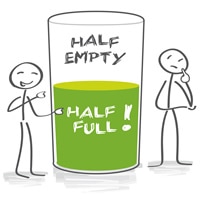
The example of the glass which is half full or half empty is often used to show how people view the same situation differently.
However, instead of giving equal importance to both the views, we tend to prefer the view that the glass is half full. Those who see the glass as half empty are advised to be more optimistic and see the glass as half full. Nonetheless, the statement that the glass is half empty is equally true.
The half full glass has no more space while the half empty glass has scope to take up more liquid. From this perspective, the half empty view seems to be more positive and optimistic than the half full view.
Yet again, the half full glass of water has the capacity to dissolve salt so it definitely has space within and we cannot say that the space is occupied fully by water. And similarly, the half empty glass is already filled with air so it was never empty, right from the beginning.
Now lets say, we pour out the water and suck out the air from the glass. What is remaining is called vacuum, which is supposed to be empty, really empty. But scientists say that even a vacuum is not empty – it consists of micro particles which are in some sort of flux.
So what does this tell us. That in this universe, there is nothing really empty. The notion of emptiness must always be qualified – empty of what? Like in the case of the half full glass, we can rightly say that it is half empty of water.
Similarly in the Buddhist concept of emptiness, the emptiness is the absence of an enduring self. However, that does not negate phenomena and therefore, emptiness is only in relation to fullness and in itself, it cannot be. Therefore, this is also known as the emptiness of emptiness.
Psychological Balance
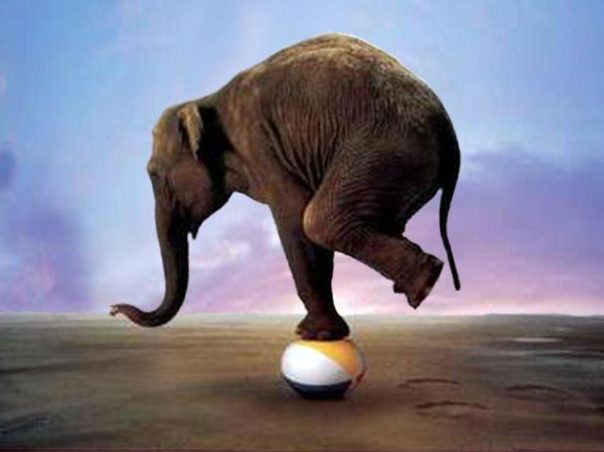
We observe that sometimes we get carried away by our emotions. When things are going well, we are excited and which shows in our animated behavior. On the other hand, when things are not going well, that also shows as a relative heaviness in our behavior.
Most of us tend to spend our lives on one side of our emotions. Some people are always depressed no matter what the external situation is. They will always find something to complain about in the best of events. Psychologically, they are carrying a burden of expectations, ideals and thoughts which makes the surroundings heavy with anxiety and worry. Very rarely do these people experience carefree joy.
Then there are others who always want to have a positive attitude even if things are not going as per their expectations. They are always hoping that the future will bring better tidings and this is what helps them live.
While it may seem that the second way is advisable, a positive attitude does not imply psychological balance. Those who advocate positive attitude suffer equally as those who possess negative attitude.
Having any attitude – positive or negative – is like a crutch. It is a dependency. Real balance is when there is no attitude. One takes things as they are without differentiating the situation as being fine or not fine.
A person who is psychologically balanced does neither complain about the situation nor takes the help of a positive attitude to endure the situation. When you get involved in a situation, you lose balance. The only way to be balanced is not to get involved psychologically with anything or anyone. A high order indeed!
Real Happiness Does Not Depend on Anything

It is very normal to think that once I get something, I will be happy. Most people search for happiness in events and struggle to make those events happen.
While there is a certain pleasure and joy to be had when you get what you want, that is not real happiness. This is because, things do not remain the same. They change and when they do, you will lose the happiness you had.
Many people even lose the sense of joy when they get what they want because they have been struggling so hard to get that that they are emotionally drained and cannot feel any joy at all.
Real happiness is something totally different. It is not dependent on anything external. When a person discovers this happiness, it is totally irrelevant whether there is food to eat or house to stay or money to spend.
This happiness can only be discovered when one sees the insubstantial and hollow nature of worldly achievements and possessions. It is through this sense of emptiness that one can get in touch with what is real. When you throw away all that is false, what remains has to be the genuine.
Does it Matter?
There are two outlooks that one can get attached to. One outlook says “It matters” & the other says “It does not matter”. But let’s look more closely.
When “it does not matter”… the ‘it’ can stand for “It matters”
Therefore, “It matters” does not matter.
Similarly, “It does not matter” matters.
Rephrasing the same
It does not matter even if it matters & it matters even if it does not matter.
So does it matter?
 Big Picture Zen