Tag Archives: Stories

The Emperor’s New Clothes

theEmperorsNewClothes

The emperor’s birthday was nearing and many celebrations were planned in his honor. For this special occasion, the emperor wanted to look his best & wanted a new dress stitched for him. Tailors from across the kingdom were invited to present their designs. Although tailors came from far and wide, the Emperor did not like any of their designs. He announced a big reward for the person who could make the most unique dress for him.

Then one day a stranger appeared in the court & claimed to have the most unique fabric in the world with which he would make the emperor’s birthday suit. The specialty of the fabric was that it could be seen only by one who was wise and could not be seen by one who was foolish. He produced a sample of the fabric from his bag and displayed it to everyone in the court. Although no one could see or touch the fabric, they all exclaimed that they had never seen such a thing. Even the emperor could not say anything for fear of being discovered to be foolish. He had to agree that it was indeed a special fabric most suitable for his birthday. The stranger was then allowed to spend several weeks weaving the imaginary clothes.

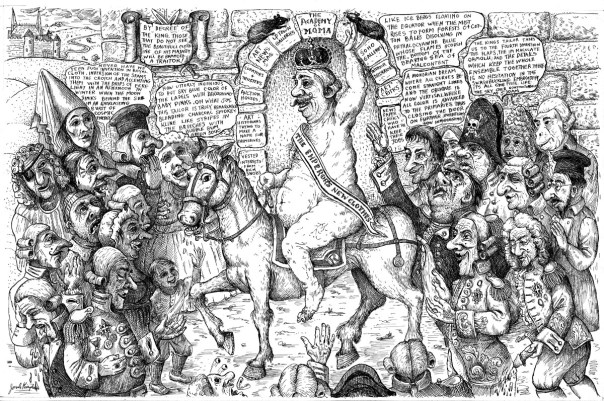
On the day of the emperor’s birthday, he got ready to wear his unique clothes. He got down to his inner wear & the stranger put the new clothes on him. Although no one could see the clothes they all appreciated the dress because they did not want to appear foolish. Even the emperor could not say anything. He even rewarded the stranger for his superb work.

Dressed in this invisible suit, the emperor rode his royal horse through the city wearing acknowledging the birthday wishes of his people. All his citizens, seeing the emperor wearing his inner wear on his horse, were in a shock. But no one said anything for fear of attracting his wrath. Suddenly one child in the crowd started laughing & pointing to the emperor said – Look there. the king is not wearing any clothes. The king is not wearing any clothes. ha ha hah!

The emperor immediately realized the truth & rushed back to his palace in shame.

In the very effort to appear wise, shines our stupidity.

Life is such. When there is a great desire for something, it makes us blind. We ignore the truth staring in front of our eyes. We do not believe our own intuition but believe what someone else is saying.

Fear of being termed foolish makes us do things & say things which are contrary to what is. We accept other people’s interpretation of the situation even if we are able to see the same situation differently. The underlying assumption is that the crowd cannot be wrong, all at the same time.

The crowd on the other hand is afraid of itself. So only a small child, pure of heart, without any preconceptions, one who has not yet become a part of the crowd, is not afraid to speak the truth.

We are all like that Emperor who goes about the world displaying our good qualities, nobility, holiness, acumen and spirituality without realizing that others, even though they may see through our nakedness, pretend to see our clothes.

Nakedness is our truth. Even if we wear layers of clothes, fundamentally we are naked inside. How can we ignore that fact? When all the traditional dresses and functional uniforms are taken off, we are all the same.

Going further when we divest ourselves of our stories about who we are in terms of name, family, education, designation & achievements; fundamentally we are pure emptiness, the stuff of what existence is made of. From this place you will never see any clothes however hard someone like that stranger would make you believe that the clothes exist. Because now you can really see and the child in you starts laughing.
Jain Zen – Getting Down from the Elephant

The origin of the Jain religion is in a story that is so Zen-like.

The first Tirthankar of the Jains, Rishabdev, left a major part of his property to his two sons, Bharata and Bahubali, and renounced the world. Bharata had ambitions and he conquered the rest of India and also asked Bahubali to surrender his share. Bahubali had a great ego and he refused and it was decided to settle the matter in a one on one combat.

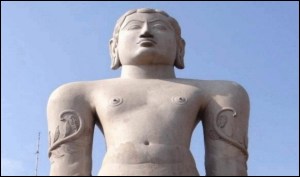
Bahubali turned out to have the upper hand and right at the moment when he was about to kill Bharata, he realized the futility of it all. He stood at the same place and entered meditation. It is said that he stood there for a year and still did not attain enlightenment. Tribute has been paid to his meditative position through the various Bahubali statues in India, the most famous being the one at Shravanbelagola.

So when one stands in the same position for a year, he will lose his clothes and creepers will grow on him. Bahubali’s sisters got worried and asked their father Rishabdev what to do. He said, nothing can be done unless Bahubali gets off the elephant first. So the sisters went to Bahubali and asked him when he will get off the elephant. Hearing this, Bahubali got instantly enlightened. He is said to be the first person to get enlightened in this cosmic era.

The analogy is apparent to those who understand but the point is that the story is so Zen-like. Zen, as we know it, came much later but the essense of what we call Zen is clearly seen in this story.

Slow and Steady Wins the Race

tortoise-and-hare_orig

A hare one day ridiculed the short feet and slow pace of the Tortoise, who replied, laughing: “Though you be swift as the wind, I will beat you in a race.” The Hare, believing her assertion to be simply impossible, assented to the proposal; and they agreed that the Fox should choose the course and fix the goal. On the day appointed for the race the two started together. The Tortoise never for a moment stopped, but went on with a slow but steady pace straight to the end of the course. The Hare, lying down by the wayside, fell fast asleep. At last waking up, and moving as fast as he could, he saw the Tortoise had reached the goal, and was comfortably dozing after her fatigue.

The moral of the story has always been told as – slow & steady wins the race.

Why is this the only moral of the story? Can the moral not be stated as – Do not be too proud of your strengths?

Is it not possible that this particular hare was foolish enough to doze off? Is it not possible that the hare learnt his lesson after losing the race?

What is the probability that the tortoise has more than 50% odds of winning in any given race with a hare? Will you bet on the hare or the tortoise?

Why is the moral told from the tortoise’s viewpoint but not from the hare’s viewpoint?

I think there would be no story if the hare had won the race. The tortoise was the underdog & therefore his winning is the crux of the story.

But it is still difficult to wrap one’s head around the point that a slow & steady approach of the tortoise will always be a winning strategy against the hare.

While this seems obvious, there is another perspective from which this approach makes real sense and this is what Aesop was referring to as the moral of the story.

​The slow and steady approach is actually a mental attitude towards attaining one’s aim. It refers to remembering one’s aim and not forgetting it. Even if one makes a slow and steady progress, it is better than making fast, random, distracted efforts like the hare, who got lazy, tired and slept off. The hare did not remember his aim and ultimately lost to the tortoise.

Looking at Life as a Story


story

How do you describe yourself? Don’t you say something like the following:

​My name is Y. I was born in N city on DD-MM-YYYY. I attended this school and that school. I studied graduation from a reputed college and post graduation from an even reputed college. I work as a manager in some renowned company. Previously, I have worked in many companies like M, F and C. I am married and my wife’s name is B and I have two kids A and A. My parents stay in N. I like to read books. I like new age and fusion music. I also like watching movies.

That is my story. I can add more details and elaborate on it. But doesn’t everyone have a story? What is your story? You have a name. You were born somewhere. You did this and did that. You went here and went there. You like this and you dislike that. And many more things like this. Then you have your goals. “I want to do this in life. I am working on a great project. I want to earn a million dollars. I want to drive a BMW and live in a penthouse.”

Observe this carefully. Is there anything apart from the story? I say there is just the story and nothing else. Our mental life is made up of nothing but the story. The obvious question you might raise is then what is all that we see and feel. “The hand that I see is not the story; it is apart from the story. The sky, the tree, the road, the bus, other people and so on.. they are not simply stories. They are real.”

What all those things are cannot be said in words. All words and descriptions are again stories. Whether it is the story of the big bang, or how the earth was formed, or how Alexander conquered countries, how a bud becomes a flower and how a child grows into a man, all these are stories – descriptions made out of concepts invented by us. You read stories in novels, you read stories in newspapers, you listen to stories on television and radio..

Reality is not compelled to follow these stories. Reality cannot be understood with these stories. You will see what is real only when you empty your mind of all stories. You must not attach importance to these stories but know them simply as yarn woven out of thin air.

The Six Blind Men and the Elephant

elephant

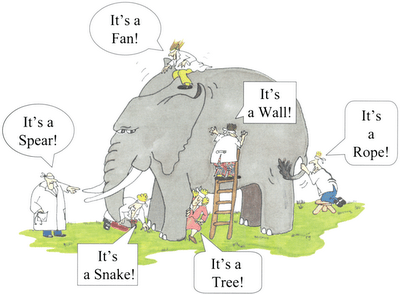
Once upon a time, there was a king who, wishing to amuse himself, ordered the Royal Elephant to be brought before him. He also ordered some blind men, blind from birth, to be brought near the elephant. He then asked these blind men to touch the elephant and give a description of the elephant to him.

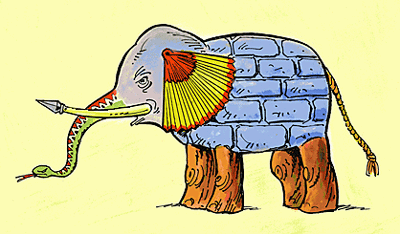
The man who touched the tail said the elephant was like a rope.
The one who touched a leg said it was like a tree.
The one who touched the body said it was like a wall.
The one who touched the ear said the elephant was like a fan.
The one who touched the trunk said it was like a snake.
The one who touched the elephant’s tusks, said it was like a spear.

elephant-blind-compo

Thus, each described the elephant differently, but each was sure that his own version was the true description of the elephant. They did not realize that each one touched only a part of the elephant. Each blind person had only a one-sided truth. They started arguing with each other, each sticking to his own point of view. The argument ended up in quarreling and fighting. The king and his ministers rolled with laughter as the blind men continued to quarrel and fight with each other.

The origins of this story are unknown but it appears in almost all religious literature through the world. There are many many ways to look at this story and understand it. Just goes to prove what the story intends to convey.

When the blind truly open their eyes, they will see there was no elephant there.