Category Archives: Nature of Reality

Worldly Knowledge vs. Ultimate Knowledge

3764362_1_orig

Human beings have the unique privilege of being born with the capacity to learn. Using signs, symbols, language and science, we have gathered a lot of knowledge over the centuries. This knowledge has transformed our lives through its application in technology, medicine and engineering.

​As we know more and more, we realize there is always something more to know. In every theoretical discipline – physics, chemistry, mathematics and so on – the search for more knowledge continues. There does not seem to be an end to knowledge. Although many scientists are diligently seeking a unified theory which will be the mother of all theories and will answer all the questions, their quest has not been successful so far. This does not mean that one day they will be successful. Scientific discoveries in the field of Quantum dynamics tend to point to the conclusion that there might be fundamental limits to knowledge.

Despite such limits, knowledge can always increase endlessly. Such is the nature of worldly knowledge. The increase in the amount of this worldly knowledge has also increased the number of years young human beings have to spend in school. There is ever increasing amount of knowledge we need to imbibe before we are ready for working in the world. Beyond a point, one must choose a specialization and literally know a lot about very little.

One must observe this carefully in the world.

Realizing this some people go in search of spiritual knowledge – the knowledge of God. The case is the same in this field also. There is endless knowledge of meditation, consciousness, soul, higher energy and so on. It is crucial for one to realize that such knowledge is equally worldly. It has the same nature of being never ending.

​As one understands this, one begins to investigate how knowledge is created. One sees clearly how simple sensory inputs are concretized, symbolized, given a name and then woven to form the fabric of knowledge. Much of this is done by one person and then later just informed to others through the process of education, without the actual sensory experience.

By investigating deeper into this, the grip of knowledge on oneself weakens. Everything one knows is put under the microscope of the mind, questioned and understood in its entirety. Knowledge literally falls away and there is freedom from all that is known. All that remains is bare experience – the experience of the air on the skin, the sound on the ear, the object on the eye, and the taste on the tongue. The mind will still name the experience but not in the same way as before. There is a certain knowing of the knowing – a constant moving knowing state not an accumulating process. This is ultimate knowledge.
Seeing Clearly vs. Clear Seeing

eye_orig

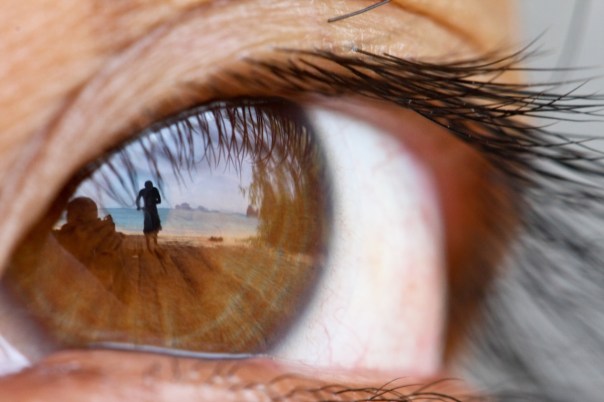
There is a difference between Seeing Clearly and Clear Seeing.

Seeing clearly means being able to see the differences between things, being able to distinguish between one and the other. This depends on sensory inputs. If your eyes have cataract, you will not be able to see clearly. What is true of the eye is true of the other sense organs including the ears, nose, tongue, skin and brain. When you understand a concept well, you can say that you see clearly.

Clear seeing is seeing the sameness in everything, despite apparent differences. This does not depend on sensory input. While sense organs provide you information to the contrary, there is the knowing that it is not as it appears to be. It is possible that a person with cataract may not be able to see clearly but he may be able to clearly see.

Clear seeing is an insight into the nature of things, into the nature of senses, into the differences, into the nature of seeing clearly.

What is better? Seeing clearly or Clear seeing? That depends.

In day to day life, people, schools, organizations and society gives more importance to seeing clearly. However, it need not be so always.

A close analogy is like the Necker cube which can be seen in two ways. There are some people who have difficulty in seeing the other perspective.

mcol-necker-cube

Seeing clearly can mean being able to see one or both of the perspectives. This may sometimes lead to arguments between those those who see one perspective and those who see the other.

​Clear seeing can mean being able to flip between the two at will and empathize with the person who is unable to see the other perspective.

The Word is Not The Thing

apple_orig

Our language can be considered to be a mutual agreement between all people to use certain symbols and associated sounds to represent various things found in nature or to represent various abstract notions developed by the mind. The invention of language gives tremendous power to human beings. All advances in science and technology, engineering and medicine would not have been possible without the foundation of language.

As much as language helps in changing our environment, it is also the source of much misery, misunderstanding and suffering. Words can deceive and words can hurt. Words can influence masses of people and words can make people fight with each other. The root cause of all the problems caused by our language can be traced to Alfred Korzybski’s famous statement – The Word is not the Thing.

Let me explain with an example. The word “bulb” stands for the physical object, which is spherical in form made out of glass and contains a filament made of tungsten. When connected to an electrical outlet, it glows and gives off light. You, me and everyone else has agreed to call it a bulb. We could have agreed to call it by any other name but for some historical reason we have called it the bulb.

The physical bulb is not a static object because it is undergoing change all the time. The filament is wearing off and the glass is getting weaker. But the name remains the same. The word “bulb” does not change. Now most people when shown a bulb will say that it is a bulb whereas in reality there is only the agreement to call it a bulb. The physical object can break when dropped on the floor but the word “bulb” does not break.

In the case of the bulb, there is no problem. Most people would agree wholeheartedly that the word, which is the symbol, is not the real thing. But in many other instances, all of us confuse the two. We fuse the word and the thing together as if they were never separate. And this confusion leads to all the troubles.

Let me explain with another example. The word “communist” stands for a person who believes in a certain way of thinking, who has a certain ideology and has certain political convictions. Communism is generally associated with negative connotations. Now, suppose you come to know that Mr. X, your friendly neighbor, is a communist. You will automatically forget all the excellent qualities of Mr. X and starting being cautious in interacting with him.

This reaction is common in many other cases where the symbol is confused to be the thing. We salute the flag (a symbol) to show our respect to our country. We offer flowers to a statue (a symbol) in order to pray to God. We give a birthday card (a symbol) to express our love. We attach a lot of emotion to our symbols. So if someone burns the flag, we consider it as an attack on the country and if someone throws away the card, we consider it as an insult.

If we think about our reactions with a calm mind, we will discover that they are not warranted. However because of our habit, we continue to confuse the word for the thing.

It is X Only Because it is Not X

X is a name. It can be a name of a person or thing or event or process. We all use names to identify things and people. But in the process we forget that they are simply names, not the things themselves.

There are different shades of identification. Some identification is stronger than others. One’s own name is the strongest identification. My name is Y but I start believing that I AM Y. Similarly I believe that my friend is A, my wife is B and my dog is D.

Other strong identification is with time. We actually believe that today is 9th of AUgust 2015, Sunday. The fact is that a date is only a convenient means to have order in our activities and planning.

The fact is that the name is not the person or the name is not the thing. We might say Hurricane Katrina, but that is just a name. The hurricane did not have a name. It was nameless all the time. Therefore, the truth is that it was not Hurricane Katrina. In other words, it was Hurricane Katrina only because it was NOT Hurricane Katrina.

This statement must be understood carefully. X is X only because it is NOT X. A name can be given to something which is nameless. If it already had a name, why give it one?

The Hurricane does not say that its name is Katrina. Similarly the dog does not say that its name is D. In the same spirit, even if I say that I am Y, you should not believe me because I am fundamentally nameless. So are you. That is why your name is P or S or K.

So look around you. In actual fact, nothing has a name. Everything is nameless from the beginning – all the chairs, tables, walls, people, are chairs, tables, walls and people only because they are NOT chairs, tables, walls, and people.

It is more true to say that it is not a chair than it is to say that it is a chair. Both statements are true but one is really true and the other is only conventionally true.

So if you can look at things and people as nameless which is not recognizing anything by its name – whether it is a tree, a bird, a flower, the sun and so on, you will attain the original mind, untainted and pure. After all, isn’t this what you want?

Does it Matter?

There are two outlooks that one can get attached to. One outlook says “It matters” & the other says “It does not matter”. But let’s look more closely.

When “it does not matter”… the ‘it’ can stand for “It matters”
Therefore, “It matters” does not matter.
Similarly, “It does not matter” matters.

Rephrasing the same
It does not matter even if it matters & it matters even if it does not matter.

So does it matter?

Is There Anything To Be Done?

matrix_orig

We wake up in the morning and as soon as we finish washing our face and brushing our teeth, we get busy in boiling milk, reading newspaper, getting ready for the office. Then the rest of the day we spend in doing whatever our office work demands – typing on the computer, reading and sending emails, attending meetings, tea, coffee, lunch… then we get back home, watch television, read books, spend time with family and go to bed.

Day in and day out we do the same thing. On weekends we go to movies, do some shopping, eat at restaurants and go on a long drive to the countryside. That is what most of our life consists in.

We do all these things but never wonder why we do them. we might have reasons like – in order to survive, in order to earn money, to support our family, and so on. But those reasons are not the real reason why we do things.

We do things mostly by habit. We cannot do anything else. We are so used to doing things in the same way and same manner, it becomes a habit and we don’t realize what we are doing. Not only our physical actions like eating, bathing and dressing is determined by habits, even our psychological actions like thinking and feeling are driven by habit.

In reality we don’t know anything. So we tend to follow others thinking that they know. But they are following someone else. So everyone is simply following others blindly without knowing the underlying reason. This is the way we take decisions on buying a house, a car, going for a vacation and so on.

Fear is a strong motivator of actions. Based on experiences and memory we develop fear and that determines our actions in many situations.

Another strong influence for our actions is our desires. Most people think their desires are their own. But where did they find those? They did not decide to have those desires. It came as a natural inclination without any conscious effort.

So if we really look at the world and the people carefully, beginning with oneself, we find that everyone is sleepwalking, not realizing what they are doing, why they are doing, where they are going and so on. They meet with accidents, love, friendship, joy, grief and everything else without conscious effort. It happens to them. Their inner world of emotions and thoughts also happens.

When we say – I am thinking… it is the thoughts which are going on in my mind. I don’t think anything. Neither do I have any control on my thoughts. And it is the same with everyone.

Can you see how dangerous the situation is? People are living their life and dying completely unaware of who they are, what they are doing and whither they are going. They are dreaming happily with the story they invent of their name, education, job, achievements, children, family, love and friendship.

If you see the danger of this situation clearly, you instantly become conscious and you stop doing what you are doing. You become alert, mindful, and watchful. Suddenly there are no thoughts in your mind. The mind becomes calm and sharp.

And if you attain this state, you realize there is nothing to do. This non-doing is the real doing. All else that we normally call doing is only automatic reaction. No one is in control. The stopping of everything is the real doing.

The World as Illusion

maxresdefault_orig

Mystics throughout the ages have termed the world as illusion – a dream landscape with people and things with no inherent substance. How do we reconcile this with what we sense in our everyday life – the people, the objects, the animals, the trees?

What is an illusion? When something appears to be what it is not, it is illusion. To be more precise – when something appears, it is already an illusion. Appearance itself is illusion.

A tree appears to have a trunk, leaves, fruits, and flowers. A dog appears to have legs, tail, eyes and ears. A human being appears to have hands, face, mouth, nose and hair. We have given names to appearances. But just giving names do not make those appearances real.

What appears to us appears the way it does only because of the various conditions in which it appears. To be more precise – appearances are nothing but conditions. The sky appears blue in the day and black in the night. A leaf appears green when young and yellow when old.

What we see is not an object but an appearance which we name. To understand what is real and what illusion, we must investigate deeper than the surface appearances.

Wood appears solid, but disappears into thin air when burnt. We see a rainbow with many colors but there is nothing but water. Conditions are such that from the point we are the light is reflected by water in the air to create the illusion of a rainbow. There are no colors in the air but we still see them. That is the illusion.

We see the sky but “sky” is a word which has no object. You cannot go up and touch the sky. But touching something does not mean it is not an illusion. When you touch a table, there is only the touch, no you and no table. And what is touch? It is nothing but an appearance or sensation of touch.

I hope you see… go ahead and investigate for yourself. Apply your brain power to this and find out for yourself. Do not try to understand words but find out what the words mean in your mind.

When you are thus able to see only appearances, the whole world dissolves, leaving only the pristine existence in its bareness.

What Is It That Exists?

One of the best ways I have found to understand what exists is from the Tibetan Buddhist teachings. Any object can be considered in 3 ways

The object is made of its components

For instance, the laptop is made up of the screen, the keyboard, the CPU, the memory, the casing and so on. Even a solid object like a stone can be considered to be made of up of atoms and molecules.

The source from where the object originates

To take the same example, the screen of the laptop might be manufactured in China, the CPU in Malaysia and other components in different places and the final assembly would have happened in USA. Similarly, the stone that you see on the road has come there from somewhere. Maybe it broke off a mountain, got carried in a truck and fell down there.

It is an object because we give it a name

This is easier to see for things which are changing rapidly. For instance, we give the name Katrina to the hurricane that swept across the US. But what is a hurricane but the movement of air in a certain pattern. The hurricane is no longer there but the air which was part of the hurricane is still around. By giving a name we create an object. This way of thinking is radically different from the normal way of thinking that we give a name to an object.

​If you really want to see the world as it is, then learn to see everything from these 3 perspectives. Take a leather shoe for instance. See that it is made up of the sole, the upper portion and the lace. Then see that the leather would have originated from some animal, processed and then made in to a shoe. Finally, it is a shoe because you think it is. This point might need some insight but try to see it. Can you see the object without giving it a name?