All posts by Big Picture Zen

Unknown's avatar

About Big Picture Zen

Center for Self-inquiry and Awakening is a space for inner exploration and self-realization.

Arhat vs. Bodhisattva

Bodhisattva-2

Arhat and Bodhisattva are commonly understood terms in Buddhism. The Arhat is the pinnacle of spiritual achievement as mentioned in the Theravada scriptures while the Bodhisattva is an ideal which spiritual seekers aim for in order to achieve Buddhahood.

There are several sects within Buddhism, the main ones being the Theravada, also called as Hinayana and the other being Mahayana. Arhat is a term used by the Theravada sect while Bodhisattva is used by the Mahayana. And there is some amount of debate among the Buddhists on these terms and what they signify. In order to understand what this means, it is important to learn the context of the terms used.

THE ARHAT

In many Theravada texts, the Buddha is described as an Arhat, one who has completely extinguished birth and death. An Arhat is not reborn in any realm. This is the highest spiritual achievement, the goal of all meditation and practice. The Arhat is the final stage of 4 stages of spiritual evolution – the stream enterer, the once returnee, the non-returnee and the Arhat.

The stream enterer is one who has entered the path of Nirvana and within a maximum of 7 rebirths will attain to the level of Arhat. He cannot go back into the realm of suffering. The once-returnee as the name suggests is reborn only once before he becomes an Arhat. The non-returnee has no more rebirths in the lower realms but has not yet become an Arhat. The Arhat is one who has extinguished all desire, all ignorance which leads to rebirth.

There is a distinction which is made between the Buddha and the Arhat. A Buddha is one who discovers the supreme path with his own efforts, without recourse to a teacher. The Arhat on the other hand achieves Buddhahood but with the guidance from a Buddha. There is another category called Solitary Buddhas or PratyekaBuddhas, who also become Buddhas without any teacher, but they are unable to teach others. It is mentioned in several texts that after his disciples became Arhats, the Buddha sent them all across the land to preach the Dhamma.

THE BODHISATTVA

Bodhisattva, which is the Mahayana ideal, is someone who has taken the vow to save all sentient beings, wherever they are however innumerable they are, from ignorance and the rounds of rebirth and until then, he does not enter Nirvana. In order words, he does not free himself until he has helped each and every other being to free themselves. The Bodhisattva willingly gets reborn in order to fulfill his vow.

A Bodhisattva is also someone who is eventually going to become a Buddha in a time to come. So if you are intent of attaining Buddhahood, you need to take the Bodhisattva vow and help people in innumerable lifetimes, leading to the perfections and eventually to Buddhahood.

THE CONTENTION

The Mahayana Buddhists accuse the Arhat of being selfish, looking after his own salvation without helping others. Monks in the Theravada tradition go off into the jungles away from society, beg for their food and spend their time in meditation in order to become Arhats. The Mahayanists claim that you cannot become a Buddha unless you have the Bodhisattva attitude.

The source of the Bodhisattva ideal can be traced to the stories of the past life of Buddha as told in the Jataka tales. In each of these stories, Buddha recounts how he helped other people through millions of previous births as a human being or as animal, on his path to becoming the Buddha.

THE RESOLUTION

I believe the people who make a dispute out of Arhat and Bodhisattva have not really grasped the essential teaching of the Buddha. The core of the realization which makes a Buddha is that there is no Self, separate from the rest. It is not that you strive and meditate to destroy the Self. The Self does not exist right from the beginning. What you do is to eliminate the illusion or notion of its existence.

So looking at things from this view, there are no people to begin with. And if you really understand in your bones what impermanence is, what emptiness is, there is no more dispute. Then there is no difference whether you help people or not because you are not there at all and neither are they. When you eliminate the notion of self, there is no me and no others, so no sentient beings to save.

​But so long as you see others suffering, you also have a subtle notion of self. When you do away with this, whatever you do will be a help to people. You see, there is a limit to explanations with words.

If you are taking the Bodhisattva vow, it is good. It helps to direct the mind outwards away from the self-centeredness. But eventually, your goal is to become the Buddha when you no longer hold the view of Self. If you are coming back again and again into the world to help people, you are only increasing the delusion. On the other hand, if you consciously strive to become an Arhat, you are caught in the deepest swamp.

The true son of Buddha only looks directly into the mind, discovers there is emptiness, and stays there with nothing further to be done.


Language in Thought and Action

51LKWLkuwML._SX338_BO1,204,203,200_

Language in Thought and Action by S I Hayakawa

This is a book that must be made compulsory reading for every human being who communicates. Now that means pretty much everybody.

All of us communicate throughout the day. The ability to talk and communicate is what has made human beings the reigning species on the planet. Yet how little we understand about how we communicate!

Even though we have been communicating for centuries and millenia, we still cannot be certain that what we speak is understood by the other person as we intended. This is a rare book which I picked up in an obscure bookshop in Singapore.

I have been making photocopies of this book and have gifted it to many people. This book makes so much sense that I have also prepared a presentation on its contents and make it point to teach it to others whenever I get the opportunity.

Quotes from Language in Thought and Action

The habitual confusion of symbols with things symbolized, whether on the part of individuals or societies, is serious enough at all levels of culture to provide a perennial human problem… The symbol is not the thing symbolized; the word is not the thing; the map is not the territory it stands for.


Many situations in life as well as in literature demand that we pay no attention to what the words say, since the meaning may often be a great deal more intelligent and intelligible than the surface sense of the words themselves.


What we call society is a vast network of mutual agreements.


Having defined a word, people often believe that some kind of understanding has been established.


What we call things and where we draw the line between one class of things and another depend upon the interests we have and the purposes of the classification.


It has been said that knowledge is power, but effective knowledge is that which includes knowledge of the limitations of one’s knowledge.

Reinterpreting the 3 Jewels of Buddhism

Global_Rise_of_Buddha_Dhamma_Sangha-01

The Buddha, the Dhamma and the Sangha – The Triple Gem

All practitioners of Buddhism take refuge in the triple gem. However, a deeper meaning can be interpreted about them apart from the conventional meaning.

The 3 jewels of Buddhism are the Buddha, the Dhamma and the Sangha. Conventionally, the Buddha stands for the person Gautama Buddha who taught 2500 years ago in India. The Dhamma stands for his teachings and the Sangha is the order of monks which he founded.

Whenever a lay person wants to get ordained as a Buddhist, he has to recite the three refuges thrice. By doing this, the person expresses his intention to lead his life by following the teachings of the Buddha. If the person wishes to become a monk, he must take formal vows.

Most lay people who consider themselves as Buddhists do not investigate the deeper meaning of the triple gem. They pay respects to the statue of the Buddha; they perform rites and rituals or read Dhamma and also offer food and robes for the monks in the Sangha. However, if one really investigates the true significance of the three jewels, one can discover the Buddha’s teaching for himself and become enlightened.

First Jewel – Buddham Saranam Gacchami (I Take Refuge in the Buddha)

Buddha literally means the ‘Awakened One’. It also stands for the Buddha Nature which is the underlying substance of all the phenomena of this universe and also one’s true self. So when one takes refuge in the Buddha, it is not bowing down to the image of Buddha or praying to that image. In a deeper sense, it means taking refuge in one’s true self or true nature.

Ordinarily, we are known by our individual names and are living according to the circumstances that life presents to us. However, in the Buddhist understanding, this is bondage. To be free, one must recognize one’s true nature and live in it, which puts an end to all striving because one has reached one’s home.

Second Jewel – Dhammam Saranam Gacchami (I Take Refuge in the Dhamma)

The word Dhamma has many meanings. The most commonly used is that of the body of teachings of the Buddha in the form of discourses and the sutras. However, a deeper meaning of the word Dhamma is also phenomena or ultimate reality. It is like saying that ‘water flows because it is the Dhamma of water to flow’.

Taking refuge in the Dhamma does mean, at the superficial level, studying the sutras and following the teachings in one’s life. However, in a deeper sense, one must take refuge in the true nature of things. One must understand that all things have the nature of impermanence, dissatisfaction and emptiness and live that understanding. This refuge meant to free oneself from attachment to things and wrong notions.

Third Jewel – Sangham Saranam Gacchami (I Take Refuge in the Sangha)

The Sangha is the community of monks who live according to the teachings of the Buddha. They beg for their food and spend their time in meditation. In the literal sense, taking refuge in the Sangha means to join their order by becoming a monk. However, in the deeper sense, it means living the right life oneself. Living in society, where one is tempted by all kinds of desires and influences, one must live rightly even if one has to stand alone.

Taking refuge means one is protected against all danger and calamity. And taking refuge in the triple gem is the true protection from the vicissitudes of life. However, one must take the refuge understanding the deeper significance of the three jewels.

What Time is it Now?

timezone-map_orig

What time is it NOW? If you are looking at your watch to find out, you are a victim of one of the greatest mass hypnosis on earth! And you are not alone. Each one of us is imprisoned in the net of time.

Your watch might say it is 7:15 am. But look around at the other clocks in your house. Are they exactly showing the same time to the second? Probably not! They might be running a few minutes apart. For our normal consciousness, this is not a problem. We assume that there must be an exact time RIGHT NOW, which someone (probably the government or GOD) must obviously be maintaining.

It is not even surprising to us that in Singapore, it might be 9:45 am on April 10th right now or in the United States, 7:45 pm on April 9th. This is because it is a commonly accepted notion that there are different time zones. But note that the earth is not physically but only conceptually divided into longitudes. We are taught so many things in history and geography early in childhood that we fail to question anything and get so busy with our life that we never get around to examining the nature of reality.

If on the earth, there are different times at different places, what time is it actually NOW?

We are so hooked to the watch and the time it shows, that our whole life revolves around it. We wake up at a certain time, have to catch a bus or train at a certain time, reach office at a certain time, meet a friend at a certain time, cook pizza in the microwave for a certain time, grow from a baby to an adult in a certain number of years and so on. It is so so obvious that there IS time that no one questions whether time exists in reality. I know that no one is going to believe this, but if you are one of those inquisitive types and want to know the “behind the scenes” story then please pay attention.

You will at least accept that the clock is just an instrument. If the clock stops, the time does not stop. This is our conventional understanding. So if time never stops for anyone, can we see it moving?

Look at any object around you – say a door. Observe very keenly. Do you see it moving from the past minute to the present minute into the next minute? Or do you see it coming from the future into the present and fading away into the past? If you do not claim to possess divine vision, you will just see the door. You will not see it going anywhere or coming from anywhere.

And that’s a fact. The door is there right now. The wood, out of which the door gets its shape and name, is decaying in the context of its surrounding environment due to heat and moisture and maybe termites. This process cannot be seen with the naked eye on a second to second basis, but is happening and cannot be denied. You can look at the door after 10 years and you will surely see the change.

So if you tell yourself that the door that you see is actually changing right now due to the moisture and heat, it will actually be the truth compared to believing our normal consciousness that provides a false picture of a permanent and unchanging door.

So it is with everything around us, including ourselves. Everything is continuously changing. Now look at the clock and watch the second hand. It is moving and changing its orientation continuously. One of the first things that was taught to us as a child (who was changing all the time growing into an adult), is to read the time from the clock. So we see which hand is pointing to which number and speak out the time. But if you drop the interpretation and just see the hands, they are only changing their position continuously. This change of position is interpreted as different times.

Fundamentally, there is only change. Time is a concept invented to have a common measure of this change. Time does not exist by itself. When the world had not changed so much, people used a sundial to note time. The change in the position of the shadow on the sundial, caused by the change in the position of the sun was a proxy for time. Today we might use the vibrations of atoms as a proxy for time but the analogy is the same – one change is used to measure another change. There is no time, only change.

We are so deeply caught in the illusion of time that we think that changes happen in time. This is not true. There are only changes, no time. The concept of time is used only to achieve a certain purpose. When you are going to meet your friend at 5pm, it means that both you and your friend will try to change your positions to the decided point along with the sun changing its position to a certain point.

If you stare at the open sky for a while, you tend to lose the sense of time. This is because there actually is no time. Only when you see about you people rushing around or when thoughts start running in your mind, that you are fooled about time.

There never was any history. Everything that has happened has happened now and will happen now. Some people had calculated that the earth was created in 4004 BC. Today some people believe that the universe began some 13 billion years ago with the big bang. None of this needs to be believed because it is all an interpretation of their observations.

Everything is continuously changing. That is the only truth. If you just watch the change continuously without the notion of time entering your perception and if you are lucky, you might get a glimpse of what is timeless, the very fabric of existence, who you are, GOD! Life will not be the same for you after that!

The Outsider


the-outsider

The Outsider by Colin Wilson

The Outsider is a unique composition. Although, it is prose, it is almost poetry to all those who are “Outsiders”.

Colin Wilson has defined a category of people called Outsiders who are psychological misfits in this world. He has given examples of real people and through their life story has shown, how for outsiders, living life is a deep psychological struggle against the norms of the world.

I read this book on the recommendation of Prof. Anil Gupta of IIM-Ahmedabad and founder of SRISTI and National Innovation Foundation – India.

I have liked the lucid and precise way in which the author has made a case for the Outsider so much that I have underlined sentences in almost every page throughout the book.

While reading this book, I have constantly felt that I am definitely an Outsider. The society does not recognize the presence of outsiders, therefore there is immense pressure to conform to societal “madness”.

The author has struggled throughout the book to come to a solution to the outsider problem but without much success. Wilson has taken examples of real life ‘outsiders’ and has shown how they have tried to solve the problem without succeeding.

I am pretty sure there are many outsiders in the world who either try to solve the problem without realizing clearly what they are trying to solve or those who simply give up and become mediocre as the rest.

The Outsiders are ‘psychological mutants’ and they need to be understood and accepted and allowed to be themselves… Who am I asking!?

Quotes from The Outsider

The Outsider’s case against society is very clear. All men and women have these dangerous, unnameable impulses, yet they keep up a pretense, to themselves, to others; their respectability, their philosophy, their religion, are all attempts to gloss over, to make look civilized and rational something that is savage, unorganized, irrational. He is an Outsider because he stands for Truth.


Broadbent: …I find the world quite good enough for me – rather a jolly place in fact.
Keegan (looking at him with quite wonder): You are satisfied?
Broadbent: As a reasonable man, yes. I see no evils in the world – except of course – natural evils, that cannot be remedied by freedom, self-government and english institutions. I think so not because I am an Englishman, but as a matter of common sense.
Keegan: You feel at home in the world then?
Broadbent: Of course, dont you?
Keegan (from the very depths of his nature): No.
– From – Bernard Shaw: John Bull’s Other Island, Act IV


The Outsider sees too deep and too much
The Outsider is a man who has awakened to chaos.


The cinema sheet stares us in the face. That sheet is the actual fabric of our being. Our loves, our hates, our wars and battles, are no more than phantasmagoria dancing on that fabric, themselves as insubstantial as a dream…These men (outsiders) who had been projecting their hopes and desires into what was passing on the screen suddenly realize they are in a cinema. They ask: Who are we? What are we doing here?


Art is thought, and thought only gives the world an appearance of order to anyone weak enough to be convinced by its show.


Exhaustion limits him more and more to the present, the here-now. The work of memory, which gives events sequence and coherence, is failing, leaving him more and more dependent for meaning on what he can see and touch.


‘God has some work for everyone to do. There can be no idle hands in his kingdom.’ – This sort of thing is notoriously meaningless to the Outsider


There is an appetite for ‘progress’ in all Outsiders; and yet…not primarily for social progress…Man is as much a slave to his immediate surroundings now as he was when he lived in tree-huts. Give him the highest, the most exciting thoughts about man’s place in the universe, the meaning of history; they can all be snuffed out in a moment if he wants his dinner, or feels irritated by a child squalling on a bus. He is bound by pettiness.
It is not enough to accept a concept of order and live by it; that is cowardice, and such cowardice cannot result in freedom. Chaos must be faced. Real order must be preceded by a descent into chaos.


Steppenwolf knows well enough why he is unhappy and drifting, bored and tired; it is because he will not recognize his purpose and follow it with his whole being.


The man who is interested to know how he should live instead of merely taking life as it comes, is automatically an Outsider… his wretchedness is the result of his incorrigible tendency to compromise, to prefer temperate, civilized, bourgeoise regions. His salvation lies in extremes – of heat or cold, spirit or nature.


When we dream that we dream we are beginning to wake up.


Beyond a certain point, the Outsider’s problems will not submit to mere thought; they must be lived.


The Outsider’s first business is self-knowledge.


He feels that the universe and himself are of the same nature; then all life seems purposive, and his own miseries purposive. The rest of the time is a struggle to regain that insight. If there is an order in the universe, if he can sometimes perceive that order and feel himself completely in accord with it, then it must be seeable, touchable, so that it could be regained by some discipline…Unfortunately, the problem is complicated by quite irrelevant human needs that claim the attention: for companionship and understanding, for a feeling of participation in the social life of humanity. And of course, for a roof over one’s head, and food and drink. The artist tries to give attention to these, but it is difficult when there are so much more important things to think about; and it is all made more difficult by the hostility of other people who everyday arouse the question, Could it be that I’m wrong?


A man becomes an Outsider when he begins to chafe under the recognition that he is not free.


Unknowable. My glimpses of it caused me nothing but trouble because they ruined me for everyday triviality without telling me where I could find another way of living. After it, my life became a meaningless farce.


For the Outsider, the world into which he has been born is always a world without values. Compared to his own appetite for a purpose and a direction, the way most men live is not living at all; it is drifting. This is the Outsider’s wretchedness, for all men have a herd instinct that leads them to believe that what the majority does must be right. Unless he can evolve a set of values that will correspond to his own higher intensity of purpose, he may as well throw himself under a bus, for he will always be an outcast and a misfit.
What is life for? To die? To kill myself at once? No, I am afraid. To wait for death till it comes? I fear that even more. Then I must live. But what for? In order to die? And I could not escape from that circle.


He is a dissatisfied man and therefore a dangerous man. There is human misery, and he asks himself the question: What can be done about it? His healthy minded answer is: ‘You can do nothing as you are.’ And why? Because as he is he suffers from all the Outsider’s disabilities; he is aware of his strength, but has no idea how to use it; he thinks instead of acting.


…for freedom is the greatest burden of all: to tell every man to think for himself, to solve the problem of good and evil and then act according to his solution: to live for truth and not for his country, or society or his family.

Science and Spiritualism

sciencespiritualityad

The above invitation was published by the Haryana State Council for Science and Technology, Kurukshetra in the Times of India sometime in June 2006. The following was my response to the invitation.

Science is an understanding of matter

This is a definition. This is something which is generally accepted. Science is a word that stands for something, which is defined as ‘understanding of matter’. Matter is also a word referring to something.

whereas spiritualism is related to the consciousness of the soul.

Consciousness is a word which refers to the quality of being conscious. Soul is a sound/word which refers to the actual entity (Never seen, felt, touched, tasted or smelt) called soul.

If we begin by defining both science and spiritualism in different terms, how can we ever reconcile them? Can we say that science is related to the consciousness of the soul, whereas spiritualism is an understanding of matter? Only if the definitions can be interchanged can both science and spiritualism be linked.

Usually, we analyze them as separate entities, whereas in reality, they are indeed inter-dependent and inalienable parts of each other.

If we are sure of this, then there is nothing to discuss. But we are not. There is a certain sense, a certain feeling that they are inter-dependent and parts of each other but every now & then we separate the two and then struggle to bring them together. If they are inter-dependent, there is nothing to talk, nothing to argue and no puzzle to solve. But if they are seemingly separate, then there is a puzzle. So we come together to resolve.

​Trying to solve the puzzle without knowing how the solution will look is like looking for something without knowing what but only knowing that something is lost.

Understanding life, the creation and its creator has been the biggest challenge before the human mind and has been the unresolved puzzle so far.

Why does the puzzle exist? When did it first appear? Was the puzzle existent before the humans appeared on the earth?

What happens if the puzzle is not resolved? What will go wrong? What will happen if the puzzle is resolved? How do we expect the puzzle to be resolved? What will the solution look like? Will it be a scientific discovery or invention? Will it be something which an individual will realize while meditating? Will the solution be a formula (mathematical or chemical) or a set of instructions to arrive at the solution? Will a human find it or a computer? Will the person finding the solution be able to show it to another? Will the solution be another entry in the Encyclopedia Britannica?

​It is assumed that the solution will help us resolve the problems faced by humans in this world. Will it be a pill to be taken after dinner? Will it be a program to watch on television? Will it be a site on the Internet?

What will be the form of the solution to the puzzle of life, creation and creator? Any serious individual, who reflects on this question, without jumping to try finding out the solution through various means, will see that any solution in a worldly form will not make sense.

Science and spiritualism have both tried to solve this puzzle in their own way and have not been completely successful.

If both have been unsuccessful, then what will succeed? Prayer? Blind Faith? We must investigate this deeper.

It is assumed that both science and spiritualism use different methods. Superficially, they do look poles apart. The scientist is busy dissecting matter, studying its qualities, making records and making hypotheses and building theories. On the other hand, the sage (practitioner of spiritualism) sits and meditates. It looks as if he is doing nothing.

There is a misconception that these two methods are different. On a little investigation, a perceptive individual will see the similarity. Fundamentally, the approach is the same that of setting up an experiment, making observation and drawing inferences. Whereas the scientist sets up the experiment with external objects, the sage sets up the experiment with internal mental states. Whereas the scientist observes the objects of his experiment interact, the sage observes whatever mental states his mind produces.

​The difference is that the scientist is in a hurry to reach a conclusion, so he draws inferences based on a few experiments. This is generalized and becomes knowledge. But the perceptive individual will see that this knowledge is limited. He sees the need for further observation. He also sees that any amount of knowledge is limited. Today, science has reached its limits. Even those scientists at the frontier of experimentation and research are unable to explain matter, let alone understand it. Spiritualism is in a certain sense an extension of science. It starts where science finds its limits. The observation of external objects and events gives way to the observation of the instruments of observation i.e. the senses and the mind. The sage realizes the need for continuous observation. He is not in a hurry to reach a conclusion, a solution to the puzzle. He continues to observe.

However, if the efforts are made to combine the two approaches, some acceptable and convincing solution can be achieved.

Trying to combine the two approaches will lead us to a blind alley, a dead end because there are no two approaches. The solution to the ‘puzzle’ cannot be something which can be decided by vote. Does it have to be convincing?

​The solution will most probably be obvious. Something which is right in front of our eyes but we cannot see it. Continuous observation of the observer eventually dissolves the puzzle. We then see that that it was the question that was blocking the answer. The moment the question dissolved, the answer is right there shining brightly.

In order to bring experts from both fields on a single platform and to discuss all the issues in a new perspective threadbare, HSCST invites knowledgeable persons…

More discussion may not help. Knowledge always leads to more discussion. It is vital to see that it is knowledge which is blocking the solution. More knowledge and more discussion will create more clouds before the sun of truth.

…inviting the most impressive entries.

I do wish that the discussions are fruitful.


My response was shortlisted and I was invited to address the conference, which was held in the campus of Kurukshetra University in Nov 2006.

The Fifth Discipline

51i3CtLoSGL._SX345_BO1,204,203,200_

The Fifth Discipline by Peter Senge

This is a seminal book on the topic of systems thinking. Peter Senge has brought together various concepts from the field into a single book. Reading the book feels almost like listening to the Buddha if he would have preached to organizations today.

The key premise of systems thinking is that you cannot understand one thing in isolation. It can only be understood as part of the whole. And the whole has its own movement. If we are able to understand these patterns, then we can know where our leverage lies in dealing with the situation. Without a systemic understanding, we will continue to exert in the wrong direction constantly perplexed why we are not seeing results for our efforts.

The book introduces systems archetypes like limits to growth, shifting the burden, growth and under-investment, explains them with real life examples from various organizations. The systems archetypes are equally valid in the realm of personal growth and that is what makes them very powerful.

The five disciplines of a learning organization as put forward in the book are

  1. Personal Mastery
  2. Mental Models
  3. Shared Vision
  4. Team Learning
  5. Systems Thinking

Quotes from The Fifth Discipline

Seeing that our actions create the problems we experience is at the core of a learning organization


When placed in the same system, people, however different, tend to produce similar results.


The Laws of the Fifth Discipline

  1. Today’s problems come from yesterday’s solutions
  2. The harder you push, the harder the system pushes back
  3. Behavior grows better before it grows worse
  4. The easy way out usually leads back in
  5. The cure can be worse than the disease
  6. Faster is slower
  7. Cause and effect are not closely related in time and space
  8. Small changes can produce big results but the areas of leverage are often the least obvious
  9. You can have your cake and eat it too but not at once
  10. Dividing an elephant in half does not produce two small elephants
  11. There is no blame

The best ideas fail because they conflict with mental models of people involved. Mental models, when tacit, are the most dangerous.

Popo was our parrot. He was a baby in a small little cage when we purchased him. With his round fluffy body, he could barely walk – hardly aware of his reality. We brought him up on the choicest of fruits and chillies. We used to whistle in front of him and teach words to him.

As he grew up, we shifted him into a larger cage, so that he had more space to move about. He was a fast learner and soon started whistling at girls passing in front of our house (we never taught him that). We loved this bird very much and sometimes used to allow him out of the cage in the living room. We kept the door and windows closed so that he does not fly away. His cute parrot-walk on the sofa – a kind of a curious drunken joker-like walk – was always a sight to watch. He used to get a chance to fly around the room for sometime.

But then he started to get restless within the cage and would always look for opportunities to get out. He tried his best to cut through the bars, damaging his beak in the process. He started biting some of us who were offering him food.

One day he escaped.

We were very sad to see the empty cage but were pleasantly delighted to see him back the next day sitting on top of the cage. We put him back in the cage and treated him with delicious food.

Very soon he started to become restless again. Just a few days later, he got another opportunity to fly off, as the cage door was not shut properly. But this time, a passing cat pounced on him and he became the cat’s lunch!

Makes me wonder whether I am in a cage too?
Have I also been given the choicest of food?
I also want to be free.
But do I have the skills to survive in the wild?

The Six Blind Men and the Elephant

elephant

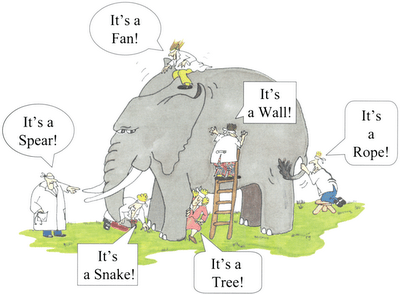
Once upon a time, there was a king who, wishing to amuse himself, ordered the Royal Elephant to be brought before him. He also ordered some blind men, blind from birth, to be brought near the elephant. He then asked these blind men to touch the elephant and give a description of the elephant to him.

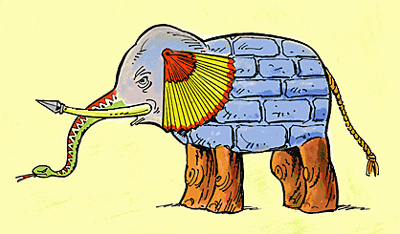
The man who touched the tail said the elephant was like a rope.
The one who touched a leg said it was like a tree.
The one who touched the body said it was like a wall.
The one who touched the ear said the elephant was like a fan.
The one who touched the trunk said it was like a snake.
The one who touched the elephant’s tusks, said it was like a spear.

elephant-blind-compo

Thus, each described the elephant differently, but each was sure that his own version was the true description of the elephant. They did not realize that each one touched only a part of the elephant. Each blind person had only a one-sided truth. They started arguing with each other, each sticking to his own point of view. The argument ended up in quarreling and fighting. The king and his ministers rolled with laughter as the blind men continued to quarrel and fight with each other.

The origins of this story are unknown but it appears in almost all religious literature through the world. There are many many ways to look at this story and understand it. Just goes to prove what the story intends to convey.

When the blind truly open their eyes, they will see there was no elephant there.