All posts by Big Picture Zen

Unknown's avatar

About Big Picture Zen

Center for Self-inquiry and Awakening is a space for inner exploration and self-realization.

Do You Need a Guru?

A close friend once wrote to me about her dilemma:

They say you get a guru when it’s the right time. Some say you always have a guru – you just need to identify him. Learning from nature is fine, identifying a guru in situations and people around is again fine – but it is easier said than done, isn’t it? If there is someone who physically holds your ears and tells you – that you are foolish running after this, or this is just an illusion, beware! – then progress would be faster isn’t it? Sometimes I feel so lost, I just feel there should be some guru in human form to guide me through.

My reply to her:

A really good question indeed.

The answer is surprisingly simple. You need a guru because you think you are lost. But when you realize who you are, you SEE and that’s it. Then there is no need for a guru.

As they say in Zen Buddhism, one has to pass through the gateless gate. Once you pass through the gate, you realize there was no gate in the first place. The gate, the passing, the person who shows the path to the gate – all was just a dream.

In other Buddhist symbolism, the enlightenment is likened to crossing a river. The teachings are a raft on which you cross. But when you reach the other bank, you realize there was no river at all, no crossing, no raft, no guru.

To a normal (actually abnormal) mind which is trained in duality and conceptual thinking, such ideas as the above seem paradoxical. And therefore, one keeps on searching for a guru who can explain this paradox and sort out matters. But in actuality, the only hurdle one has to cross is one’s own mind and one’s own conceptual thinking.

Even the guru cannot help someone who is not ready to listen. And what is listening? It is not understanding in terms of concepts and logical ideas. Listening is having no mind to analyze and judge. When your mind stops analyzing; when it listens with its senses, then you are present in the NOW and you do not need to go anywhere else. You have reached home.

Now if you are able to listen deeply to what I have said, you can see immediately the truth of it and the falsity of a guru.

The mind describes a desired outcome and seeks it constantly. And when it is lost, as it usually is, it searches for a guide. But if only we can drop the search, knowing that it is only the restless mind at work, we can remain in the present moment.

How can there be a path and direction to come to the present moment?

It is possible that one hears some teachings of a particular man and gets the insight. Then that man becomes a guru for him but that is only as a mark of respect. The real work was done by the person who listened, not by the guru. Therefore, they say that one can learn from nature because nature changes every moment and if you follow the previous moment, you are dreaming. As soon as you realize you are dreaming, you are already awake. That’s all.
Travelers and Magicians (2003)

Director – Khyentse Norbu

3171036

This is a simple movie shot in the picturesque country of Bhutan against the backdrop of the great Himalayas. It tells the story of a Bhutanese government officer who desperately wants to go to America – his land of dreams. He starts his journey from his remote village and on the way encounters an apple seller, a monk, and a merchant with his young daughter. As they have missed the bus, they hitch hike their way to the city.

To pass time, the monk tells a story of a young man who is similarly enchanted with dreams. Wanting to learn magic, he leaves home and reaches a lonely hut in the forest occupied by an old man with a young and attractive wife. Staying with them, the young man forgets about his dreams and falls in love with the wife of the old man. The story then takes a sinister turn with the young man realizing the danger in to which he had run into.

In the meanwhile, the officer takes a liking to the daughter of the merchant and is having second thoughts about going to America. All the while the monk is amused with the effect his story has on the officer who is impatient at one moment, irritable at another and chivalrous at yet another moment.

​Followers of Buddhism will love this movie, not because one of the central characters is a Buddhist monk, but because the story depicts vividly how desires drive and change man from moment to moment.

The Matrix (1999)

Director – Wachowski Brothers

matrix

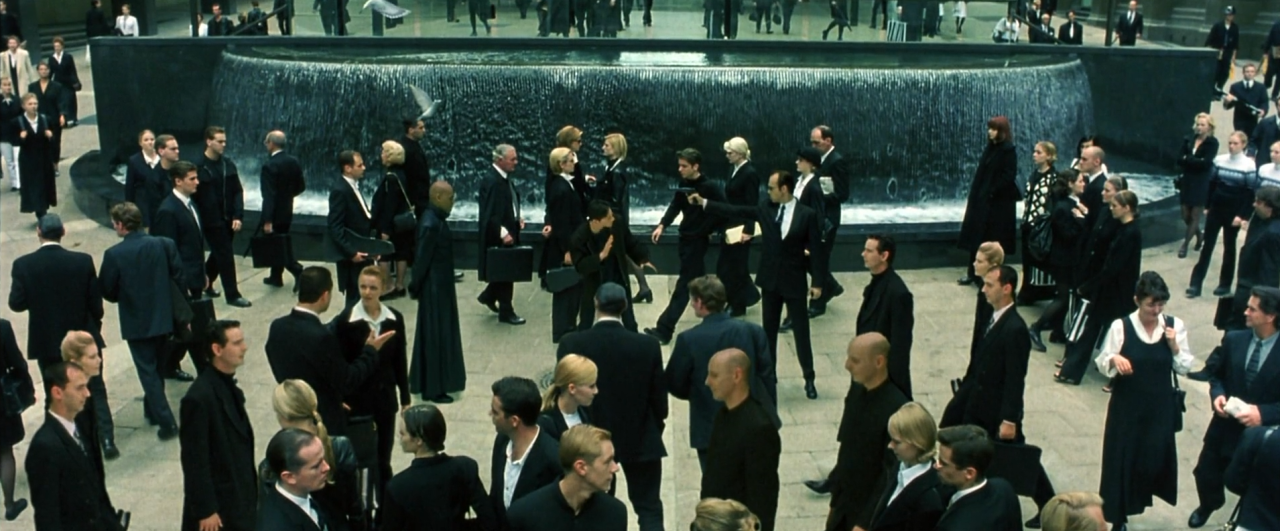
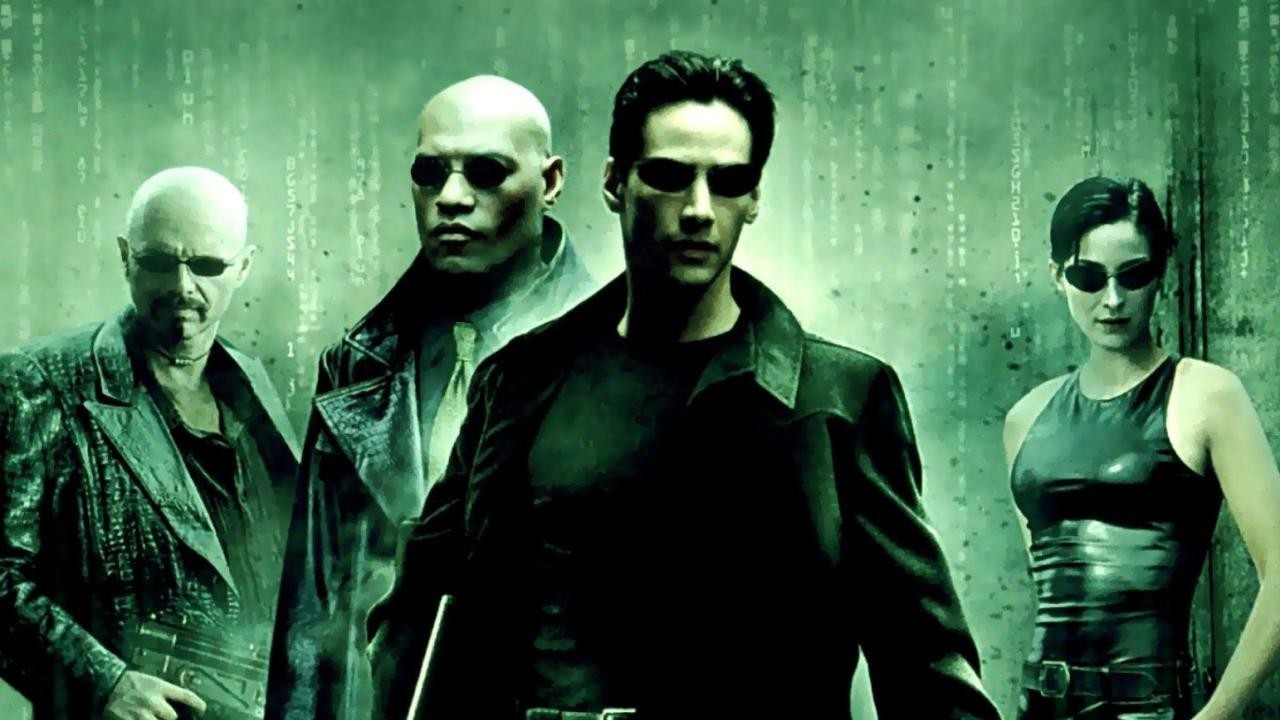
What can I say about The Matrix. I am sure everyone who has seen this movie has loved it and more so if you are a spiritual seeker. The film depicts a futuristic scenario where mankind is living in illusion while in reality they are simply being used as energy sources by machine intelligence. There are innumerable parallels in the story with the search of the ultimate reality. This is a great movie.

Is There Anything To Be Done?

matrix_orig

We wake up in the morning and as soon as we finish washing our face and brushing our teeth, we get busy in boiling milk, reading newspaper, getting ready for the office. Then the rest of the day we spend in doing whatever our office work demands – typing on the computer, reading and sending emails, attending meetings, tea, coffee, lunch… then we get back home, watch television, read books, spend time with family and go to bed.

Day in and day out we do the same thing. On weekends we go to movies, do some shopping, eat at restaurants and go on a long drive to the countryside. That is what most of our life consists in.

We do all these things but never wonder why we do them. we might have reasons like – in order to survive, in order to earn money, to support our family, and so on. But those reasons are not the real reason why we do things.

We do things mostly by habit. We cannot do anything else. We are so used to doing things in the same way and same manner, it becomes a habit and we don’t realize what we are doing. Not only our physical actions like eating, bathing and dressing is determined by habits, even our psychological actions like thinking and feeling are driven by habit.

In reality we don’t know anything. So we tend to follow others thinking that they know. But they are following someone else. So everyone is simply following others blindly without knowing the underlying reason. This is the way we take decisions on buying a house, a car, going for a vacation and so on.

Fear is a strong motivator of actions. Based on experiences and memory we develop fear and that determines our actions in many situations.

Another strong influence for our actions is our desires. Most people think their desires are their own. But where did they find those? They did not decide to have those desires. It came as a natural inclination without any conscious effort.

So if we really look at the world and the people carefully, beginning with oneself, we find that everyone is sleepwalking, not realizing what they are doing, why they are doing, where they are going and so on. They meet with accidents, love, friendship, joy, grief and everything else without conscious effort. It happens to them. Their inner world of emotions and thoughts also happens.

When we say – I am thinking… it is the thoughts which are going on in my mind. I don’t think anything. Neither do I have any control on my thoughts. And it is the same with everyone.

Can you see how dangerous the situation is? People are living their life and dying completely unaware of who they are, what they are doing and whither they are going. They are dreaming happily with the story they invent of their name, education, job, achievements, children, family, love and friendship.

If you see the danger of this situation clearly, you instantly become conscious and you stop doing what you are doing. You become alert, mindful, and watchful. Suddenly there are no thoughts in your mind. The mind becomes calm and sharp.

And if you attain this state, you realize there is nothing to do. This non-doing is the real doing. All else that we normally call doing is only automatic reaction. No one is in control. The stopping of everything is the real doing.

The Shocking Realization

0149

It is natural to consider – I am Y. I can do this and I can say this. I have independent will to do what I wish. I can listen. I can think.

It is also natural that I get angry, I get depressed, I like something and I don’t like someone. I have my habits, my assumptions, my judgments, and my way of thinking.

Further, I also believe that I can change whenever I want to. I don’t change simply because I don’t think it is necessary. There might be some aspects of my personality that hurt others or hinder me to attain my best.

However, when things don’t turn out the way I want, I blame others and I blame circumstances. I project all sorts of intentions on other people but do not realize it at that moment.

Now what I am going to explain is the most shocking realization on the path to realization. Every person who has walked on this path faces this hurdle. Only if he accepts this and see the truth of this can he move ahead on the path.

This realization is that – I am not in control!!

I have no control on what I do, what I say, what I think… none at all. Things are happening of their own accord without any one controlling them. In other words, one thing happens because of all the other things. There is no way that one thing would not have happened in any other way keeping all other things the same.

Everything depends on everything else. There is no individual will.

When I see this in myself first, I don’t believe it. But there is no doubt since I am seeing it directly. And when I extend the same observation to other people around me, I am overwhelmed by the danger of the situation.

I cannot expect someone else to simply believe this fact. You gotta see it for yourself. Watch each action of yours – what you do and what you think. If you see carefully, you will observe an infinite chain of events but no original will.

Let’s say you lift your hand to your face. Why did you do it? In most cases, you won’t be able to answer that because we are always making movements of our hands, fingers and body as a reaction to the entire stimulus of the external world on our senses. But if you are observing, you will see that there was a thought to lift the hand and before the thought there was some itching sensation on your face which you want to do away with so you raise your hand. But where did the itching come from?
That is not in your control.

You might develop great theories and plans and think you have done something. But go over it slowly and find out the time when you decided to do that and ask yourself whether you decided independently or as a reaction to something that came to your mind.

All our actions and thoughts are completely involuntary. Nobody can do a thing about it. Our life might seem haphazard but everything happens as a reaction like a spring being released. This realization needs to be deepened before you can come to full realization of the nature of reality and your life.

The World as Illusion

maxresdefault_orig

Mystics throughout the ages have termed the world as illusion – a dream landscape with people and things with no inherent substance. How do we reconcile this with what we sense in our everyday life – the people, the objects, the animals, the trees?

What is an illusion? When something appears to be what it is not, it is illusion. To be more precise – when something appears, it is already an illusion. Appearance itself is illusion.

A tree appears to have a trunk, leaves, fruits, and flowers. A dog appears to have legs, tail, eyes and ears. A human being appears to have hands, face, mouth, nose and hair. We have given names to appearances. But just giving names do not make those appearances real.

What appears to us appears the way it does only because of the various conditions in which it appears. To be more precise – appearances are nothing but conditions. The sky appears blue in the day and black in the night. A leaf appears green when young and yellow when old.

What we see is not an object but an appearance which we name. To understand what is real and what illusion, we must investigate deeper than the surface appearances.

Wood appears solid, but disappears into thin air when burnt. We see a rainbow with many colors but there is nothing but water. Conditions are such that from the point we are the light is reflected by water in the air to create the illusion of a rainbow. There are no colors in the air but we still see them. That is the illusion.

We see the sky but “sky” is a word which has no object. You cannot go up and touch the sky. But touching something does not mean it is not an illusion. When you touch a table, there is only the touch, no you and no table. And what is touch? It is nothing but an appearance or sensation of touch.

I hope you see… go ahead and investigate for yourself. Apply your brain power to this and find out for yourself. Do not try to understand words but find out what the words mean in your mind.

When you are thus able to see only appearances, the whole world dissolves, leaving only the pristine existence in its bareness.

What is the Purpose of Life?

So that’s the main question. Is it not? It is easy to say that you must discover your purpose in life or that different people have their own purposes. But I am not asking this question in the superficial sense. And if you have reflected for some time on this, you would have found that superficial answers do not really answer the question deeply.

Just to explain a little more. Is the purpose of my life to become somebody – a celebrity, a CEO, a wealthy person, a father, a grandfather, a good human being? Does my purpose lie in fulfilling all my responsibilities as a son, a husband, an employee, a citizen? Is my purpose gathering knowledge, learning how to do things, earning money, helping others?

All of that! We are doing all of that all our life? Is that all and then we simply die and hope that others will remember us for ever for the sons and daughters we leave behind, the houses and companies we have built. I don’t know about you but to me, none of these things seem to have any meaning. It seems to me that I engage in all these activities only because I don’t really know what I am supposed to do. So I just do what I have been educated in and what I see others doing.

The only way I can answer the question so that the question does not remain is to investigate where the question comes from and not by looking for an answer. The question is formed by the words – What, is, the, purpose, of, Life? Each word in itself has no meaning; neither does each alphabet of the word. Isn’t it true that I have composed the question simply because I can do so or have heard it or read it and then go about searching for the answer?

My mind and your mind have been trained to find answers to questions. Whenever a question is asked we are supposed to find an answer or else we will fail the exam. But can you drop the question altogether? If you can do that in reality, you might come across something which you never expected and come face to face with life in its naked form.

What Is It That Exists?

One of the best ways I have found to understand what exists is from the Tibetan Buddhist teachings. Any object can be considered in 3 ways

The object is made of its components

For instance, the laptop is made up of the screen, the keyboard, the CPU, the memory, the casing and so on. Even a solid object like a stone can be considered to be made of up of atoms and molecules.

The source from where the object originates

To take the same example, the screen of the laptop might be manufactured in China, the CPU in Malaysia and other components in different places and the final assembly would have happened in USA. Similarly, the stone that you see on the road has come there from somewhere. Maybe it broke off a mountain, got carried in a truck and fell down there.

It is an object because we give it a name

This is easier to see for things which are changing rapidly. For instance, we give the name Katrina to the hurricane that swept across the US. But what is a hurricane but the movement of air in a certain pattern. The hurricane is no longer there but the air which was part of the hurricane is still around. By giving a name we create an object. This way of thinking is radically different from the normal way of thinking that we give a name to an object.

​If you really want to see the world as it is, then learn to see everything from these 3 perspectives. Take a leather shoe for instance. See that it is made up of the sole, the upper portion and the lace. Then see that the leather would have originated from some animal, processed and then made in to a shoe. Finally, it is a shoe because you think it is. This point might need some insight but try to see it. Can you see the object without giving it a name?

Looking at Life as a Story


story

How do you describe yourself? Don’t you say something like the following:

​My name is Y. I was born in N city on DD-MM-YYYY. I attended this school and that school. I studied graduation from a reputed college and post graduation from an even reputed college. I work as a manager in some renowned company. Previously, I have worked in many companies like M, F and C. I am married and my wife’s name is B and I have two kids A and A. My parents stay in N. I like to read books. I like new age and fusion music. I also like watching movies.

That is my story. I can add more details and elaborate on it. But doesn’t everyone have a story? What is your story? You have a name. You were born somewhere. You did this and did that. You went here and went there. You like this and you dislike that. And many more things like this. Then you have your goals. “I want to do this in life. I am working on a great project. I want to earn a million dollars. I want to drive a BMW and live in a penthouse.”

Observe this carefully. Is there anything apart from the story? I say there is just the story and nothing else. Our mental life is made up of nothing but the story. The obvious question you might raise is then what is all that we see and feel. “The hand that I see is not the story; it is apart from the story. The sky, the tree, the road, the bus, other people and so on.. they are not simply stories. They are real.”

What all those things are cannot be said in words. All words and descriptions are again stories. Whether it is the story of the big bang, or how the earth was formed, or how Alexander conquered countries, how a bud becomes a flower and how a child grows into a man, all these are stories – descriptions made out of concepts invented by us. You read stories in novels, you read stories in newspapers, you listen to stories on television and radio..

Reality is not compelled to follow these stories. Reality cannot be understood with these stories. You will see what is real only when you empty your mind of all stories. You must not attach importance to these stories but know them simply as yarn woven out of thin air.

Koans – A Zen Practice for Enlightenment

laozi

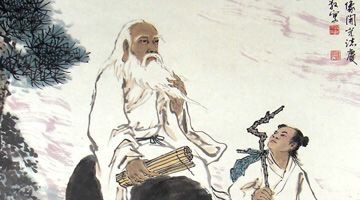
Koan is a technique for awakening by silencing the conceptual mind.

Traditionally there have been two main schools of Japanese Zen Buddhism – the Rinzai School and the Soto School. The main emphasis of the Soto School was on sitting meditation while that of the Rinzai School was on the Koans. The aim of both was essentially the same – enlightenment or awakening.

WHAT IS A KOAN?

A Koan is a statement, a dialogue, a story or a question which cannot be understood or answered by logical thinking. In fact, logical thinking is the biggest hindrance in understanding the meaning of the Koan. Some famous koans used by Zen masters are

  • What is the sound of one hand clapping?
  • All the ten thousand things return to the one. Where does the one return to?
  • A monk asked Joshu, “Does a dog have Buddha Nature?”. Joshu shouted, “Mu”.
  • Shuzan held out his staff and said, “If you call this staff short, you oppose its reality. But if you don’t call it short, you ignore the fact. Now, what do you call it?”

HOW IS THE KOAN USED?

The Zen student requests the Master to give him a koan for practice. The Master understands the specific mental snags in the student and gives him a koan which is most helpful in his practice. He also explains to the student in private what he must do with the koan. The student is instructed to constantly keep the koan in mind and try to grasp its hidden meaning. He has to think of the koan while walking, eating, sweeping, and while doing all the daily activities.

When the student believes he found the answer or when the student meets the Master during the scheduled times, he must explain what he has understood. If the Master finds evidence to believe that the student has really understood, he will certify the enlightenment of the student else he will drive him away asking him to put in more effort into the koan.

Mumon, a great Zen Master, said to his students that they must make their whole body and mind into the koan in order to penetrate it.

HOW DOES THE KOAN PRODUCE ENLIGHTENMENT?

Although the koan is a paradoxical statement and appears to be some sort of puzzle; it is not something that can be solved using a mental trick. It cannot be understood in conceptual terms at all. The purpose of the koan is to silence the conceptual mind completely as this is essential for awakening.

A statement that one does not understand makes the mind go on hyper drive. The mind turns and twists the question to find out its meaning and find an answer in one way or another. As long as the student keeps giving conceptual answers, the Master keeps sending him away. Even if the student realizes that there is no conceptual answer and says so, the master might tell him that knowing it is one thing but feeling it in one’s bones is another.

However, with constant practice with a koan, the student’s mind finally falls silent on its own accord and then whatever answer he gives will be spontaneous not based on rational thought. This is the first step to awakening.

COLLECTION OF KOANS

The most famous collections of Koans are found in two books – The Blue Cliff Record and The Gateless Gate.