All posts by Big Picture Zen

Unknown's avatar

About Big Picture Zen

Center for Self-inquiry and Awakening is a space for inner exploration and self-realization.

Awareness – The Goal As Well As The Means

If you care to observe the people around you – family, friends, co-workers, shopkeepers, people on the street, people on television, people in the market, and people in general – you would surely have noticed several times that most people are unaware of what they do, what they say or how they behave. That is to say only when you consciously pay attention to how people are going about doing their work. Otherwise, you also are one of them – going about your work, lost in thoughts. This is not to say that you are not doing important things but only to point out the quality of the awareness that goes with the activity.

The problem is common across people of different countries, races, ages and gender. No doubt, there are people who are more aware than the general population but for the majority, limited awareness (almost as if walking in sleep) is the rule.

Consider a spectrum of awareness beginning with the whole universe, only a part of which is perceivable to the human senses. There is a vast portion of the universe which cannot be perceived by humans, even with high tech instruments. Of the perceivable world, people are aware only of a limited fragment which is based on our conditioning. Each person selectively experiences the world. And of that small portion of the world that people selectively experience, people limit their awareness to quick judgments, conclusions, opinions, likes and dislikes.
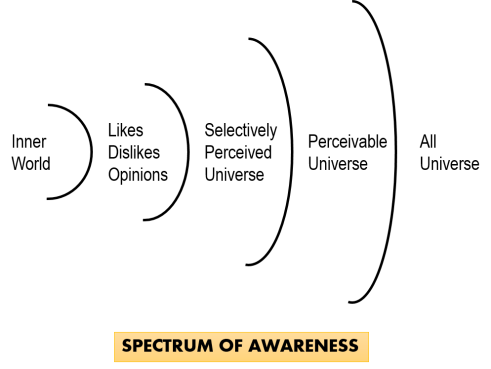
Spectrum of Awareness

For most people, the real world is external, what is out there, outside of themselves. They believe that they, with their bodies, are living as a separate unit within the external world. At best, they have only a very vague awareness of what goes on inside their bodies and minds. There is a huge stream of thoughts, emotions, instincts and intuitions that are constantly flowing through the mind. And yet, because it is through these thoughts and emotions that humans make sense of the external world, these are almost totally hidden from normal awareness.

Only when the body screams out with tiredness or a headache or stomach ache that we have the opportunity to recognize there is something inside us which we are not aware. Only when there is anger or frustration that we have the opportunity to note that there is something inside us that we are not aware. We only are aware of the external manifestation of those elements when we have to face their consequences, which are usually painful.

All human suffering arises from a lack of awareness. As awareness increases, suffering reduces. This is the law of nature. Despite all the clues and pointers that one must look within, most people find ways to blame the external circumstances or other people for their troubles.

Left to itself, the nature of awareness is to shrink, to focus on only the most important elements. People are anyways conditioned by education and environment to focus on limited goals, limited choices, limited alternatives, and limited outcomes. So people learn very fast what is desirable and what is not, what must be done and what must be ignored. As people practice limiting their awareness, they become experts at it. Therefore, when problems arise, the prescription is to increase awareness – through relaxation, meditation, out of the box thinking, going off on vacation to seek new experiences. All of this temporarily increases awareness and people feel fresh but when they go back to normal life, they stop investing in awareness. They give credit to that nice beach, or the thrill of the speedboat or the soothing music used for relaxation but do not realize the importance of their own awareness in healing themselves.

Awareness is the goal and awareness is the means of achieving that goal.

One must consciously be aware and expand that awareness in order to experience life more fully. Right now, sitting where you are, you can notice how limited your awareness is – limited to the words on the screen of your computer and some sounds that reach your ears. Right now, you can consciously increase your awareness by being more aware.

  • Become aware of your posture
  • Become aware of the contact of your feet with the floor
  • Become aware of your weight on the chair on which you are sitting
  • Become aware of the variety of sounds around you
  • Become aware of the things you can see from the corner of your eyes

Notice that as you become aware, small corrections happen automatically – maybe you shift your posture, become more centered in yourself, relax a little, notice the change in breathing… As you become more and more aware, your experience undergoes a qualitative change, maybe you can notice what mood you are in right now. When you are aware of something, you have the opportunity to act in full knowledge of what you are doing.

Awareness cannot be increased mechanically by taking a pill or an injection. It cannot be increased by doing exercises in meditation and yoga. All those have temporary effects. The only way to increase awareness is through a gentle conscious effort which begins with noting that one is not aware in the moment.

Awareness is its own reward. As awareness grows, one realizes that all activities in life, whether it is family or career are not ends in themselves but a stage or platform on which to develop our awareness. Awareness can make every moment in our life seem divine. What else can we desire for?

Micchami Dukkadam – Beyond Forgiveness

micchami dukkadam

In the Jain community, there is a notion of asking for forgiveness once every year during their Paryushan event. Typically the words are

If I have caused you offence in any way, knowingly or unknowingly, in thought, word or deed, then I seek your forgiveness.

While most people exchange those words with each other as a ritual, I wonder if there is any deep feeling attached to the word forgiveness. Many joke about it as an opportunity to start offending afresh, now that the forgiveness is asked for.

To forgive means to stop being angry or resentful towards another for an offence or a mistake committed.

Forgiveness is considered a significant act in many traditions including Christianity where you ask the Father or God to forgive you for the sins you have committed. To forgive others and to ask for forgiveness is said to have health benefits also.

Let’s take a closer look at the whole scope of forgiving and forgiveness. The notion of forgiveness is tightly coupled with being hurt or with some kind of offence or mistake. If there is no mistake or offence or sin, the need for forgiveness does not arise. After all, where is the need to forgive another if he has not done anything wrong to you or where is the need to ask for forgiveness if you have not done anything wrong to anyone.

So essentially, we need to delve a little deeper into the notion of being hurt or offending another, if we have to understand what is forgiveness.

Let’s say A breaks the windshield of B’s car. So the car is hurt and also, B is hurt psychologically. Now if A asks for forgiveness from B, what happens? At the physical level, it is immaterial. The car is not going back to its state before the windshield was broken. The key question is whether the state of mind of B will go back to the state before the event, if B forgives A.

Another example. A says something offensive to B. B is offended. A asks for forgiveness. B forgives. Can the state of mind of B go back to the same state of mind before the event?

In both cases, the state of mind of B has changed irreversibly. The memory of the event, the broken windshield, the associated psychological hurt and the offending words are permanently etched on the memory. That cannot be undone even if B forgives. We often say – forgive and forget. But we cannot really forget anything.

So what does it mean to forgive? It means for B to not carry the hurt feelings for A, to heal B’s own hurt sentiments, to not actively plan a revenge against A. But once the hurt feelings are created, it is very difficult to get over them even with repeated forgiveness.

Is it possible, not to get hurt at all? As we know, when there is no hurt, there is no need for forgiveness.

We are not hurt psychologically when we are in full awareness and full wisdom about the nature of existence. When we know that a windshield is something that can break, can be broken, when we know that most people act with no awareness of what they say or do, then that knowledge becomes our psychological protection against being hurt or being offended. Nothing can hurt us in that state. Even if someone shoots us, we can be smiling.

Maybe that was the state Jesus was in when he was being crucified. He said – Father, forgive these people as they do not know what they are doing.

You might have noticed that when you are in a certain high state of mind (happiness might not be the right word), you are not hurt by what someone says or does. On the other hand when you are not in a happy state, then you might go around hurting others unintentionally.

So from the perspective of B, the need is to protect oneself from getting hurt which can be done through understanding and awareness of that understanding.

From the perspective of A, merely asking for forgiveness does not cause a transformation in A. It is possible that A will repeat the same mistake again. The transformation in A can happen only when there is a realization of the pain caused to another by one’s actions,  which means, A feels the same pain that B felt. Then there is a genuine repentance of the action, which leads to an increase in awareness.

Only an increase in awareness will make A realize the pain of another and will sensitize him in his actions to prevent hurt or offenses towards another. Then there is no need ask for forgiveness.

So the notion of forgiveness is relevant only in the domain of hurt. But there is a domain beyond hurt which is accessible to human beings in which forgiveness has only a limited role while awareness and wisdom have a primary role.

Alice in Fleetingland

If we look at the world around us minutely, we will notice that things are happening at different speeds. Vehicles on the road are moving at around 60 km/hour. A plane in the sky must be moving at 800 km/hour. People on the streets are walking at their own pace, some are running, some are ambling. If you watch the sun during sunset, you will be amazed at how fast it moves, which actually means how fast the earth is rotating on its axis.

There are some things which change rapidly like the scene on the road and there are other things that change slowly. We usually do not notice those and assume they are permanently there. For example a tree or a bench in the garden seem static. Everyday, you can see them there and we do not notice the gradual changes taking place.

273

We can see changes in the tree only when the season changes and we can see the changes in the bench only if it broken or gets disfigured due to constant use. However, we do not appreciate how they are changing even while we are looking at them.

The tree is actually like an extremely slow moving fountain. As sunlight falls on the leaves and water escapes, the branches pull up more water and nutrients from the trunk and roots. We cannot see this happening yet it is happening.

As people sit on the bench, there is wear and tear every moment. Even the flow of wind over the bench, the falling of leaves on the bench will keep affecting the bench very gradually. We all know how the waves created sandy beaches over millions of years.

Everything around us is constantly changing, fleeting every moment. We are also changing. We might see the same face and body in the mirror everyday. Yet we are changing – every cell, every organ is undergoing change. At the microscopic level, the changes are very rapid and mind boggling, if only we could notice or feel.

We usually get fooled by the illusion that things are permanent, as if they are existing in themselves and not as a process of happening. Our senses fool us into believing that the chair we are sitting on is solid and is not changing. Same is true about the people in our life. We start thinking he or she is the same individual everyday, every moment.

But armed with the knowledge about transience, We can become aware of the whole illusion. This does not mean that we get scared because the world is falling apart. On the contrary, you learn to love this creation, the beauty and the mystery of it.

So the wise way to live in this Wonderland is as if Alice.


Being Dharma

41ULCnFkFrL

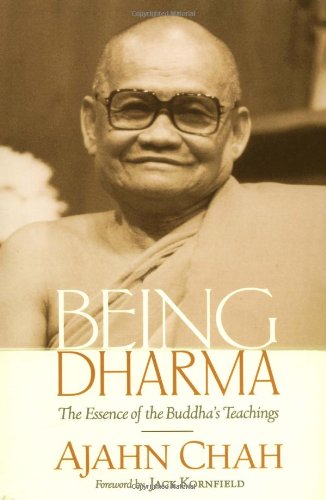
Being Dharma – The Essence of the Buddha’s Teaching by Ajahn Chah

Buddhism as we know branched out into 3 main followings, depending upon the inclination of the followers. The Theravada or the path of the elders is considered to be the original teachings of the Buddha, probably because the monks who follow it stick to the same rules as set during the time of the Buddha. They live in the forest, go to the town to beg for food and spend the day and night in solitary meditation. Other major branches include the Tibetan Buddhism, which takes Buddhism even beyond the teachings of the Buddha and Zen Buddhism, which makes no bones about its intention of pointing to the reality directly and nothing else.

Ajahn Chah was a renowned teacher of the Theravada school. He lived in the forests of Thailand and is the teacher of many western Buddhist monks. The hallmark of a good teacher is his ability to make complex theory into simple ideas and Ajahn Chah is one of the best teachers in this.

The book Being Dharma is a succinct exposition of the whole teaching of the Buddha. It covers just enough for any sincere seeker to grasp the insights. Ajahn Chah does not spend time in metaphysical discussions but directly addresses the heart of the matter. In this regard, he resembles a zen master.

The book is organized in the following chapters – hearing dharma, understanding dharma, practicing dharma, seeing dharma and being dharma. The contents are also as easy as the chapter titles.

Just like in the meditation practice, you are told to return to the breath whenever the mind is distracted, this is one book, I return to whenever I get lost in multiple other books. It always helps me to regain my center.

Quotes from Being Dharma

First one learns Dharma, but does not yet understand it; then one understands it, but has not yet practiced. One practices, but has not seen the truth of Dharma; then one sees Dharma, but one’s being has not yet become Dharma.


When there is no person, there are no problems. There is no need for solutions, because there are no problems to solve anymore and no one to solve them.


No matter where you are, no matter what your situation, it is possible for you to be practicing Dharma well


We are called Joe or Alice or perhaps Prince so-and-so, but if we realize the Dharma then we too are Buddha, no different from him.


That which we are talking about does not arise and does not cease. It abides as it is. Or to put it simply, it is not born and does not die.


People are born with physical form and mind. In the beginning these things are born, in the middle they change, and in the end they are extinguished. This is their nature. We can’t do much to alter these facts.


Wake Up!

maxresdefault (1)

Life is a dream. Wake up from this dream.
Come to your senses and get in touch with reality.
What you think of reality is an illusion.
Watch carefully and apply yourself with your full being
to understand in what sense it is called an illusion.
If this is an illusion, is there anything real?
Know for yourself without depending on any authority – scripture or teacher.
Know it without any doubt. Know it directly, not through some explanation.

Renunciation – The Last Step

171666658-56a0c4c95f9b58eba4b3a8a2

The most debated topic when it comes to spirituality is renunciation. No wonder, there are many misconceptions about it.

Renunciation, the way it is understood by most people, is the act of leaving home and family life in order to pursue the spiritual life – to live the life of a wandering hermit in search of the ultimate truth. The central question is whether it is necessary to renounce worldly life in order to achieve enlightenment.

Before we enter the debate on the pros and cons of renunciation, we must understand some basics about enlightenment. Enlightenment is the same for all human beings. In fact self-realization is about discovering your true self, beyond the illusory person that you think you are. So the question is about the approach – whether leaving family is going to help you to achieve that.

Let’s pause for a moment and reflect on the situation. We know that we have to be born in a family setting. No human being is born without a mother and a father and if he has grown up to get enlightened, then we can be sure, he or she has spent significant time in the care of the family and society. If there was no family, no society, then there would be no enlightened individuals also.

Society at times or rather at all times is a place full of chaos, where every individual is seeking his self-centered happiness and does not hesitate to harm others and cheat others to get what he wants.  Children are prepared through education to get ready to enter the society and sustain its existence. Customs of marriage and rituals of coming of age are all significant for the sustenance of the society.

One cannot force anyone to exit the society, except as an outcast for breaking some of the agreements of the society. So by default, everyone is condemned to live in the society despite its cruelties. All one can do is to further one’s own goals, hoping one gets through life without serious incidents. The whole desire for enlightenment has no place in this structure. Society does not encourage the seeking for truth. Its existence depends on the illusion of progress and civilization.

A PRACTICAL SOLUTION

When an individual who perceives these illusions promoted by the society, he tries to understand what is going on. He comes across other individuals who talk of a true life, self-realization, etc and he is intrigued. He tries to find answers in the society but quickly comes to the conclusion that nobody knows anything about it.

His mind is boiling with the question and he is not finding any outlet because he has to fulfill the responsibilities of his life. He cannot focus on anything unless he gets an answer and therefore needs time and space to go within to explore. However, life has no mercy. It is unrelenting in its demands for survival and sustenance of the family and societal institutions.

Therefore, the only practical way out for a person is to renounce the family and go off to live alone in search of the truth. This has been happening in India throughout history. All those who had this inner calling have promptly renounced their worldly life and went into the forest. Whether they were successful in their search or not is another question.

The search for one’s true self requires meditation for long periods so if you are sitting and doing nothing while at home, other people will think you are lazy and a shirker. They do not appreciate the inner calling of the person. On the other hand, if you are in the forest, away from the home life, then  there is no one to disturb you in your meditation. You have voluntarily retired from all responsibilities so you can focus singlemindedly on your goal.

The Buddha used to say that going from the home to the homeless life was the fastest way to self-realization. Hundreds and thousands of young men left their homes to join the Buddha’s Sangha. Even today, many people leave their homes and join a spiritual order, whether Buddhism or Christianity or Hinduism.

Point to note is that if a person is leaving home just to avoid the arduous responsibilities, then that is not the right renunciation. It is right renunciation only when the individual’s intention is to realize his true self. Only then is the renunciation a practical choice because there is no other way to live in the society and seek the higher reality.

So the question naturally arises. Is enlightenment impossible without this renunciation of worldly life? It is not impossible. There have been many cases of family people getting enlightened by hearing the teachings of masters.

In fact Gurdjieff actively promoted the fourth way, a way of self-realization while living the ordinary life. He was of the opinion that the situation one finds oneself in in one’s life is the most appropriate situation to start the struggle against sleep in order to awaken.

The truth about awakening is one of conditions. If a man is living in conditions that are conducive to enlightenment, then it will happen whether he is living at home or in the forest. And if the conditions are not suitable, then awakening will give him a slip even if he has renounced worldly life.

THE MIDDLE WAY

So is there a middle way between renouncing and not renouncing? Yes, definitely there is a way for the intelligent person who knows the conditions to be created. These conditions include first and foremost unobstructed time and space for meditation. If a man is able to organize this time wherein he is able to devote time to meditation with the sincere aim of awakening, then he will be in a much better position than a man who has renounced the world and is living troubled with the thought of where to get his next meal in the forest.

True renunciation is the renunciation of the idea of ‘I’. This can be done anywhere. The only problem of living in the society is that others remind you of being you all too often for you to practice the inner renunciation of ‘I’. However, for a person who is able to maintain self-awareness in all his worldly interactions, he will not be troubled. Within his mind, he has renounced while he is still performing ‘self’-less actions in the world outside.

If at some time, the awakened person wants to really change his way of life and live away from society, then the outer renunciation is only a formality. True renunciation has already happened when the person stopped identifying himself with his body and mind.

Therefore, it can be said that renunciation is the last obvious step rather than the first courageous step.


Prisoners of Philosophy

ee0dc655da02e88747edcd64313856a3_1496835778

Are we truly free or freedom is an illusion? Aren’t we all prisoners of our own philosophies?

You wake up in your house, use a toothpaste of your choice to brush your teeth, a soap of your choice to take bath, drive in a car, walk freely in the market, go to office, travel freely to places of your choice, watch television programs when you want and eat and sleep when you want. Can anyone say you are a prisoner? No way. A prisoner is locked in his cell, gets to eat only limited food, has to do work he cannot refuse to do and cannot do anything to get out the prison. The prisoner and you are not the same. Yet, at the level of the mind, we are all prisoners – prisoners of our own philosophy.

We are all philosophers whether we accept it or not or whether we speak philosophically when we are down a couple a drinks. What we think about our life is our philosophy. It consists of our beliefs, ideas, and assumptions of all kinds. There is no question we live our life with hundreds and thousands of beliefs. Some of them are conscious beliefs and many of them are tacit, hidden below our normal perception. Some beliefs are useful to live in society while some don’t make any sense.

For instance, you do believe that cleaning teeth with a toothpaste prevent bad mouth odor because you have some experience to back it up.

But you do not necessarily believe that the toothpaste will make your teeth sparkle like a diamond as the advertisers would like you to believe. You might have many more things to say about a toothpaste and brushing of teeth and all those ideas form your philosophy.

That was a simple example but as we live life, there are many things which are more complex than a toothpaste. Say for example, your philosophy about your work, how much should employees work in the office, what should be their attitude to work, what you think about your spouse, about men or about women in general, about politics, about economics, health, etc, etc. We all have come to certain conclusions about everything in life and we debate it out with our friends and colleagues. Despite the wide variety of positions and opinions about things and people, everyone believes that his opinion is the right one. We accumulate all these ideas and opinions and then because we are so imprisoned by them that all our actions that follow must be consistent with our previously formulated conclusions, even if we have lot of evidence to the contrary.

Lets say, that your job is not working out. It was good for the first 2 years but then it is no longer enjoyable. Yet because you want to show to the world that you love your job, you continue in it. Same with relationships.

So what starts as a mere opinion in the mind has the power to lock you physically into a pattern of action. Isn’t that living like a prisoner. You might have a choice but the options are limited so it is a pseudo choice. And most of us are happy with that variety. We are happy to live as prisoners because we get to watch a movie once a week or go out on a vacation once a year. And the situation becomes worse because everyone else is also a prisoner of his own philosophy. So very few even thinks of escaping or living a free life.

Life is meant to be lived in freedom. Yet we are afraid of that freedom. We create a pattern in our life. That pattern creates familiarity. In that familiarity, we feel secure and so continue in that. So even though we are free from the beginning, we enclose ourselves in to limited notions and ideologies. The one idea is especially very harmful, which keeps people in their prison is the idea of putting efforts to be free from the prison. There is no more ridiculous thing than that belief.

If you are in an open field, you are free to walk in any direction. Now somebody has created a pattern of roads and you cannot leave the road. In that sense you are prisoner of the road. But at the same time, you are free to wander off the road into the field anytime. That is freedom. You have always been free. The story of being a prisoner of philosophy is told just so that you recognize your eternal freedom once again and not be limited to be on the road forever. Then it does not matter whether you are on the road or in the field, it is just that in the mind you have no philosophy to get bound to. And that is awakening, enlightenment. Here is wishing that all of us live a free life with awareness and insight.

Two Realities

There are two realities going on simultaneously. One is the reality of which we cannot speak and EVERYTHING happens in THAT reality. Actually it is the only reality. However, there is the second reality which is the superimposed reality – the one created by thought, name, concept and description. It attempts to describe and understand the first underlying reality. However, the second reality is made of the same substance as the first one. It is the second reality only from the perspective of the second reality. From the perspective of the first reality, the second superimposed reality does not exist.

big-tree-wallpapers-1-800x600_orig

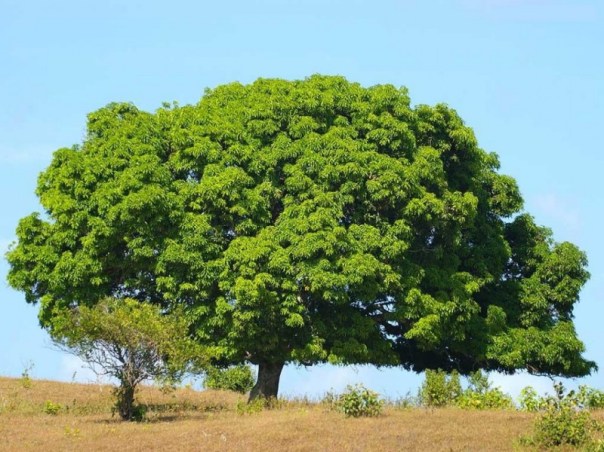
For example, a chair or a tree exists in the first reality as atoms, molecules and process. This cannot be described. It is a mystery, just nameless BEING. In the second reality, we call it the tree, the mango tree, the wooden chair and so on.

Now we must understand the overlap between the two realities. The tools used by the second reality – sounds, letters, names, images – are all expressions of the first reality. That means that the second reality cannot exist independently of the first one. It is made of the first reality.

Here is the funny thing. The first reality can only be known through the medium of the second. It is not right to say that the first and the second do not intermingle. From the very beginning, it is only the first reality and will always be. The second exists only to know the first.

People do not realize that the second reality, the superimposed reality, is nothing but the original source reality. They think the superimposition is a separate reality and by constantly forgetting that, they only live in the second reality R2.

Sometimes, R2 is in sync with R1. It can describe it well and goes together with it. At other times, it is not in sync, does not overlap and is incapable of describing whats going on. At this time, for a person, who is only living in R2, there is stress, conflict, anguish and suffering.

The nature of R1 is impermanence, change, dynamic while the nature of R2 is permanence, static, same. Again, this distinction is only from the perspective of R2, not from R1.

Remember R2 is nothing but R1 and has always been so. If a person realizes that, he comes back in sync. In other words, he accepts R2 … whatever description he has of R1 … and stays with it. The effort to modify R1 to meet R2 or R2 to meet R1 causes suffering.

A wise man, or one with this insight, knows both R1 and R2 and can distinguish R2 from R1 or know the limitations of R2 to describe R1 and at the same time accept that R2 fully as R1 itself and not run away from R2.