Yesterday, late in the afternoon, after a sumptuous lunch, I was doing nothing (i.e. scrolling reels). I came across Shakespeare’s quote from King Lear
I paused to reflect – Am I doing something or doing nothing? I started to feel a bit uneasy & guilty. However, the next reel raised my spirit.
I relaxed on reading that. It was very sound advice but it lasted only a few reels until I came across Henry David Thoreau.
I had to read that a few times before it sank in. Having nothing to do, I must still do something. What could that be? As I was reflecting on what to do, I got the answer on the 12th reel.
Zen sayings have a magical effect. They stop your thinking and make you wonder. I couldn’t agree more. Everything happens on its own. Who am I to do something?
Energized by that I now aimed for perfection. However just then Robert Schuller, the author of ‘Tough Times Never Last but Tough People Do’ pitched in
Oh. Is it so? Doubts started to creep in about my doing nothing even though I did it perfectly. How can one handle such criticism? As I browsed through reels striving to achieve clarity. Aristotle made an appearance and helped me find inner peace by pointing out in a typically Greek way
I thought to myself that there must be some truth to his advice since no one criticized him for so many centuries for putting the Earth in the center of the Universe. I continued scrolling further…
Even before I could figure out what that ‘SOMETHING’ to do was…
I thought I finally found that ‘SOMETHING’ to do – ‘NOTHING’!
In a way the previous two quotes seemed to cancel each other. I wonder what Keillor and Lounsbrough would have discussed over a cup of coffee.
But I don’t like to regret my actions later. What if I was supposed to DO SOMETHING but I did NOTHING. Or what if I was supposed to DO NOTHING but did SOMETHING? Wouldn’t it be a disaster?
To hell with that.
Things were really getting heated up (My phone was also feeling warm in my hands). It was like nearing the climax of a mystery. Anytime now it would become crystal clear what I needed to do.
To Do or Not To do That is the Question!
The anticipation brought me to Warren Buffet, arguably the greatest ‘INVESTOR OF ALL TIME’ [unlike me]
I was going to settle on that as the final word when I heard my wife shout from the other room
I had asked you in the morning to get some fruits and vegetables. DID YOU GET IT?
Have you ever felt like life is just going around in circles? The routines, the struggles, the repeating thought patterns, the same troublesome emotions, the same “new beginnings” that end up eventually in the same rut that one feels the need to start again.
At first, being in a pattern can feel safe, it is familiar, predictable, and gives a sense of rhythm. But after a while, the safety of the pattern turns into the suffocation of repetition.
Going in circles is deceptive. You feel you are moving but are always in the same place. You feel the momentum of motion, but in reality, you are orbiting the same thoughts, patterns, and habits. The scenery changes slightly – new job titles, different faces, altered circumstances – but the essence of your life remains the same.
Faster or Slower, it’s still the Circle
When we notice this pattern, our instinct is often to change the speed. We think: “If I push harder, go faster, and achieve more, I’ll break free.” Or sometimes the opposite: “If I slow down, practice patience, and let things unfold, maybe I’ll escape the monotony.”
But here’s the hard truth: whether you speed up or slow down, you are still moving in the same circle. Velocity does not change trajectory. The only way out of a circle is not acceleration or deceleration, it is deviation. You have to go off on a tangent.
The Tangent
A tangent is radical. It does not continue the curve; it breaks away from it. It looks like rebellion, disruption, or even recklessness from inside the circle. And that is exactly what makes it powerful.
But here’s what we often underestimate: going off on a tangent is not easy. There is a strong gravitational pull that keeps us tied to the center, the comfort of familiarity, the approval of others, the inertia of habit. Breaking away feels like tearing yourself from an invisible tether. You may step out briefly, but very soon, the force of conformity pulls you back.
That’s why tangents are often short-lived. People quit their jobs, leave a relationship, or embark on a bold new path, but before long, they find themselves in another circle that looks strikingly like the one they left. The old cycle has been replaced by a new one, and the illusion of freedom doesn’t last.
Tangent as both Freedom and Responsibility
From the perspective of the circle, a tangent looks like absolute freedom. You’ve escaped! You’re no longer bound to the endless loop. But once you are truly on the tangent, a deeper demand arises – the demand to see for yourself.
The circle gave you the comfort to close your eyes. It told you how to behave, what to expect, and what was acceptable. You did not have to think for yourself. The tangent offers no such guidance. It gives you freedom, but also the responsibility of discovery, of finding your own path. You cannot lean on the crowd anymore; you must rely on the integrity of your own mind.
This is what Ralph Waldo Emerson meant when he said:
Society everywhere is in Conspiracy against every one of its members. The virtue in most request is conformity. Self-reliance is its aversion. One who would gather immortal palms must not be hindered by the name of goodness, but must explore if it be goodness. Nothing is at last sacred but the integrity of your own mind.
The circle is society’s conspiracy of conformity. The tangent is self-reliance – the courage to explore goodness not as it is defined for you, but as you must discover for yourself.
The Hidden Trap: Circles Disguised as Tangents
There is another subtle danger here. Sometimes what looks like a tangent is just another circle waiting in disguise. You may think you’ve escaped by changing careers, moving cities, choosing a new partner or adopting new beliefs. But unless the movement is inwardly awake and conscious, it is easy to get trapped again – another orbit, another loop, another pattern.
The lesson here is that true tangents are not one-time events. They are not just about leaving a particular job, person, or place. They are about cultivating the courage to question, to step aside, to not be lulled into conformity every single day.
Being Always on a Tangent
To be truly free is to keep breaking the circles as they form. It means watching when you are being pulled back by habit or by society’s voice and daring, once again, to step out. Every day brings opportunities for tangents, small ones and large ones.
When you say no to a familiar but draining pattern, you’ve taken a tangent.
When you question a belief that everyone around you holds, you’ve taken a tangent.
When you dare to listen to your own integrity over collective approval, you’ve taken a tangent.
The point is not to escape once and be done with it once and for all, but to live in such a way that tangents become your mode of life. And to realize and accept that others might think you are crazy not to follow the path of the circle.
Breaking away from circles, going off on a tangent
So if your life feels like it’s going around in circles, recognize that speeding up or slowing down will not change the geometry. The only real move is to break away. And yes, it’s uncomfortable. Yes, it comes with the risk of being misunderstood. Yes, you may even end up in another circle. But in the act of choosing the tangent, you awaken to yourself.
Life’s vitality comes not from perfect routines or flawless circles, but from the courage to keep breaking them. The tangent is not just the way out, it is the way to be alive. The real point is not about going off on a tangent but to not get trapped in a circle.
P.S. The Illusion of the Circle and the Tangent
If you really investigate the circle, you will find it is not some solid structure that traps you. It is made only of people moving in circles, repeating patterns, conforming to expectations. The circle has no independent existence. It is only maintained because we keep walking on it, following others blindly. And so, while it seems difficult to break free, the truth is that nothing actually binds you. The circle dissolves the moment you become aware.
I would define counseling as a process in which one human being helps another to solve a personal problem or discover a direction to solve a troublesome issue. There are many kinds of specialized counseling – relationship counseling, career counseling, psychological counseling, parent-child counseling, teenage counseling, and so on.
In all counseling, it is assumed that the counselor has more experience, more knowledge, more insight about a subject and is therefore in a superior position than the client. One goes to a counselor expecting to receive customized advice or personalized solutions from someone who knows the patterns of such problems and the generic solutions to those. And what does the counselor do? He hears the problems of the client and maps it to some similar problems in his past experiences, searches for an appropriate solution for that and gives that advice to the client.
A canned solution can never solve a unique problem.
But most counselors learn only canned approaches and solutions which they offer to their clients – because those solutions are in vogue, in current fashion or currently acceptable.
But let me ask a question. Can one person help another person just by virtue of being another human being? Without being an expert, without being more experienced in any skill or domain? Is there a quality in which every human being in equally skilled? What is the action that every person can do equally well – in all circumstances, always, in any relationship, in any environment, through any means of communication?
Yes, there is this skill, this ability, this faculty which is equal in all human beings – it is not thinking, it is not talking, it is not walking or acting
It is LISTENING.
Anyone can listen, young or old, fair or dark, male or female, today or tomorrow, 10,000 years in the history or 10,000 years in the future, anyone can listen.
Everything else might be different, the way we speak, the way we think, the language we speak or the content of our thoughts. But the way to listen cannot be different in any age for anyone. Every human being can listen.
And with listening, one human being can help another. Anyone can help anyone without any special skills on knowledge or expertise or experience. The power of listening to solve problems is the most under-appreciated power in human beings. In fact, listening is not considered to be of any significance in daily life. I say that almost all human problems arise because we do not listen enough, and we do not listen deeply.
How does listening help another person?
Listening conveys acceptance: As human beings, we are unique in our thoughts, likes, dislikes, experiences and desires. We want others to accept us as we are. Listening to another shows that you accept the other person as he/she is.
Listening does not judge: Given a person’s problem or situation, if we judge that as good or bad, it puts an end to the discussion. Any judgement is a conclusion and stops further conversation. You don’t feel understood if the person listening to you is constantly judging you. But when you listen attentively without judging then the speaker opens up. He/she starts to trust you and opens up more.
Listening gives space: In today’s world, everyone wants to speak and get his thoughts out there in front of other people. Advertisements, slogans, speeches – everyone seems to be speaking and no one seems to be listening. This suffocates the mind. Mind needs space for creativity, for problem solving. But when there is no space, mind reacts, gets into a survival mode and deteriorates into emotional outbursts. When you listen, it gives space for the other person to look at his own thoughts, to unwind, to untie the knots within.
Listening is compassionate: When you listen, you show an interest in the other person. Since you want to know more, you ask questions, you clarify things. All this displays compassion and empathy towards another.
Listening is freedom: In normal conversation, there seems to be a compulsion to say something, to respond with an answer or a suggestion. But when you are listening you are free. You don’t have to respond to any pressure. Listening is therapeutic. Listening is relaxing.
Zen Counseling is based on this power of listening to help other people solve their problems. It combines listening with the fundamental insights and principles of Zen Buddhism to provide a very potent and very effective way to problem solving.
Zen Buddhism considers every human being to be a Buddha.
A Buddha is an awakened one, one whose mind is awake. An implication of this premise is that for any person who as a problem, the solution to that problem is within his own mind. No external answer will suffice.
Therefore, in Zen Counseling, the first rule for a counselor is to consider the client as a Buddha. And the second rule is not to offer any advice.
The Zen Counselor simply listens in a relaxed manner. As the client talks about his / her problem, the Zen Counselor continues to listen. And in this listening process, in the space that is created, in the acceptance and the non-judgmental atmosphere, the client starts to unravel his problem in his own awareness. As the problem becomes clear, the client will start to see the solution emerge.
The life situation of the client, the experiences of the client and the specific attitude and personality of the client determines the solution.
Any solution offered by the Zen Counselor is not going to be effective because it will be colored by his own biases and past experiences or no experiences. Therefore, a Zen Counselor never offers any advice. And that is the power of Zen Counseling.
It is effective in any circumstance, any age, for anyone, young or old, for any problem – career, relationship, finance, goal setting, sometimes even physical pain.
Zen Counseling is the way of the Buddha. It is surprisingly effective in solving problems or helping people find a direction.
This is a famous zen
poem and has been one of my favourites for the many years that I have been
studying zen. I really thought I had penetrated to the core of this poem. But
that was not true and I realized the true meaning of this poem in the Zen
Counselling course I attended during 15 to 18 Aug at the Integral Space, Lower
Parel, Mumbai.
The training was
organized by Loving Foundation’s Dr Ronak Gandhi, a four times black belt in
Zen Archery and who is on a mission to spread love. Zen is not so well known in
India and apart from Osho’s followers, not many profess to follow it. There are
no zen monasteries to talk about, no zen masters as such, although I remember
having been to Bodhi Zendo, a zen monastery near Kodaikanal and met Zen Master
Ama Samy, but that’s the exception.
So I was really
intrigued with the Zen Counselling course that I came across on Google and
instantly felt like I should go there. But I had my reservations. Because I
knew I had a deep understanding of zen from my study and practice over 15 years
and so had a doubt whether this was true zen. Seeing that the teacher was a
Japanese person added to the mystique of the course. After speaking with Dr
Ronak, I confirmed my participation.
Kenichi Ishimaru is
the founder of Zen Counselling and there are only a few videos with him
speaking on You Tube. The thing that caught my attention was the premise of Zen
Counselling that every client is a Buddha. And this is a high class
understanding, in fact the highest understanding in Zen. So I went for it.
With Dr Ronak Gandhi and Kenichi San and Kyoko
And what a time it
was! Those four days with Kenichi San and the 22 fellow students. I solved all
my problems, hesitations, mental blocks, diffidence, attitudes towards women
and discovered my true way. I learnt more from the live experience of listening
to the master, watching his demonstrations and his answers to our questions
than in all my readings of zen of the last decade. Kenichi san lives zen and
teaches zen. And he does not teach theory because zen is a matter of experience
so all the teaching was actually learning through personal experience.
Zen Counselling is
the most powerful technique (if one can call it a technique) to solve any
problem of any individual. When an individual has a problem, he suffers. When
the problem is solved, he is happy and free. But in contrast to other forms of
counselling, in Zen Counselling, the counsellor does not give any kind of
advice. The premise is very clear and it is non-negotiable – the client’s
problem can be solved only by the client. The counsellor can only support with
a few intelligent techniques based on listening, being relaxed and asking
questions to clarify the problem. In the process of Zen Counselling, the client
solves the problem for himself by clarifying it in his own mind with the
support of the counsellor. And I have experienced this magic of solving
problems without doing anything, in all my practice sessions.
This experience of
Zen Counselling has given me the power and confidence to go out and help
others. I had reached a conclusion long time back that people are not
listening. And therefore, I always hesitated to speak to anyone about zen and
my work on Big Picture Zen. But now with all my problems solved, I am free to
talk and free to listen.
I have always been a
good listener but that was not enough. But the listening approach that I learnt
in Zen Counselling was nothing short of magic. And I realized that the way to
another person’s heart is through our ears – through listening. There is no
value I can place on this skill and technique. This is priceless. This skill is
what makes a real loving human being.
To me, this
clarified to me many zen stories and also the way Buddha would have helped
people, and not just theoretically but now I can also do it. All the
disconnected pieces in my mind have now connected into a whole. Now I can truly
see with my ears and listen with my eyes.
Ever since I had my
awakening experience around 2003, I have been very keen to share it with others
and get others to become curious about it and strive for it. But nobody
listened. And I had almost given up. I was also thinking upside down about
helping others. The reason I was reading all kinds of books on human psychology
was to be able to learn how to help others. But that’s not the real way.
My zen mind was
always against learning things to teach others because the end goal was to drop
all knowledge. So how can I help someone drop all knowledge by giving him
knowledge of any kind – zen or otherwise? I was caught in this koan for many
years.
Zen Counselling
opened me up to direct experience and then at last, I reached the point where I
had nothing to say anymore. This was like a second satori to me. It became a
clear fact not a statement of belief that every person is a Buddha. Now
knowledge or no knowledge is no hindrance. Everything is perfect as is.
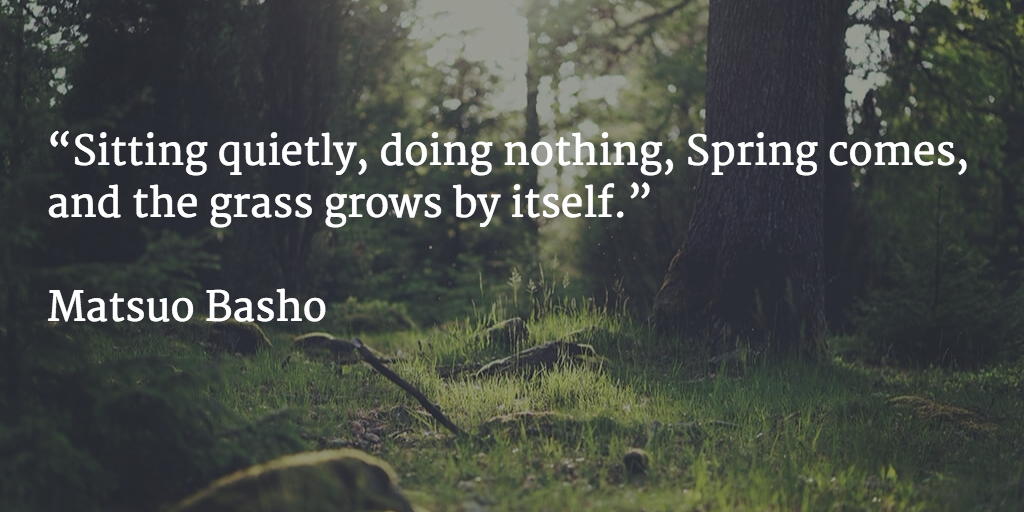
Sitting quietly doing nothing, the Zen Counselor listens relaxed, the client shares his problem and the solution appears by itself
But truth is not something that can be seen as some image.
It is not something that can be heard as some sound.
It is not something that can be smelled or tasted.
It is not something that can be touched.
So in what way do people expect to find the truth?
Is it an idea?
Is it some thought that is considered as the truth?
Is it an experience?
Note that in order to be sure that one has found the truth, one must be in a position to recognize it.
How can one recognize the truth if one has never had an experience of it before, when one does not know what it is?
Some say that truth is to be found within
True we can search for it within but what does one expect to find.
When the search begins one does not know what one is searching for & there are many falsities masquerading as the truth. So how does one differentiate ?
What if truth is right there in front of us but we miss it & go on seeking somewhere else ?
These are some questions that every sincere seeker of truth must investigate. He or she must not accept or discard anything without proper investigation.
A ZEN KOAN
If you ask a question it will obstruct the answer. If you don’t ask the question, you will never find the answer. What will you do?
The origin of the Jain religion is in a story that is so Zen-like.
The first Tirthankar of the Jains, Rishabdev, left a major part of his property to his two sons, Bharata and Bahubali, and renounced the world. Bharata had ambitions and he conquered the rest of India and also asked Bahubali to surrender his share. Bahubali had a great ego and he refused and it was decided to settle the matter in a one on one combat.
Bahubali turned out to have the upper hand and right at the moment when he was about to kill Bharata, he realized the futility of it all. He stood at the same place and entered meditation. It is said that he stood there for a year and still did not attain enlightenment. Tribute has been paid to his meditative position through the various Bahubali statues in India, the most famous being the one at Shravanbelagola.
So when one stands in the same position for a year, he will lose his clothes and creepers will grow on him. Bahubali’s sisters got worried and asked their father Rishabdev what to do. He said, nothing can be done unless Bahubali gets off the elephant first. So the sisters went to Bahubali and asked him when he will get off the elephant. Hearing this, Bahubali got instantly enlightened. He is said to be the first person to get enlightened in this cosmic era.
The analogy is apparent to those who understand but the point is that the story is so Zen-like. Zen, as we know it, came much later but the essense of what we call Zen is clearly seen in this story.
I enjoy reading Zen stories. It is so wonderful to read those interactions between master & student – the innocent question from the student and the crazy answer from the master.
Most of the times there is a question asked by the student, followed by the master’s enigmatic reply. The master’s reply is mysterious only to a non-enlightened student. The reply which takes many forms, not just words but sometimes a whack of a stick or a kick or a loud shout, is always intended to point directly to the mind.
Zen is described by many to be a teaching beyond scriptures & tradition, directly pointing to bare reality.
So, not surprisingly, many students get enlightened on hearing the master’s reply. Such stories are the most interesting ones. We hope too to get an insight into the master’s response.
Zen Story of Gutei’s Finger
Whenever anyone asked him about Zen, the great master Gutei would quietly raise one finger into the air. A boy in the village began to imitate this behavior. Whenever he heard people talking about Gutei’s teachings, he would interrupt the discussion and raise his finger. Gutei heard about the boy’s mischief. When he saw him in the street, he asked the boy and asked him a question. The boy raised his finger as usual. Gutei grabbed his finger and cut it off with a knife. The boy cried and began to run away, but Gutei called out to him. When the boy turned to look, Gutei raised his own finger into the air. At that moment the boy became enlightened.
Zen Story of Dojen’s Enlightenment
One day Master Ju-Ching was scolding another monk for sleeping, and said, “The practice of Zazen (Sitting Meditation) is the dropping away of body and mind. What do you think dozing will accomplish?” Upon hearing these words, Dogen became fully enlightened.
Enlightenment apart, I really wonder who is it that takes the time to write down these stories?
The dialogue in a Zen story is a deeply intimate, intensely personal and mostly private exchange between the student & the master. So for the story to have passed down through the oral tradition, someone has to report it verbatim, for us to enjoy.
Is it the teacher who takes pride in his responses to his students & keeps repeating them to others so as to make stories out of it? I doubt it because if they are real Zen teachers, they would be more concerned about the student getting enlightened than about making a story of it to brag about.
So is it the student who reports his conversation with the teacher & shows off how he got enlightened? Again I doubt it because if the student really attained enlightenment, that would be such a great event, he would have been too out of his mind to cry “Eureka” and run down the street.
So there must be somebody else – the elusive journalist – who eavesdrops on the conversation, sees the changed expression on the face of the student & infers whether he got enlightened & then runs away to share the story with fellow students.
There were no hidden microphones or voice recorders in those days & obviously neither Zen master nor the student who got enlightened would be interested in making silly stories, then WHO THE HELL NOTED ALL THESE ZEN STORIES? – TAKE IT AS A KOAN TO SOLVE.
Zen Story of Huike’s Enlightenment
Huike and Bodhidharma were climbing up a mountain peak. Bodhidharma asked, “Where are we going?” Huike replied, “Please go right ahead—that’s it.” Bodhidharma retorted, “If you go right ahead, you cannot move a step.” Upon hearing these words, Huike was enlightened.
Zen stories are very popular among students of Zen. These stories have been around since the time Bodhidharma went to China.
Monk asked, “What is the meaning of Bodhidharma’s coming to China?” Joshu said, “The oak tree in the garden.”
All Zen stories have the same two characters – a student monk and the master – and it contains an interaction between them. The student wants to know “why did Bodhidharma come from the west?” in other words he wants to know the essence of the teaching or the true nature of reality. The Zen master responds & sometimes the student gets enlightened.
The Zen master’s response is usually mysterious & that is the main reason why Zen stories are so popular. However the Zen master does not intend to be mysterious. He is as direct as one can be in that moment & intends to point to the essence directly.
Monk asked, “What is Buddha?” Unmon said, “A dry shit-stick”
Over the centuries, as these stories have been retold by students & translators, they have lost their details. The only part that is passed down is about what the student asked & what the master said. The whole context & the situation in which the dialogue took place has gone missing.
A Zen master helps a particular student at a particular point & it is so very intimate. Everything in that moment is important to the story – what the master was doing when the student asks him, how the student asks, things around the place, time of the day – not just the words.
Monk asked, “What is Buddha?” Tozan said, “Three pounds of flax”
For an astute student, knowing the context of the master’s response can help a lot in understanding what the master is pointing to.
Monk asked, “Does a dog have Buddha nature?” Joshu said, “Mu”
Joshu did not merely say “Mu”. He shouted at the top of his voice. Mu is a Japanese word that means No.
Finding something that you had lost brings great joy & relief. Even if it is a trivial thing like locating a misplaced TV remote or something significant like getting in touch with a lost friend after decades, there is that unique feeling when you find something you had lost.
Even when we see others finding their lost things, we experience the same joy. It is a universal feeling across nations, cultures & history.
We have enjoyed numerous Bollywood movies based on the “Lost & Found” theme. Manmohan Desai used it in many films & we were never tired of it.
Every time we lose something we feel the same anxiety & every time we find it we feel the same relief. The joy & relief is directly proportional to the time after which you find it multiplied by the value of the thing in your life.
On one occasion, I forgot my laptop bag in the train & I realized it only after reaching home. Imagine the anxiety! l rushed back to the station – a crazy 10 km drive – & was lucky enough to get it back. Imagine the relief!
There is tremendous anguish when you realize you lost something of great value. However, with time you adjust to the loss and come to terms with it. Things like lost keys, lost valuables & lost money can be replaced. If you find them after you got the replacement, the joy is not that much. As life goes on, you will even forget that you had lost something.
Awakening is similar to finding your true self – the original mind – the Tao – that which is, before anything else is. There is joy & relief of tremendous intensity. Because you simultaneously realize that you had forgotten who you are & that you had forgotten it for an infinite time & now you suddenly find it. You were lost in living & dying & have found back that which was never born & can never die. It cannot be put into words.
Paradoxically, you also realize that you had never lost anything. Just that, to explain to another, the theme of lost & found can be a metaphor.







 Big Picture Zen