It is X Only Because it is Not X

X is a name. It can be a name of a person or thing or event or process. We all use names to identify things and people. But in the process we forget that they are simply names, not the things themselves.

There are different shades of identification. Some identification is stronger than others. One’s own name is the strongest identification. My name is Y but I start believing that I AM Y. Similarly I believe that my friend is A, my wife is B and my dog is D.

Other strong identification is with time. We actually believe that today is 9th of AUgust 2015, Sunday. The fact is that a date is only a convenient means to have order in our activities and planning.

The fact is that the name is not the person or the name is not the thing. We might say Hurricane Katrina, but that is just a name. The hurricane did not have a name. It was nameless all the time. Therefore, the truth is that it was not Hurricane Katrina. In other words, it was Hurricane Katrina only because it was NOT Hurricane Katrina.

This statement must be understood carefully. X is X only because it is NOT X. A name can be given to something which is nameless. If it already had a name, why give it one?

The Hurricane does not say that its name is Katrina. Similarly the dog does not say that its name is D. In the same spirit, even if I say that I am Y, you should not believe me because I am fundamentally nameless. So are you. That is why your name is P or S or K.

So look around you. In actual fact, nothing has a name. Everything is nameless from the beginning – all the chairs, tables, walls, people, are chairs, tables, walls and people only because they are NOT chairs, tables, walls, and people.

It is more true to say that it is not a chair than it is to say that it is a chair. Both statements are true but one is really true and the other is only conventionally true.

So if you can look at things and people as nameless which is not recognizing anything by its name – whether it is a tree, a bird, a flower, the sun and so on, you will attain the original mind, untainted and pure. After all, isn’t this what you want?

Does it Matter?

There are two outlooks that one can get attached to. One outlook says “It matters” & the other says “It does not matter”. But let’s look more closely.

When “it does not matter”… the ‘it’ can stand for “It matters”
Therefore, “It matters” does not matter.
Similarly, “It does not matter” matters.

Rephrasing the same
It does not matter even if it matters & it matters even if it does not matter.

So does it matter?

The Holy Mountain (1973)

Director – Alejandro Jodorowsky

2530175

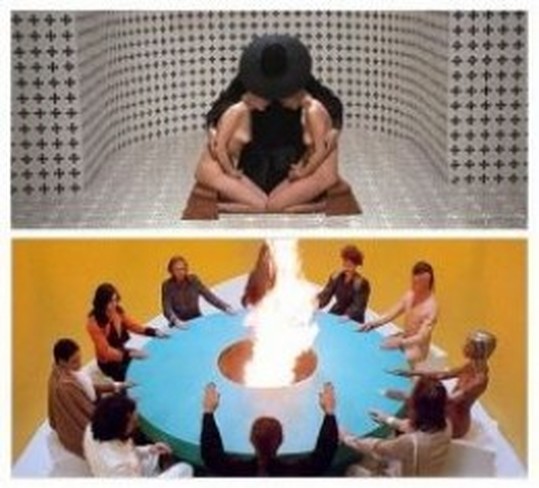
This is an allegorical film which depicts the process of spiritual search. It is based on Rene Daumal’s unfinished book ‘Mount Analogue’ and St. John of the Cross’s ‘The Ascent of Mt. Carmel’. The Holy Mountain is a difficult film since it is full of Christian symbolism which makes it incomprehensible in one viewing. Moreover, the film is not meant for sensitive eyes since it depicts male and female nudity, graphic scenes of animal slaughter and crude violence.

The spiritual path has always eluded description by either words or images. Therefore, symbols have been used by teachers or guides to direct the seeker on the right path. For instance Alchemy – the process of converting base metals to gold stands for the possibility of the transformation of man. The search for the ultimate is likened to a climb to the summit of a mountain overcoming various inner obstacles.

​The film uses these metaphors throughout. In brief, the storyline is of a thief who meets an Alchemist who along with seven other characters go in search of the masters residing on the holy mountain.

Ground Yourself in Impermanence

SEA

Change is the basic fact of nature. Everything around us and within us is changing every moment. Take a second to stop, see and listen. You can hear sounds changing, you can see things moving, you can feel the air on your skin, you can sense the breath going in and coming out. You can feel the sensations in your body and know the thoughts in your mind. Changing.. changing.. changing..

​Impermanence is the only permanent thing. Even the things which are seemingly solid like walls, wood, iron and stones are also changing at the microscopic level. It would be foolish to say that they do not change at all and are permanent.

When you strive for permanence in an impermanent world, it makes for a lot of sorrow, frustration, dissatisfaction and discontent. Real happiness can only be found when you ground yourself in impermanence all the time. Stay with impermanence, flow with it, and allow impermanence to flow through you.

It is a paradoxical notion that when nothing is permanent, how can there be a ground? And yet, the only refuge is the ground of impermanence.

One only needs to observe to penetrate this paradox. It is only when you are not aware that the nature of things is to change that you try to hold on to them – you want the good situation to continue, you want the good relationship to continue, you want the pleasant experience to extend and so on.

When you are continuously conscious of change, you have no experience. You ARE the very impermanence. In this state, there is no separation of experience from one who experiences. You have reached home.

Do Not Look Forward to Anything

Lookout-Large_625x349

It is so natural to think and imagine that tomorrow will be better than today. Aren’t we all planning for something or thinking of something that is going to happen sometime in the future? Maybe we are looking forward to a vacation. Maybe we are looking forward to getting married or having children. Maybe we are looking forward to a promotion in our job. On a daily scale, we look forward to the party at night or the meeting in the afternoon or even the cricket match on television.

Looking forward to a pleasant event causes anticipation of joy and excitement. Similarly, looking forward to an unpleasant event causes anxiety or fear. Have you even watched the process of looking forward to? Doesn’t it involve a lot of imagination born out of memory of past experiences or what information you have heard and gathered?

For instance, if you are looking forward to a vacation to a place you have never been to, do you not imagine what you will do or what you expect to find there based on the stories and experiences related by others who have been to that place before? Do you not imagine how happy you are going to be there or what experiences you are going to have there?

But what happens in reality? You might not have the exact same experiences when you visit that place? Many things might not be as you imagined they would be. That leads to frustration and anger. You blame those people who recommended that place to you. Even if you find most things as you imagined, you are unable to enjoy completely because the mind is filled with ideas about the place and is constantly comparing your actual experience with your imaginations.

To take another example, you might be looking forward to your exam results. You remember what other people commented on your results the last time and you start imagining what people’s reactions will be if you get poor results or better results than last time. All this imagination causes anxiety to build up.

Is it possible not to look forward to anything? Some people might say that it will make for a dull life where there is no hope and no future. But look at it in another way. What happens when you are not lost in the thoughts of what is going to happen tomorrow? Are you not fully in the present?

​The present moment is all there is. Imagination prevents your direct contact with the present moment. That is the reason why you do not experience anything even during the experience because the mind is busy in imaginations, comparisons, anger and frustrations.

Things are changing so rapidly that to experience the present moment requires your complete attention and energy but when energy is sapped in imagination about what is going to happen, one misses the moment and its beauty.

Therefore, do not look forward to anything – near or far, pleasant or unpleasant. When you are able to do this and remain in the moment, you will discover something totally unexpected. And it is the totally unexpected which has the quality of genuine happiness.

Spring, Summer, Fall, Winter… and Spring (2003)

Director – Ki-duk Kim

spring1

This is a beautiful Korean film (2003) that captures your imagination with its heavenly scenery. The whole story is shot in a hut floating in a serene lake surrounded by tall mountains.

An old Buddhist monk lives in the hut with a mischievous young boy – one who ties stones to frogs, snakes and fish with a thread and enjoys their predicament. The master teaches him a lesson one day by tying a big stone to his back. (Spring)

When the boy grows up, he gets attracted to a young girl who had come to stay with them to heal herself. When the master discovers their liaison, he asks the girl to return. However, the boy misses her so much that he runs away in search of her.(Summer)

Many years later, he returns to the hut a dangerous criminal. The police soon catch up with him and take him away. (Fall)

The master dies. Winter sets in. The lake is frozen completely. The prisoner has completed his sentence and returns to the hut, a changed man. He puts the hut back in order and trains himself. One day, a woman abandons her baby at the hut.

When the baby grows up into a young boy, he is shown to torment snakes, frogs and fish by putting stones in their mouth. (Spring)

In most films, there is an ending – a resolution of the tensions that are built up during the story telling. However, Spring, Summer, Fall, Winter… and Spring is a true buddhist movie as it does not have an ending because the ending is simply another beginning.

Like the seasons, our life moves through stages and almost everyone experiences the same emotions, childhood antics, sexual attraction, agony of separation, anger, and repentance of actions. Life is a powerful stream through which we flow and experience different things just like changing of the seasons.

There is another Korean film which I find to be very similar in theme – Why did Bodhidharma come to the east?

I Love Huckabees (2004)

Director – David O. Russell

4885571

Also known as I Heart Huckabees, this is as lovely and humorous a movie as it can get. Have you ever pondered over questions such as who you are, what is your purpose and what is the meaning of life? Even if you have, you would not have probed deeper because of urgent matters taking your attention. But what if you could hire detectives to do this job for you! The idea itself is so ridiculous that makes one laugh. But that exactly is the story of this movie.

A husband and wife play the detectives who are available on hire to find out the meaning of your life. These detectives are not saffron clad sages but suit-wearing professionals who work for a fee. The detectives have a brand of existential philosophy which they use to investigate matters. As they help their client, they run against one of their former students who has now adopted the opposite brand of philosophy Nihilism to help her clients.

​It is a great treat to watch the characters as they try to figure out the confusion, discontent and angst in their lives with the help of these philosophies. The movie is a laugh riot if you are even a little bit interested in philosophy.

Do You Need a Guru?

A close friend once wrote to me about her dilemma:

They say you get a guru when it’s the right time. Some say you always have a guru – you just need to identify him. Learning from nature is fine, identifying a guru in situations and people around is again fine – but it is easier said than done, isn’t it? If there is someone who physically holds your ears and tells you – that you are foolish running after this, or this is just an illusion, beware! – then progress would be faster isn’t it? Sometimes I feel so lost, I just feel there should be some guru in human form to guide me through.

My reply to her:

A really good question indeed.

The answer is surprisingly simple. You need a guru because you think you are lost. But when you realize who you are, you SEE and that’s it. Then there is no need for a guru.

As they say in Zen Buddhism, one has to pass through the gateless gate. Once you pass through the gate, you realize there was no gate in the first place. The gate, the passing, the person who shows the path to the gate – all was just a dream.

In other Buddhist symbolism, the enlightenment is likened to crossing a river. The teachings are a raft on which you cross. But when you reach the other bank, you realize there was no river at all, no crossing, no raft, no guru.

To a normal (actually abnormal) mind which is trained in duality and conceptual thinking, such ideas as the above seem paradoxical. And therefore, one keeps on searching for a guru who can explain this paradox and sort out matters. But in actuality, the only hurdle one has to cross is one’s own mind and one’s own conceptual thinking.

Even the guru cannot help someone who is not ready to listen. And what is listening? It is not understanding in terms of concepts and logical ideas. Listening is having no mind to analyze and judge. When your mind stops analyzing; when it listens with its senses, then you are present in the NOW and you do not need to go anywhere else. You have reached home.

Now if you are able to listen deeply to what I have said, you can see immediately the truth of it and the falsity of a guru.

The mind describes a desired outcome and seeks it constantly. And when it is lost, as it usually is, it searches for a guide. But if only we can drop the search, knowing that it is only the restless mind at work, we can remain in the present moment.

How can there be a path and direction to come to the present moment?

It is possible that one hears some teachings of a particular man and gets the insight. Then that man becomes a guru for him but that is only as a mark of respect. The real work was done by the person who listened, not by the guru. Therefore, they say that one can learn from nature because nature changes every moment and if you follow the previous moment, you are dreaming. As soon as you realize you are dreaming, you are already awake. That’s all.

Travelers and Magicians (2003)

Director – Khyentse Norbu

3171036

This is a simple movie shot in the picturesque country of Bhutan against the backdrop of the great Himalayas. It tells the story of a Bhutanese government officer who desperately wants to go to America – his land of dreams. He starts his journey from his remote village and on the way encounters an apple seller, a monk, and a merchant with his young daughter. As they have missed the bus, they hitch hike their way to the city.

To pass time, the monk tells a story of a young man who is similarly enchanted with dreams. Wanting to learn magic, he leaves home and reaches a lonely hut in the forest occupied by an old man with a young and attractive wife. Staying with them, the young man forgets about his dreams and falls in love with the wife of the old man. The story then takes a sinister turn with the young man realizing the danger in to which he had run into.

In the meanwhile, the officer takes a liking to the daughter of the merchant and is having second thoughts about going to America. All the while the monk is amused with the effect his story has on the officer who is impatient at one moment, irritable at another and chivalrous at yet another moment.

​Followers of Buddhism will love this movie, not because one of the central characters is a Buddhist monk, but because the story depicts vividly how desires drive and change man from moment to moment.

The Matrix (1999)

Director – Wachowski Brothers

matrix

What can I say about The Matrix. I am sure everyone who has seen this movie has loved it and more so if you are a spiritual seeker. The film depicts a futuristic scenario where mankind is living in illusion while in reality they are simply being used as energy sources by machine intelligence. There are innumerable parallels in the story with the search of the ultimate reality. This is a great movie.